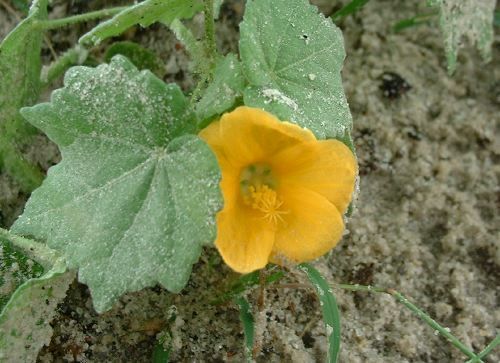
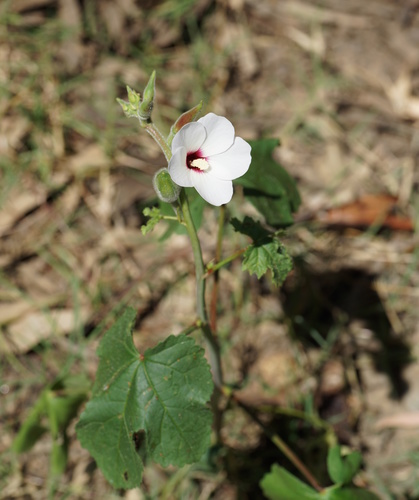
Abelmoschus moschatus
Medik.
Musk mallow, Bush carrot
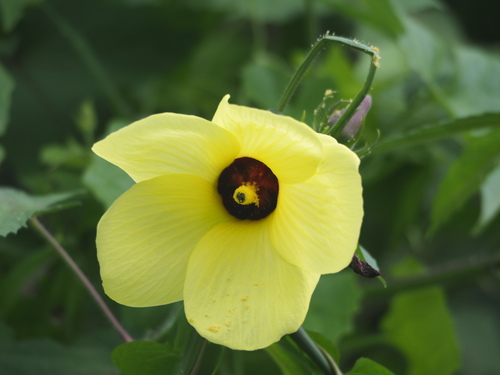
no rights reserved, uploaded by 葉子

(c) Han-Ting Liu, some rights reserved (CC BY-NC), uploaded by Han-Ting Liu

(c) 張傑夫, some rights reserved (CC BY-NC), uploaded by 張傑夫
What to Eat
Edible parts: Seeds, Leaves, Root, Pods, Spice, Vegetable, Fruit
Young leaves and shoots are cooked in soups or used as a vegetable; the leaves are also used to clarify sugar. Unripe seedpods are cooked as a vegetable in much the same way as okra (A. esculentus). Seeds are cooked — fried or roasted — and have a flavour similar to sesame seeds; they are also used to flavour liqueurs or to scent coffee. An essential oil from the plant is used to flavour baked goods, ice cream, sweets, and soft drinks. The root is also edible, though no further detail is given; it likely has a bland flavour and fibrous texture.
Where to Find It
A tropical plant. It suits tropical climates but can grow in cooler places. It needs a rich well-drained soil in a sunny position. Tolerates a pH in the range 6 to 7.8. In China is grows on flat areas and beside streams in S China. It needs a temperature above 5°C. It suits hardiness zones 9-12. In Yunnan.
American Samoa, Asia, Australia, Bangladesh, Britain, Burkina Faso, Cambodia, Central Africa, Central America, Central America, China, Chuuk, Colombia, Congo DR, Cuba, Denmark, Dominican Republic, East Africa, Europe, Fiji, France, FSM, Germany, Grenada, Guatemala, Haiti, Hawaii, Himalayas, India, Indochina, Indonesia, Iran, Italy, Laos, Madagascar, Malaysia, Mediterranean, Mexico, Middle East, Myanmar, Nepal, Netherlands, Niue, North America, Northeastern India, Pacific, Pakistan, Panama, Philippines, Rotuma, Samoa, Sao Tome and Principe, SE Asia, Sierra Leone, Sri Lanka, South America, Spain, Taiwan, Thailand, Tonga, Trinidad, Turkey, Türkiye, USA, Vanuatu, Venezuela, Vietnam, West Africa, West Indies,
How to Identify
A shrub or small tree. It grows 5 m tall. There are prickles along the stem. The leaves are twice divided and there are 8-18 pairs of pinnae. There are up to 50 pairs of pinnules on each pinnae. The flowers are yellow. They are in large clusters at the ends of branches. The pods are flattened.
Nutrition Score: 28/100
| Part | Moisture | kJ | kcal | Protein | Vit A | Vit C | Iron | Zinc |
|---|---|---|---|---|---|---|---|---|
| Leaves | 82 | 226 | 54 | 4.1 | — | — | — | — |
| Seeds | 11.4 | — | — | 2.3 | — | — | — | — |
| Roots | — | — | — | — | — | — | — | — |
| Pods | — | — | — | — | — | — | — | — |
How to Grow
Easily grown in a rich well-drained soil in a sunny position. Tolerates a pH in the range 6 to 7.8. This species is not hardy in the colder areas of the country, it tolerates temperatures down to about -5°c and can be grown outdoors in the milder areas of the country. The plant grows as a shrub in frost-free climates but is usually cut back to the ground in British winters. So long as these winters are not too cold, however, it can usually be grown as a herbaceous perennial with new shoots being produced freely from the root-stock. These flower in the summer. It is probably wise to apply a good mulch to the roots in the autumn. It is best to cut back the stems to about 15cm long in the spring even if they have not been killed back by the frost. This will ensure an abundance of new growth and plenty of flowers in the summer. The musk mallow is widely cultivated in tropical climates for its many uses. There is at least one named form, selected for its ornamental value. 'Mischief' is somewhat smaller than the species, reaching a height of 50cm.
Propagation: Sow seed in April in a greenhouse, with an ideal germination temperature of around 24°C. Once large enough to handle, prick seedlings into individual pots of rich soil and plant out after the last expected frosts. In areas with warm summers, seed can also be sown in situ in late April. Half-ripe cuttings can be taken in July and rooted in a frame.
Medicinal Uses
An emulsion made from the seed is antispasmodic, particularly effective on the digestive system. Seeds are also chewed as a nervine and stomachic and to freshen the breath, and are considered aphrodisiac. They are valued for diuretic, demulcent, and stomachic properties, and are additionally described as stimulant, antiseptic, cooling, tonic, carminative, and aphrodisiac. A bark paste is applied externally to cuts, wounds, and sprains. The essential oil is used in aromatherapy for depression and anxiety, and is applied externally to treat cramp, poor circulation, and aching joints.
Other Uses
An essential oil obtained from the plant is used as a food flavouring and as a musk substitute in perfumery, though its use in perfumery has been largely discontinued due to known photosensitivity reactions. An oil from the seed contains 18.9% linoleic acid and is of high economic value. The seeds are used as an insecticide; extracts of the fruits and upper parts of the plant also show insecticidal activity. A fibre from the stem bark is used to make ropes. Mucilage from the roots is used as a size for paper.
Wikipedia
Source ↗Abelmoschus moschatus is an aromatic and species of medicinal plant in the family Malvaceae native to Asia and Australia. It has many common names, including Abelmosk, ambrette, annual hibiscus, Bamia Moschata, Galu Gasturi, muskdana, musk mallow, musk okra, ornamental okra, rose mallow, tropical jewel hibiscus, and Yorka okra.
Other Information
Cultivated.
Notes
There are about 15 Abelmoschus species. They are tropical and subtropical.
Names & Synonyms
Adusa, Abelmosco, Algalia, Ambarina, Ambrette, Arnam hanserong, Balu-wah, Bana bhendi, Ban bheri, Bon bhendi, Bush carrot, Fai-phee, Fau tagaloa, Gandapura, Gorukhia-korai, Huang kui, Jangali-bhindi, Kapasan, Kapukinissa, Kasturi-bhenda, Kattukasthuri, Kattuvendai, Kon-kado, Latakasturikam, Muskdana, Musk okra, Nikono-koon, Okeoke, Rani, Sangul, Som-chaba, Taw-wah, Tsirandranjaza, Vakeke, Varttilai kasthuri, Wakiwaki, Yirani
References (53)
- Altschul, S.V.R., 1973, Drugs and Foods from Little-known Plants. Notes in Harvard University Herbaria. Harvard Univ. Press. Massachusetts. no. 2765
- Ambasta S.P. (Ed.), 2000, The Useful Plants of India. CSIR India. p 1
- Arinathan, V., et al, 2007, Wild edibles used by Palliyars of the western Ghats, Tamil Nadu. Indian Journal of Traditional Knowledge. 6(1) pp 163-168
- Arora, R. K., 2014, Diversity in Underutilized Plant Species - An Asia-Pacific Perspective. Bioversity International. p 47
- Bandana, P. & Debabrata, P., 2015, Wild Edible Plant Diversity and its Ethno-medicinal use by Indigenous Tribes of Koraput, Odisha, India. Research Journal of Agriculture and Forestry Sciences. Vol. 3(9), 1-10, October (2015)
- Bandyopadhyay, S. et al, 2009, Wild edible plants of Koch Bihar district, West Bengal. Natural Products Radiance 8(1) 64-72
- BARC, 2016, State of Biodiversity for Food and Agriculture in Bangladesh. Bangladesh Agricultural Research Council.
- Beasley, J., 2011, Plants of Tropical North Queensland - the compact guide. Footloose publications. p 77
- Behera, K. K. et al, 2008, Wild Edible Plants of Mayurbhanj District, Orissa, India. J. Econ. Taxon. Bot. Vol. 32 (Suppl,) pp 305-314
- Bremness, L., 1994, Herbs. Collins Eyewitness Handbooks. Harper Collins. p 228
- Brown, D., 2002, The Royal Horticultural Society encyclopedia of Herbs and their uses. DK Books. p 96
- Burkill, H. M., 1985, The useful plants of west tropical Africa, Vol. 4. Kew.
- Burkill, I.H., 1966, A Dictionary of the Economic Products of the Malay Peninsula. Ministry of Agriculture and Cooperatives, Kuala Lumpur, Malaysia. Vol 1 (A-H) p 1182 (As Hibiscus abelmoschus)
- Cabalion, P. and Morat, P., 1983, Introduction le vegetation, la flore et aux noms vernaculaires de l'ile de Pentcoste (Vanuatu), In: Journal d'agriculture traditionnelle et de botanique appliquee JATBA Vol. 30, 3-4
- Cundall, P., (ed.), 2004, Gardening Australia: flora: the gardener's bible. ABC Books. p 67
- Dangol, D. R. et al, 2017, Wild Edible Plants in Nepal. Proceedings of 2nd National Workshop on CUAOGR, 2017.
- Ekka, N. S. & Ekka, A., 2016, Wild Edible plants Used by Tribals of North-east Chhattisgarh (Part-I), India. Research Journal of Recent Sciences. Vol. 5(ISC-2015), 127-131 (2016)
- Facciola, S., 1998, Cornucopia 2: a Source Book of Edible Plants. Kampong Publications, p 146
- Food Composition Tables for use in Africa FAO http://www.fao.org/infoods/directory No. 706
- Gautim, R. S., et al, 2020, Wild Edible Fruits of Nepal. Int. J. Appl. Sci. Biotechnol. Vol 8(3): 289-304
- Grivetti, L. E., 1980, Agricultural development: present and potential role of edible wild plants. Part 2: Sub-Saharan Africa, Report to the Department of State Agency for International Development. p 29 (As Hibiscus abelmoschus)
- Hardwick, G., 2001, Economically Useful Plants for Northern Australia: Master Species List. Crusader eBooks.
- Joshi, N., et al, 2007, Traditional neglected vegetables of Nepal: Their sustainable utilization for meeting human needs. Tropentag 2007. Conference on International Agricultural Research for Development.
- Kar, A., & Borthakur, S. K., 2008, Wild vegetables of Karbi - Anglong district, Assam, Natural Product Radiance, Vol. 7(5), pp 448-460
- Latham, P. & Mbuta, A. K., 2017, Plants of Kongo Central Province, Democratic Republic of Congo. 3rd ed p 10
- Lim, T. K., 2015, Edible Medicinal and Non Medicinal Plants. Volume 9, Modified Stems, Roots, Bulbs. Springer p 2
- Manandhar, N.P., 2002, Plants and People of Nepal. Timber Press. Portland, Oregon. p 64
- Martin, F.W. & Ruberte, R.M., 1979, Edible Leaves of the Tropics. Antillian College Press, Mayaguez, Puerto Rico. p 203 (As Hibiscus abelmoschus)
- McMakin, P.D., 2000, Flowering Plants of Thailand. A Field Guide. White Lotus. p 26
- Miguel, E., et al, 1989, A checklist of the cultivated plants of Cuba. Kulturpflanze 37. 1989, 211-357
- Paczkowska, G. & Chapman, A.R., 2000, The Western Australian Flora. A Descriptive Catalogue. Western Australian Herbarium. p 286
- Parham, H. B. R, 1940, Supplement to the Journal of the Polynesian Society No. 16. Fiji Plants: Their Name and Uses.
- Plants for a Future database, The Field, Penpol, Lostwithiel, Cornwall, PL22 0NG, UK. http://www.scs.leeds.ac.uk/pfaf/
- Plants of Haiti Smithsonian Institute http://botany.si.edu/antilles/West Indies
- Price, S.H. & J.L., Wild Food, Medicine and useful plants of the Wet tropics. Kwik Kopy, Cairns. p 1
- PROSEA handbook Volume 13 Spices. p 273
- Rajkalkshmi, P. et al, 2001, Total carotenoid and beta-carotene contents of forest green leafy vegetables consumed by tribals of south India. Plant Foods for Human Nutrition 56:225-238 (As Hibiscus abelmoschus)
- Roa, J. A. G. & Boada, D. S. G., 2018, Fundación para el Fortalecimiento de la Fruticultura y Plantas Alimenticias no Convencionales en Colombia.
- Smith, A.C., 1981, Flora Vitiensis Nova, Lawaii, Kuai, Hawaii, Volume 2 p 423
- Staples, G.W. and Herbst, D.R., 2005, A tropical Garden Flora. Bishop Museum Press, Honolulu, Hawaii. p 384
- Sukarya, D. G., (Ed.) 2013, 3,500 Plant Species of the Botanic Gardens of Indonesia. LIPI p 574
- Swaminathan, M.S., and Kochnar, S.L., 2007, An Atlas of Major Flowering Trees in India. Macmillan. p 42
- Tanaka.
- Tang ya, Malvaceae. Flora of China. p
- Teron, R. & Borthakur, S. K., 2016, Edible Medicines: An Exploration of Medicinal Plants in Dietary Practices of Karbi Tribal Population of Assam, Northeast India. In Mondal, N. & Sen, J.(Ed.) Nutrition and Health among tribal populations of India. p 152
- Terra, G.J.A., 1973, Tropical Vegetables. Communication 54e Royal Tropical Institute, Amsterdam, p 50 (As Hibiscus abelmoschus)
- Tiwi Plants and Animals. 2001, Aboriginal flora and fauna knowledge from Bathurst and Melville Islands, northern Australia. Northern Territory Botanical Bulletin; No. 24 p 8
- Wiersema, J. H. & Leon, B., 2013, World Economic Plants. A Standard Reference CFC Press. 2nd Ed. p 1
- Wijayakusuma, H.M.H., et al, 1996, Tanaman Berkhasiat Obat Di Indonesia. Pustaka Kartini. p 79
- World Checklist of Useful Plant Species 2020. Royal Botanic Gardens, Kew
- Xu, Z., Tao, G. & Tan, J., 1988, Tropical Wild Flowers and Plants in Xishuangbanna, Agricultural Publishing House. photo 96
- Yuncker, T.G., 1959, Plants of Tonga, Bernice P. Bishop Museum, Hawaii, Bulletin 220. p 183 (As Hibiscus abelmoschus)
- Zeven, A. C. & de West, J. M. J., 1982, Dictionary of cultivated plants and their regions of diversity. Wageningen. p 77