Corydalis solida
(L.) Clairv.
Fumewort

Peter coxhead (via Wikimedia Commons)

Bernd Haynold (via Wikimedia Commons)

Felice Cassone (1815-1854) (via Wikimedia Commons)
(c) Юрій Бенгус, some rights reserved (CC BY-NC)
(c) Axel Gosseries, some rights reserved (CC BY-NC)

(c) maleneschjotz, some rights reserved (CC BY-NC)
What to Eat
Edible parts: Root, Tuber, Caution
The root is edible after boiling and is rich in starch. Some caution is advised, as there is a report that the plant is toxic.
Known Hazards
Where to Find It
It is a temperate plant. It is frost hardy. It will grow in most moist, well-drained soils. It needs an open sunny position. It is resistant to frost but damaged by drought. It suits hardiness zones 5-9.
Asia, Australia, China, Europe*, Luxembourg, Russia, Slovenia,
How to Identify
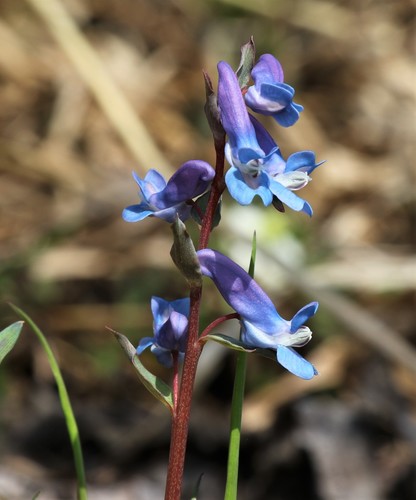
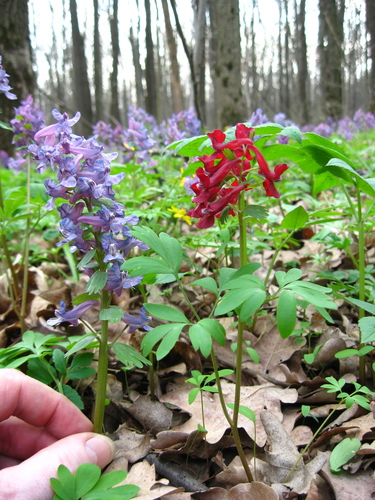
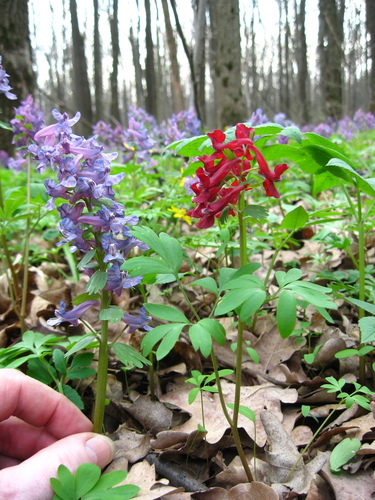
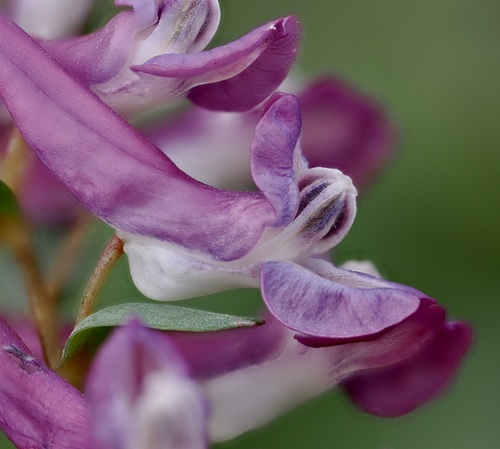
A perennial plant. It grows 2-30 cm high and 15-20 cm wide. It has a tuber. The leaves are like feathers. The flowers occur on upright spikes. They tilt and the spurs turn down. They can be white to reddish-purple. The fruit is like a capsule and contains many seeds.
How to Grow
Plants can be grown from seeds or by division.
Propagation: Seed is best sown as soon as it is ripe, as it rapidly loses viability if allowed to dry out. Surface sow and keep moist; germination usually occurs within 1–3 months at 15°C, though one source reports spring germination. For stored seed, two months of warm stratification followed by a cold period improves germination. Sow thinly so seedlings can remain undisturbed in the pot through their first year, and apply liquid feed at intervals during the growing season. Seedlings produce only one leaf in their first year and are very prone to damping off. Once dormant, divide seedlings into individual pots and grow on in a partially shaded greenhouse for at least another year before planting out into permanent positions. Can also be propagated by division after flowering.
Medicinal Uses
Fumewort has been used as a painkiller in Chinese medicine for over 1,000 years. The tuber is anodyne, antibacterial, antispasmodic, hallucinogenic, nervine, and sedative. It is taken internally as a sedative for insomnia and as a stimulant and painkiller, particularly for painful menstruation, traumatic injury, and lumbago. It is also used to lower blood pressure, and research suggests it has an action on the thyroid and adrenal cortex. The tuber should not be prescribed for pregnant women. Tubers are harvested during dormancy and dried for later use.
Other Uses
None known
Wikipedia
Source ↗Corydalis solida, fumewort or bird-in-a-bush, is a species of flowering plant in the family Papaveraceae, native to moist, shady habitats in northern Europe and Asia. Growing to 25 cm (10 in), it is a spring ephemeral, with foliage that appears in spring and dies down to its tuberous rootstock in summer. It is cultivated for its deeply divided, ferny leaves and narrow, long-spurred flowers which appear in spring. The flowers show color variation, and may be mauve, purple, red, or white.
Notes
There are about 300 Corydalis species. It is used in medicine.
Names & Synonyms
čvrsti petelinček
References (9)
- Bodkin, F., 1991, Encyclopedia Botanica. Cornstalk publishing, p 286
- Brown, D., 2002, The Royal Horticultural Society encyclopedia of Herbs and their uses. DK Books. p 179
- Cundall, P., (ed.), 2004, Gardening Australia: flora: the gardener's bible. ABC Books. p 420
- Joyce, D., 1998, The Garden Plant Selector. Ryland, Peters and Small. p 218
- Lim, T. K., 2015, Edible Medicinal and Non Medicinal Plants. Volume 9, Modified Stems, Roots, Bulbs. Springer p 43
- Man. herbor. Suisse 371. 1811, nom. cons.
- Morley, B. & Everard, B., 1970, Wild Flowers of the World. Ebury press. Plate 11
- Plants for a Future database, The Field, Penpol, Lostwithiel, Cornwall, PL22 0NG, UK. http://www.scs.leeds.ac.uk/pfaf/
- Turner, N. J. et al, 2011, Edible and Tended Wild Plants, Traditional Ecological Knowledge and Agroecology. Critical Reviews in Plant Sciences, 30:198-225