Corypha umbraculifera
L.
Talipot palm, Great fan palm
(c) Bribrábrico, some rights reserved (CC BY-NC), uploaded by Bribrábrico
(c) nandani_bridglal, some rights reserved (CC BY-NC)
What to Eat
Edible parts: Kernels, Starch, Sap, Cabbage, Sago, Nuts, Palm heart
Historically, the leaves were written upon in various South Asian and South-East Asian cultures using an iron stylus to create palm leaf manuscripts. In the Philippines, it is locally known as buri or buli. The leaves are also used for thatching, and the sap is tapped to make palm wine. In South India, the palm leaves are used to make umbrellas for agricultural workers. The tree is known as kudapana (കുടപ്പന) in Malayalam, talo (, ତାଳ) in Odia, sreetalam (శ్రీతాళం) in Telugu and kudaipanai (குடைப்பனை) in Tamil, which means umbrella palm. The plant is known as tala (තල) in Sri Lanka, by local Sinhalese people. In Cambodia, the palm is known as tréang (it was also known by the French name latanier), and as noted above was extensively used in the past to write religious manuscripts. In recent times the leaf media has been used by traditional healers and soothsayers. The mature leaves are used to make thatches, mats and hats. The petioles can be used in the manufacture of canes, arrows and netting needles. At low tide, fishers use the fruit to stupefy fish.
Known Hazards
Where to Find It
A tropical plant. Once established plants can tolerate considerable dryness. It grows best in tropical zones. It can grow on most soils but needs good drainage. In Sri Lanka it grows below 800 m above sea level. It suits hardiness zones 10-12. In XTBG Yunnan. In Townsville palmetum.
Andamans, Asia, Australia, Bangladesh, China, India, Indochina, Indonesia, Laos, Myanmar, SE Asia, South America, Sri Lanka, Thailand, Venezuela, Vietnam,
How to Identify
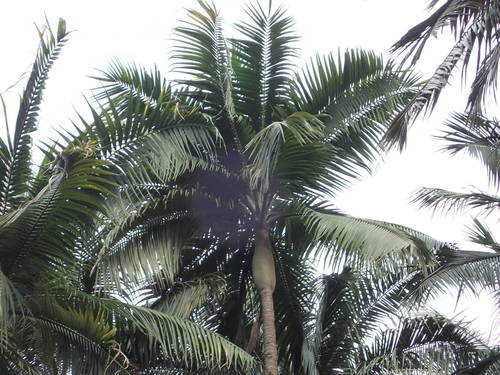
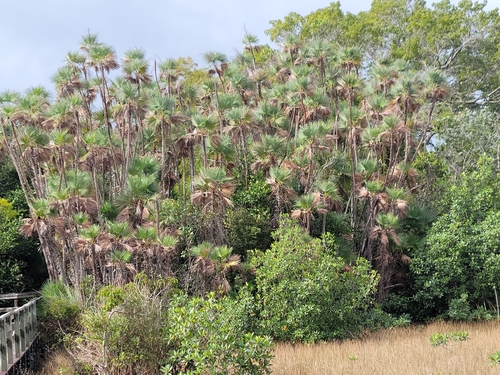
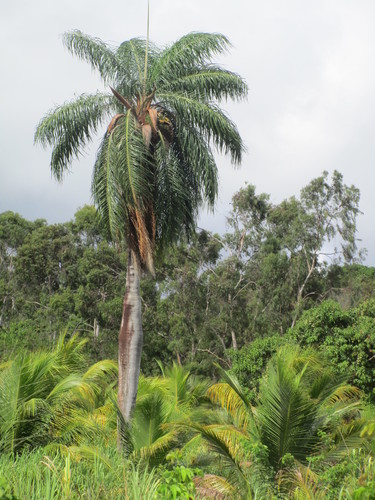
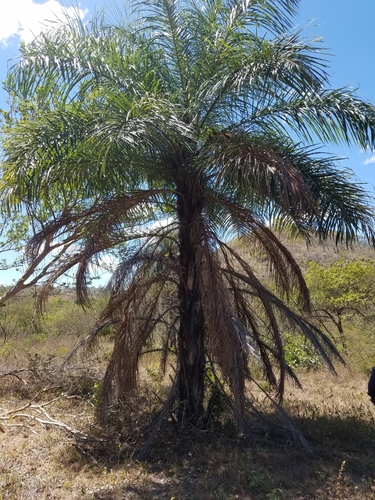
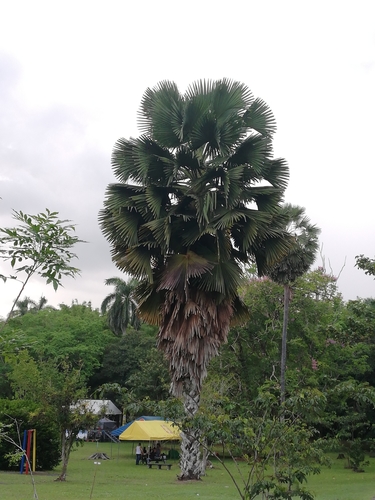
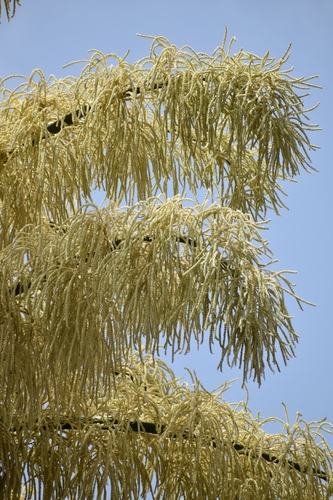
It is a solitary palm. It is very large. It grows to 25 m high. The trunk is 60-90 cm across. The leaves have leaf segments spread out like fingers on a hand. The leaf stalk continues into the leaf. Individual leaves can be 5 m across. The leaves are bright green and carried on a large leaf stalk. This can be 4 m long. The leaf stalk has many small teeth along the edge. The younger parts of the trunk are covered with the remains of the leaf bases. It only flowers once then dies. The flower panicle at the end of the plant which can be 6 m high. It has millions of tiny cream flowers. The fruit are dull green and round. They are 3-5 cm across. The plant grows for 30-80 years and reaches 12-25 m high before flowering.
How to Grow
Plants can be grown from seeds.
Propagation: Seed - best sown as fresh as possible, it usually germinates within 2 - 3 months.
Medicinal Uses
The juice from the root is used for curing diarrhoea. A decoction of the young stems is used for curing hot rheum.
Other Uses
The leaves are strong and durable. They are used for a variety of purposes, including thatching, making fans, mats, umbrellas and tents. Strips of the leaves can be used like paper for writing on. At one time, sacred Hindu and Buddhist texts used to be written on them. A fibre obtained from the stem is soft and pliable. The report does not make it clear if the leaf stem or the main trunk are being referred to. The hard seeds are used like ivory to make beads, buttons, ornaments etc.
Wikipedia
Source ↗Corypha umbraculifera, the talipot palm, is a species of palm native to eastern and southern India and Sri Lanka. It is also grown in Cambodia, Myanmar, Thailand, Mauritius and the Andaman Islands. It is one of the five accepted species in the genus Corypha. It is a flowering plant with the largest inflorescence in the world. It lives up to 60 years before bearing flowers and fruits. It dies shortly after.
Production
Plants are very slow growing.
Notes
There are 8 Corypha species.
Names & Synonyms
Bajar-battuler, Bajarbattu, Buri palm, Dridhatalamu, Gebang palm, Gewang, Karalika, Khai, Kudaippanai, Kudappana, La:n, Laang-mueng-theong, Lan, Latanier, Palem gebang, Pe-bin, Pu ti gen, Sritalam, Sritalamu, Sritale, Tala gas, Tali-pannai, Tali, Talippana, Tarit, Thalapanai, Tuli
References (27)
- Ali, A. M. S., 2005, Homegardens in Smallholder Farming Systems: Examples from Bangladesh. Human Ecology, Vol. 33, No. 2 pp. 245-270
- Ambasta, S.P. (Ed.), 2000, The Useful Plants of India. CSIR India. p 142
- Anderson, E. F., 1993, Plants and people of the Golden Triangle. Dioscorides Press. p 207
- Ashton, M. S., et al 1997, A Field Guide to the Common Trees and Shrubs of Sri Lanka. WHT Publications Ltd. p 80
- Balick, M.J. and Beck, H.T., (Ed.), 1990, Useful palms of the World. A Synoptic Bibliography. Colombia p 121, 199, 273, 292, 404,
- Blomberry, A. & Rodd, T., 1982, Palms. An informative practical guide. Angus & Robertson. p 93
- Brickell, C. (Ed.), 1999, The Royal Horticultural Society A-Z Encyclopedia of Garden Plants. Convent Garden Books. p 305
- Cundall, P., (ed.), 2004, Gardening Australia: flora: the gardener's bible. ABC Books. p 424
- Gibbons, M., 1993, Palms. Compact study Guide and Identifier. Sandstone. p 37
- Gibbons, M., 2003, A pocket guide to Palms. Chartwell Books. p 92
- Heywood, V.H., Brummitt, R.K., Culham, A., and Seberg, O., 2007, Flowering Plant Families of the World. Royal Botanical Gardens, Kew. p 348
- Johnson, D.V., 1998, Tropical palms. Non-wood Forest products 10. FAO Rome. p 40, 122
- Jones, D.L., 1994, Palms throughout the World. Smithtonian Institution, Washington. p 51, 202
- Jones, D.L., 2000, Palms of Australia 3rd edition. Reed/New Holland. p 150
- Llamas, K.A., 2003, Tropical Flowering Plants. Timber Press. p 102
- Marinelli, J. (Ed), 2004, Plant. DK. p 365
- Menninger, E.A., 1977, Edible Nuts of the World. Horticultural Books. Florida p 132
- PROSEA handbook Volume 9 Plants yielding non-seed carbohydrates. p 169
- Purseglove, J.W., 1972, Tropical Crops. Monocotyledons. Longmans p 423
- Rajapaksha, U., 1998, Traditional Food Plants in Sri Lanka. HARTI, Sri Lanka. p 367
- Riffle, R.L. & Craft, P., 2003, An Encyclopedia of Cultivated Palms. Timber Press. p 315
- Sahni, K.C., 2000, The Book of Indian Trees. Bombay Natural History Society. Oxford. p 181
- Sp. pl. 2:1187. 1753
- Sukarya, D. G., (Ed.) 2013, 3,500 Plant Species of the Botanic Gardens of Indonesia. LIPI p 773
- WATT,
- World Checklist of Useful Plant Species 2020. Royal Botanic Gardens, Kew
- www.ethnobiomed.com