Corypha utan
Lam.
Corypha palm, Sugar palm
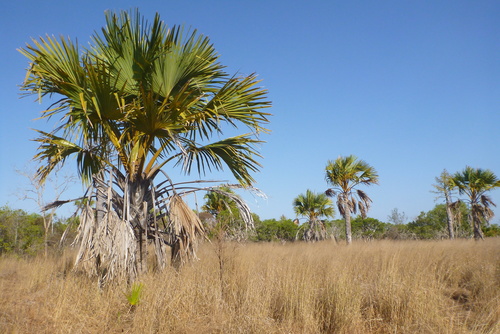
(c) coenobita, some rights reserved (CC BY), uploaded by coenobita

(c) uwekozina, some rights reserved (CC BY-NC)

(c) Pedro Nájera Quezada, some rights reserved (CC BY-NC), uploaded by Pedro Nájera Quezada
What to Eat
Edible parts: Starch, Kernel, Seeds, Cabbage, Sap, Sago, Nuts, Palm heart, Flower buds
A sweet sap obtained from the inflorescence can be used as sugar or fermented into an alcoholic drink. The apical bud can be eaten raw as a salad, cooked with rice, pickled, or prepared as a vegetable — though harvesting it kills the plant, as it cannot produce side branches. A starch extracted from the pith of the stem is used to make sago. The kernels of young seeds are eaten directly or made into sweetmeats.
Where to Find It
It is a tropical plant. It grows along the edges of tidal rivers. They are often on heavy soils on flood plains which flood. It grows best with access to ground water. They are very common and widely distributed at low and medium altitudes from northern Luzon to Sulu in the Philippines. It is frost tender when young. It needs a warm sunny position and a well drained soil. In Indonesia it grows up to 200 m above sea level. In Papua New Guinea it grows in the Western Province. It suits hardiness zones 11-12.
Asia, Australia, Bangladesh, East Timor, Fiji, India, Indochina, Indonesia, Laos, Malaysia, Mayotte, Myanmar, Pacific, Papua New Guinea, PNG, Philippines, SE Asia, South America, Sri Lanka, Timor-Leste, Venezuela, Vietnam, West Timor,
How to Identify
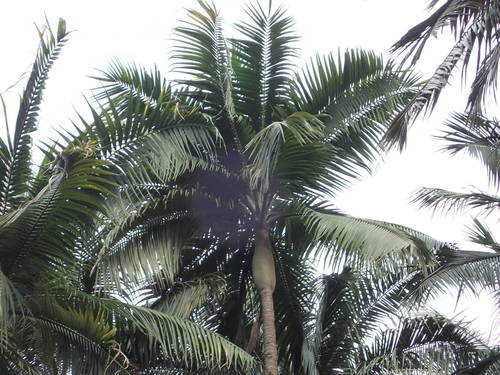
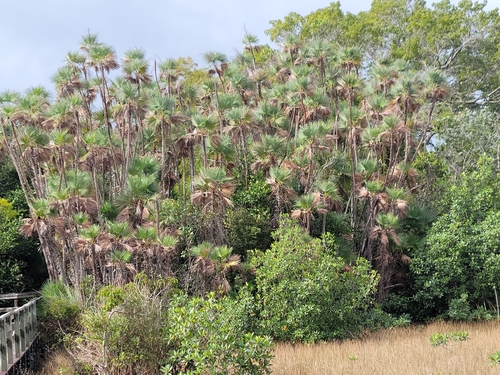
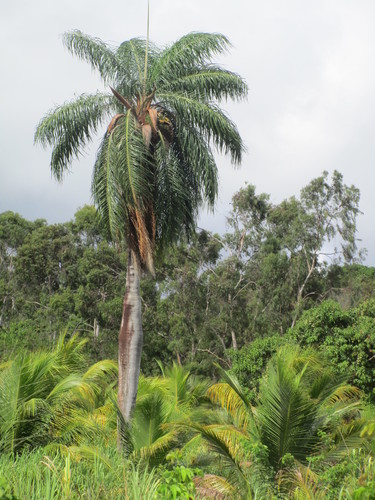
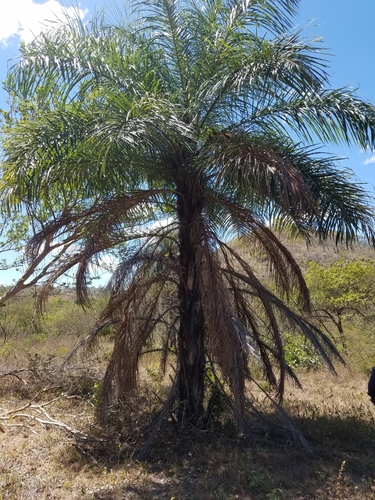
The largest and most stately member of the palm family. It is tall and single stemmed. It grows to 20 m high. The trunk can be 1 m across. The bark is smooth, grey, and has rings around it. The leaves are very large and fan shaped. The leaves are rounded, and the blade can up to 3 m long by 3 m across. The leaf is deeply divided from about half way up, into many pointed lobes. The leaf stalk is 2-4 m long. The leaf stalks and leaf edges are armed with very hard, large, black spines. The flowers are small and cream-green. They are about 5-8 mm across. They occur in groups of 6-20, in flower clusters 2-5 m long near the top of the palm. The fruit are smooth and almost round. They are 2-3 cm across. They are green, and turn brown when ripe. The fruit contain a single, hard-shelled, seed. The palm flowers once, then dies.
How to Grow
Plants succeed in moist tropical climates where temperatures never fall below 10°c, the average annual rainfall is 1,500mm or more and the driest month has 25mm or more rain. They can also succeed in drier areas with an annual rainfall as low as 250mm and one month or more where rainfall is below 25mm. Plants grow well in full sun, even when small. Plants are monocarpic - living for many years without flowering, but then dying after they flower. Like all members of this genus, these palms only flower at the end of their life, sending up a massive inflorescence, up to 5 metres high, and with up to 1 million flowers. Plants are slow-growing when young.
Propagation: Propagate by seed.
Medicinal Uses
The roots are demulcent, diuretic, emollient, and stimulant. They are chewed to treat coughs, and the root juice is used for diarrhoea. A decoction of the young plant is used in the treatment of febrile catarrh. The starch from the trunk is used in treating bowel complaints.
Other Uses
The leaves have a wide range of uses including thatching for roofs and walls and weaving into baskets, mats, and hats. Leaf ribs are used to make brooms. A fibre called 'buntal', obtained from the leaf petioles, is used for making Lucban and Baliuag hats and for rope. A very fine fibre from the unfolded leaves is used for cloth, fancy articles, and string. Fibres from the ribs of unfolded leaves are used to make Calasiao hats. Mature seeds are fashioned into buttons or used as beads on rosaries.
Wikipedia
Source ↗Corypha utan, the cabbage palm, buri palm or gebang palm, is a species of palm native to Asia and Oceania.
Production
Seedlings are very slow growing. After 40-50 years it flowers, then the leaves and palm die. So each plant can only have its sap tapped once in a lifetime. The cabbage can be removed before the palm dies.
Other Information
The starch is important in PNG during times of drought.
Notes
There are 8 Corypha species.
Names & Synonyms
Bajur, Bajoon, Bajurgatul, Buoon cao, Buri palm, Gebang palm, Gewang, Gulwirri, Ibus, Komolu Silag, Lan phru, Las, Lontar utan, Pe-bin, Pochok, Puchuk, Tali
References (47)
- Ambasta, S.P. (Ed.), 2000, The Useful Plants of India. CSIR India. p 143
- Baker, W.J. and Dransfield, J., 2006, Field Guide to Palms of New Guinea. Kew p 30
- Balick, M.J. and Beck, H.T., (Ed.), 1990, Useful palms of the World. A Synoptic Bibliography. Colombia p 652,
- Barfod, A.S., Banka R., and Dowe, J. L., 2001, Field Guide to Palms in Papua New Guinea. AAU Reports 40 Department of Systematic Botany University of Aarhus. Denmark. p 25
- Beasley, J., 2011, Plants of Tropical North Queensland - the compact guide. Footloose publications. p 63
- Blomberry, A. & Rodd, T., 1982, Palms. An informative practical guide. Angus & Robertson. p 93 (As Corypha elata), 121 (As Corypha gebanga), 163 (As Corypha elata), 216 (As Corypha elata), 350 (As Corypha elata),
- Brock, J., 1993, Native Plants of Northern Australia, Reed. p 126 (As Corypha elata)
- Brown, W.H., 1920, Wild Food Plants of the Philippines. Bureau of Forestry Bulletin No. 21 Manila. p 28 (As Corypha elata)
- Burkill, I.H., 1966, A Dictionary of the Economic Products of the Malay Peninsula. Ministry of Agriculture and Cooperatives, Kuala Lumpur, Malaysia. Vol 1 (A-H) p 676
- Call, C. A., et al, 2004, Participatory Rural Appraisal in the Upland Ecosystem of Mt Malindang, Misamis Occidental, Philippines. Biodiversity Research Programme for Development in Mindanao. p 53
- Checklist of NT Vascular Plant Species. January 2003.
- Cherikoff V. & Isaacs, J., The Bush Food Handbook. How to gather, grow, process and cook Australian Wild Foods. Ti Tree Press, Australia p 198 (As Corypha elata)
- Cooper, W. and Cooper, W., 2004, Fruits of the Australian Tropical Rainforest. Nokomis Editions, Victoria, Australia. p 70
- Cowie, I, 2006, A Survey of Flora and vegetation of the proposed Jaco-Tutuala-Lore National Park. Timor-Lests (East Timor) www.territorystories.nt/gov.au p 43
- Cronin, L., 1989, The Concise Australian Flora. Reed. p 236 (As Corypha elata)
- Cronin, L., 2000, Australian Palms, Ferns, Cycads and Pandans. Cronin Publications. p 78
- Cundall, P., (ed.), 2004, Gardening Australia: flora: the gardener's bible. ABC Books. p 424
- Dobriyal, M. J. R. & Dobriyal, R., 2014, Non Wood Forest Produce an Option for Ethnic Food and Nutritional Security in India. Int. J. of Usuf. Mngt. 15(1):17-37
- Elliot, W.R., & Jones, D.L., 1984, Encyclopedia of Australian Plants suitable for cultivation. Vol 3. Lothian. p 103 (As Corypha elata)
- Encycl. 2:131. 1786
- Etherington, K., & Imwold, D., (Eds), 2001, Botanica's Trees & Shrubs. The illustrated A-Z of over 8500 trees and shrubs. Random House, Australia. p 234 (As Corypha elata)
- Facciola, S., 1998, Cornucopia 2: a Source Book of Edible Plants. Kampong Publications, p 28 (As Corypha elata)
- Food Composition Tables for use in East Asia FAO http://www.fao.org/infoods/directory No. 833
- Friday, J. B., 2005, Forestry and Agroforestry Trees of East Timor. http://www.ctahr.hawaii.edu/forestry/data/Timor/Timor trees.html
- Garde, M., et al, 2003, A Preliminary List of Kundedjnjenghmi Plant Names. Northern Land Council. (Arnhem Land, Australia) (As Corypha elata)
- Gibbons, M., 2003, A pocket guide to Palms. Chartwell Books. p 93
- Gibbons, M., 1993, Palms. Compact study Guide and Identifier. Sandstone. p 37 (As Corypha elata)
- Haynes, J., & McLaughlin, J., 2000, Edible palms and Their Uses. University of Florida Fact sheet MCDE-00-50-1 p 5
- Hedrick, U.P., 1919, (Ed.), Sturtevant's edible plants of the world. p 222 (As Corypha gebanga)
- Hibbert, M., 2002, The Aussie Plant Finder 2002, Florilegium. p 75
- http://palaeoworks.anu.edu.au/Nuno_PhD/04.pdf
- Johnson, D.V., 1998, Tropical palms. Non-wood Forest products 10. FAO Rome. p 46, 122, 130
- Jones, D.L., 1994, Palms throughout the World. Smithtonian Institution, Washington. p 51, 57, 202
- Jones, D.L., 2000, Palms of Australia 3rd edition. Reed/New Holland. p 84
- Martin, F.W. & Ruberte, R.M., 1979, Edible Leaves of the Tropics. Antillian College Press, Mayaguez, Puerto Rico. p 210 (As Corypha elata)
- Monsalud, M.R., Tongacan, A.L., Lopez, F.R., & Lagrimas, M.Q., 1966, Edible Wild Plants in Philippine Forests. Philippine Journal of Science. p 518 (As Corypha elata)
- Ochse, J. J. et al, 1931, Vegetables of the Dutch East Indies. Asher reprint. p 566
- PROSEA handbook Volume 9 Plants yielding non-seed carbohydrates. p 170
- Riffle, R.L. & Craft, P., 2003, An Encyclopedia of Cultivated Palms. Timber Press. p 316
- Singh, H.B., Arora R.K.,1978, Wild edible Plants of India. Indian Council of Agricultural Research, New Delhi. p 81
- Smith, A.C., 1979, Flora Vitiensis Nova, Lawaii, Kuai, Hawaii, Volume 1 p 399 (As Corypha elata)
- Smith, N. M., 1991, Ethnobotanical Field Notes from the Northern Territory, Australia, J. Adelaide Bot. Gard. 14(1): 1-65 (As Corypha elata)
- Townsend, K., 1994, Across the Top. Gardening with Australian Plants in the tropics. Society for Growing Australian Plants, Townsville Branch Inc. p 140
- Tucker, R., 1988, The Palms of Subequatorial Queensland. Palm and Cycad Society of Australia, Milton, Queensland. p 28 (As Corypha elata)
- Wiersema, J. H. & Leon, B., 2013, World Economic Plants. A Standard Reference CRC Press. 2nd Ed. p 204
- World Checklist of Useful Plant Species 2020. Royal Botanic Gardens, Kew
- Yunupinu Banjgul, Laklak Yunupinu-Marika, et al. 1995, Rirratjinu Ethnobotany: Aboriginal Plant Use from Yirrkala, Arnhem Land, Australia. Northern Territory Botanical Bulletin No 21. Parks and Wildlife Commission of the Northern Territory. p 30.