Coula edulis
Baill.
African walnut
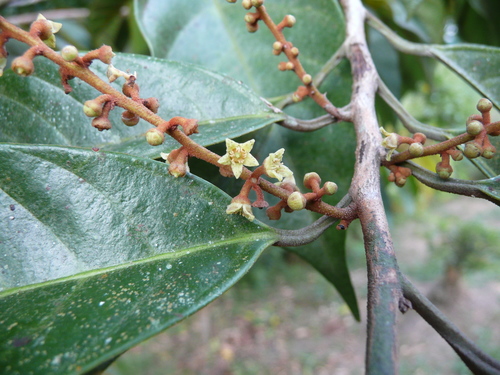
(c) Carel Jongkind, some rights reserved (CC BY-NC), uploaded by Carel Jongkind

(c) Anne-Hélène Paradis, some rights reserved (CC BY-NC)
What to Eat
Edible parts: Nuts, Seeds - oil, Fruit
The seed can be eaten raw, grilled, or boiled, and is regarded as a good dessert nut with a pleasant taste — the oily kernel is comparable in flavour to chestnut or hazelnut. The seed contains 50% oil, of which 87% is oleic acid. It is also fermented and used as a condiment. The spherical fruit is about 3cm long.
Where to Find It
A tropical plant. It grows in the hot, humid tropical lowlands. It tolerates moderate shade.
Africa, Benin, Cameroon, Central Africa, Central African Republic, CAR, Congo DR, Congo R, Côte d'Ivoire, East Africa, Gabon, Ghana, Ivory Coast, Liberia, Nigeria, Sierra Leone, Togo, West Africa,
How to Identify
A tree. It grows to 30 m high. The trunk is 1 m across. The branches are often spreading. The leaves are simple and alternate. They are 10-25 cm long by 4-10 cm wide. They end in a point. The flowers are in rusty hairs clusters. The fruit is round. They are 3-4 cm across. The fruit is fleshy with a stone inside. This has one seed.
Nutrition Score: 51/100
| Part | Moisture | kJ | kcal | Protein | Vit A | Vit C | Iron | Zinc |
|---|---|---|---|---|---|---|---|---|
| Nuts dried | 8.3 | 1935 | 463 | 7.2 | — | — | — | — |
How to Grow
It grows best in areas where annual daytime temperatures are within the range 25 - 35°c, but can tolerate 20 - 40°c. It prefers a mean annual rainfall in the range 1,000 - 2,000mm, but tolerates 800 - 2,500mm. Succeeds in full sun and in partial shade. Shading is beneficial when plants are young. The tree has no special soil requirements. Prefers a well-drained soil. Prefers a pH in the range 5 - 6.5, tolerating 4.5 - 7. Fruit is normally borne plentifully in the wild.
Propagation: Seed germination is rather poor due to the hard integument and may take up to a year.
Medicinal Uses
None known
Other Uses
The heartwood is dark red or violet brownish-red with dark brown veins, clearly demarcated from a 3–4cm wide band of pinkish-brown sapwood. The texture is fine and the grain straight or interlocked, sometimes wavy. The wood is very hard, very heavy, elastic, and very durable, resisting water well and resistant to fungal and insect attack — particularly termites and marine borers. It seasons slowly with a high risk of distortion and checking, but is moderately stable once dry. It has a fairly high blunting effect on tools, with stellite-tipped and tungsten carbide types recommended. The wood polishes well, is relatively easy to work, but is prone to shaking and cracking. It takes nails and screws well when pre-bored, and gluing is suitable for interior use only. The wood is used in turnery, as a mahogany substitute, and for heavy carpentry, industrial flooring, bridge piles, and railway ties. It also produces suitable charcoal.
Wikipedia
Source ↗An evergreen tree reaching 20 m tall and wide with medium growth rate. Hardy to UK zone 10. Tolerates light sandy, medium loamy, and heavy clay soils preferring well-drained conditions. Grows in mildly acid to very alkaline pH ranges. Suitable for semi-shade or full sun; prefers moist soil.
Production
It Sierra Leone trees flower from February to May and fruit are produced from November to February.
Other Information
It is a commonly eaten nut. It is sold in local markets.
Names & Synonyms
Atsan, Attia, Bodjue, Bodwe, Ekom, Emumu, Engom, Ewome, Ewoumeu, Fiya-towo, Gaboon-nut, Ivianlegbe, Kommol, Kumen, Kumini, Kumumu, Kumunu, Mengom, Mengoume, Ndokei, Ngoma, Noisette, Noyer du pays, Obiablon, Seh, Slah, Sweh, Tokei, Udi, Woula
References (29)
- Awodoyin, R.O., Olubode, O.S., Ogbu, J.U., Balogun, R.B., Nwawuisi, J.U. and Orji, K.O., 2015, Indigenous Fruit Trees of Tropical Africa: Status, Opportunity for Development and Biodiversity Management. Agricultural Sciences, 6, 31-41
- Billong Fils, P. E., et al, 2020, Ethnobotanical survey of wild edible plants used by Baka people in southeastern Cameroon. Journal or Ethnobiology and Ethnomedicine. 16:64 p 7
- Burkill, H. M., 1985, The useful plants of west tropical Africa, Vol. 1. Kew.
- Busson, 1965,
- Dalziel, J. M., 1937, The Useful plants of west tropical Africa. Crown Agents for the Colonies London.
- Diop, A. l., et al, 2021, Cultural importance of wild edible plants in three sympatric communities: Agni, Akyé and Gwa in the Department of Alépé (Southeast of Côte d’Ivoire). Ethnobotany Research and Applications 22:35. p 7
- Hawthorne, W.& Marshall, C., 2013, Nimba Western Area Iron Ore Concentrator Mining Project Environmental and Social Impact Assessment. AcelorMittel Liberia. p 461
- Hoare A. L., 2007, The Use of Non-timber Forest Products in the Congo Basin. Constraints and Opportunities. Rainforest Foundation. p 11
- Hwang, L. C., et al, 2020, Traditional Botanical Uses of Non-Timber Forest Products (NTFP) in Seven Counties in Liberia. ACS Symposium Series; American Chemical Society: Washington, DC, 2020.
- Ingram, V. & Schure, J. 2010, Review of Non Timber Forest Products (NTFPs) in Central Africa, Cameroon. Center for International Forestry Research (CIFR). p 34
- Iponga, D. M., et al, 2016, The contribution of NTFP-gathering to rural people’s livelihoods around two timber concessions in Gabon. Agroforest Syst. Springer
- Jardin, C., 1970, List of Foods Used In Africa, FAO Nutrition Information Document Series No 2.p 33
- liberianfaunaflora.org Plant Atlas
- Manvell, A., 2011, Use of Non-Timber Forest Products around Sapo National Park, Liberia (Report B) p 16
- Martin, F. W., et al, 1987, Perennial Edible Fruits of the Tropics. USDA Handbook 642 p 44
- Menninger, E.A., 1977, Edible Nuts of the World. Horticultural Books. Florida p 9
- Meregini, O. A., 2005, Some endangered plants producing edible fruits and seeds in Southeastern Nigeria. Fruits, Vol. 60 pp 211-220
- Moutsambote, J., 1996, Vegetation forestiere et plantes alimentaires de la region de la Sangha. Chp. 11 of Bien Manger et Bien Vivre. ORSTOM p 119
- Nkeoua, G. & Boundzanga, G. C., 1999, Donnees sur les produits forestieres non ligneux en Republique du Congo. FAO. p 22
- Peters, C. R., O'Brien, E. M., and Drummond, R.B., 1992, Edible Wild plants of Sub-saharan Africa. Kew. p 156
- Polansky, C., 2018, Annex: Tree Identification and Propagation Images and text for 29 species found in Nimba County, Liberia. ACDI p 5
- Savill, P. S. & Fox, J. E. D., Trees of Sierra Leone. p 202
- Seidemann J., 2005, World Spice Plants. Economic Usage, Botany, Taxonomy. Springer. p 119
- Udo, E. S., et al, 2009, Life-form and Density of Valuable Non-timber Plants in Ukpom Community Forest, Akwa Ibom State, Nigeria. African Research Review 3(3) p 7
- Vivien, J. & Faure, J.J., 1985, Abres des forets dense d'Afrique Centrale. Agence de Cooperation Culturelle et Technique. Paris. p 332
- Vivien, J., & Faure, J.J., 1996, Fruitiers Sauvages d'Afrique. Especes du Cameroun. CTA p 243
- Wickens, G.E., 1995, Edible Nuts. FAO Non-wood forest products. FAO, Rome. p144
- World Checklist of Useful Plant Species 2020. Royal Botanic Gardens, Kew
- www.worldagroforestrycentre.org/treedb/


