Quercus brantii
Lindl.
Brant's oak
(c) rolandgschier, some rights reserved (CC BY-NC), uploaded by rolandgschier

(c) Oleg Kosterin, some rights reserved (CC BY), uploaded by Oleg Kosterin
What to Eat
Edible parts: Seed
The seed, 30–50mm long and 12–22mm wide, can be eaten raw or cooked. It is often dried and ground into a powder for use as a stew thickener or mixed with cereals for bread-making, though it can also be eaten whole. Tannin levels vary: some oak species, particularly white oaks, have seeds that are naturally low in tannins with a mild, agreeable flavour, while others are quite bitter and require leaching before use. Since tannins are water-soluble, soaking is the standard approach. Traditional methods include burying the seed in boggy ground over winter and digging up the germinating seed in spring once most bitterness has faded, or wrapping seeds in a cloth bag and placing them in a stream for several weeks. Grinding to a powder before soaking speeds things up. Hot water leaching — cooking the powder and changing the water repeatedly until it's no longer bitter — is the fastest method. Cold water leaching, where the powdered seed is soaked for 12–24 hours and the water discarded, then repeated until the soak water runs clear of bitterness, is slower but reported to give the best flour quality. The roasted seed is used as a coffee substitute.
Known Hazards
Where to Find It
It is a temperate plant. It grows between 300-1,900 m above sea level. It suits USDA hardiness zones 7-9.
Iran, Iraq, Mediterranean, Middle East, Syria, Turkey, Türkiye,
How to Identify
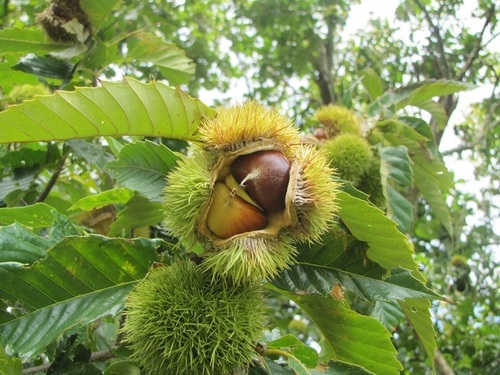
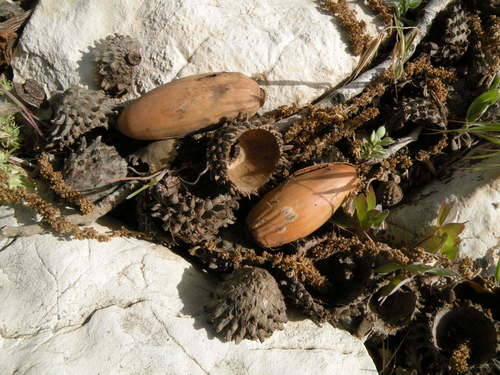
A tree. It loses its leaves during the year. It grows 8 m tall. The leaves are 6-12 cm long by 4-8 cm wide. The seed is 30-50 mm long by 12-22 mm wide.
How to Grow
Fodder: Mast Industrial Crop: Tannin Management: Standard Regional Crop Staple Crop: Balanced carb. Climate: warm temperate. Humidity: semi-arid. Quercus brantii is a plant of arid and semi-arid environments, and is able to withstand moderate amounts of frost, surviving temperatures falling to around -5°c or perhaps lower when dormant, especially if the summers are hot. Quercus species generally grow well in a sunny position, though young plants usually tolerate reasonable levels of side shade. They usually prefer a good deep fertile loam which can be on the stiff side. They are also often tolerant of moderate exposure, surviving well but being somewhat stunted. Established plants of this species are highly drought tolerant. Seedlings soon develop a taproot and become intolerant of root disturbance, they should be planted into their permanent positions whilst young. Most Quercus species hybridize freely with other members of the genus. Plants in this genus are notably resistant to honey fungus. Carbon Farming - Cultivation: regional crop. Management: standard. Acorns are harvested in Autumn, usually from September to November(Northern Hemisphere) , depending on the species and local climate. Oaks flower in Spring, with male flowers (catkins) appearing in April to June (Northern Hemisphere). Oaks generally have a slow to moderate growth rate, often taking several decades to reach full maturity. Some species may grow 1-2 feet per year under optimal conditions. Oaks are generally not self-fertile; they require cross-pollination between different trees for acorn production.
Propagation: Seed loses viability quickly if allowed to dry out. It can be stored moist and cool over winter, but is best sown as soon as it ripens in an outdoor seed bed with protection from mice and squirrels. Small quantities can be sown in deep pots in a cold frame. Plants develop a deep taproot and should be moved to permanent positions as soon as possible — seed sown in situ gives the best results. Trees should not remain in a nursery bed for more than two growing seasons, as they transplant very poorly after that point.
Medicinal Uses
The seeds are used in traditional medicine, though no further specific details are recorded for this species. More broadly, oak species are valued across many cultures for their tannin content. Preparations from the leaves, bark, seeds, seed cups, or galls are astringent, antibacterial, antifungal, antiseptic, styptic, and haemostatic. Taken internally, these preparations treat acute diarrhoea, dysentery, and haemorrhages. Applied externally, they are used as a mouthwash for toothache and gum problems, and as a topical wash on cuts, burns, skin complaints, haemorrhoids, and inflammation of oral, genital, and anal mucosa. Plant extracts can also be added to ointments for wound healing.
Other Uses
Oaks are valuable in agroforestry for shade, timber, wildlife habitat, soil improvement, and erosion control. Most oak leaves are rich in tannins; partially decayed leaves used as mulch repel slugs, snails, and grubs while eventually breaking down to enrich the soil. Fresh leaves should be used cautiously, as they can deplete soil nitrogen during decomposition and inhibit plant growth. Oak galls — formed by insect larvae living within growths on the tree — are a rich tannin source once the insects have left, and are also used as a dyestuff and to make ink in many cultures. Oak bark is similarly tannin-rich and useful as a dyestuff and for waterproofing rope. The timber of Quercus species is among the most commercially important in the world, valued for strength, durability, and appearance. It is used for fuel, railroad ties, construction, shipbuilding, interior trim, flooring, and furniture. The wood also produces good quality charcoal. Catkins provide pollen for insects, though wind pollination limits nectar production. Acorns support birds, mammals, and insects, and the tree's structure provides nesting and roosting habitat. Oak leaf litter and bark offer valuable overwintering sites for invertebrates.
Wikipedia
Source ↗Quercus brantii, Brant's oak, is a species of oak native to Western Asia, mainly in Iran, Iraq, Syria, and Turkey. A shrub or small tree, Quercus brantii grows to between 6 and 15 meters tall, and has serrated leaves with 5-14 teeth per side. Quercus brantii (covering more than 50% of the Zagros Mountains forest steppe ecoregion) is the most important tree species of the Zagros Mountains in Iran. It grows in soils derived from limestone at altitudes up to 2200 meters above sea level, and forms communities with other oaks, as well as Pinus brutia, Styrax officinalis, and Paliurus spina-christi. Iranians use its seed in traditional medicine. Other useful products derived from oaks include fuel wood, charcoal and timber hardwood.
Names & Synonyms
Beru, Karamese, Mese, Palamut
References (6)
- Dogan, A. & Tuzlaci, E., 2015, Wild Edible Plants of Pertek (Tunceli-Turkey). Marmara Pharmaceutical Journal 19: 126-135
- Ertug, F, Yenen Bitkiler. Resimli Türkiye Florası -I- Flora of Turkey - Ethnobotany supplement
- Ferns, Plants for a Future
- World Checklist of Useful Plant Species 2020. Royal Botanic Gardens, Kew
- Yesil, Y., et al, 2019, Wild edible plants in Yeşilli (Mardin-Turkey), a multicultural area. Journal of Ethnobiology and Ethnomedicine (2019) 15:52
- Yesil, Y., et al, 2019, Traditional knowledge of wild edible plants in Hasankeyf (Batman Province, Turkey). Acta Societatis Botanicorum Poloniae. 88(3):3633
More from Fagaceae