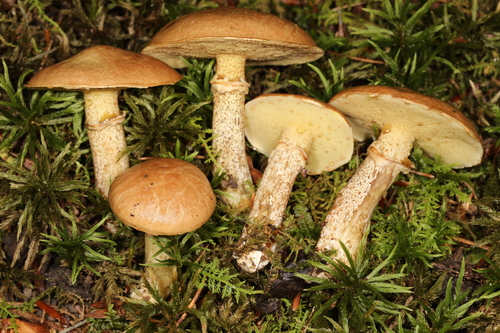
Suillus sibiricus
(Singer) Singer

(c) Marco Floriani, some rights reserved (CC BY-NC), uploaded by Marco Floriani

(c) Federico Calledda, some rights reserved (CC BY-NC), uploaded by Federico Calledda

(c) Tatiana Bulyonkova, some rights reserved (CC BY-NC-SA)
What to Eat
Edible parts: Mushroom, Fungus
The mushroom fruiting body is edible.
Where to Find It
It is a temperate plant.
Asia, Nepal, Russia,
How to Identify
A temperate mushroom in the Suillaceae family.
Wikipedia
Source ↗Suillus sibiricus is a mushroom-forming fungus in the family Suillaceae. In North America, it is commonly called the Siberian slippery jack. Phylogenetic analysis has shown that S. sibiricus is closely related to S. umbonatus and S. americanus, and may in fact be conspecific with the latter species. The fruit bodies have slimy caps in wet weather, which can reach diameters of up to 10 cm (3.9 in). On the underside of the cap are yellow angular pores that bruise a pinkish to cinnamon colour. The stem is up to 8 cm (3.1 in) tall and 2.5 cm (1.0 in) wide and typically has a ring, a remnant of the partial veil that covers the fruit body in its early development. It is found in mountains of Europe, North America, and Siberia, strictly associated with several species of pine tree. Due to its specific habitat and rarity in Europe, it has been selected for inclusion in several regional Red Lists.
References (1)
- Christensen, M., et al, 2008, Collection and Use of Wild Edible Fungi in Nepal. Economic Botany, 62(1), 2008, pp. 12–23