Adansonia za
Baillon
Za, Za boabab

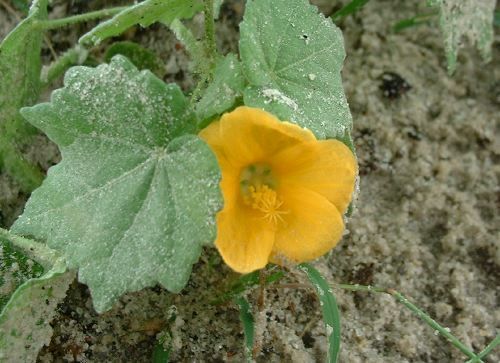
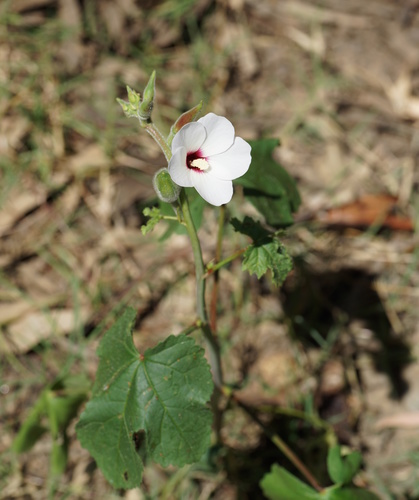
(c) Vitaly Alyonkin, some rights reserved (CC BY-NC), uploaded by Vitaly Alyonkin
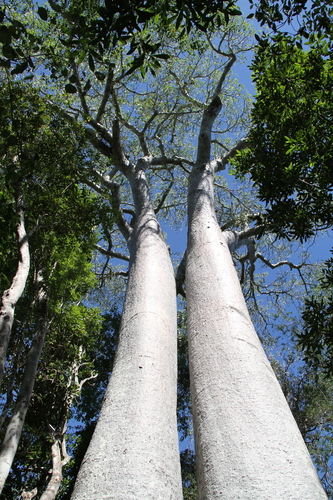
(c) Phil Boyle, some rights reserved (CC BY-NC), uploaded by Phil Boyle
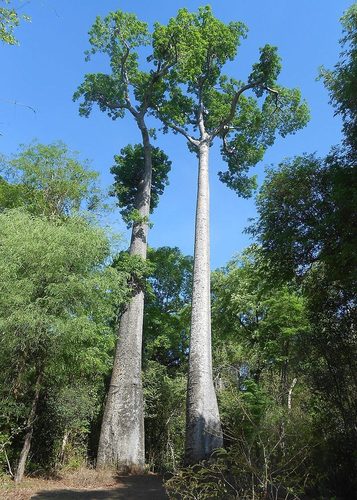
(c) subhashc, some rights reserved (CC BY-NC)
What to Eat
Edible parts: Leaves, Roots, Fruit, Seeds, Vegetable
The fruit pulp and roots of seedlings as well as the seeds are edible. Seeds contain 11% oil. Wood may be fed to cattle during droughts and the trunk can be hollowed out to store water. The bark fibre can be use for cloth or rope and the flowers may be used to sooth sore throats.
Where to Find It
It is a tropical plant. It is native to Madagascar. It grows on sedimentary or crystalline rock. It grows from sea level to 600 m altitude.
Africa, East Africa, Madagascar*,
How to Identify
A large tree. It grows 30 m high. The trunk is thick and can be 3 m across. It narrows towards the crown. The bark is grey and smooth but with ridges. The crown is rounded. The leaves are compound with 3-7 leaflets. The leaflets are an oblong sword shape. They are 5-10 cm long by 2 cm wide. The middle leaflets are larger than the side ones. They have long leaf stalks. The flowers are bright yellow with a somewhat red base. The fruit are woody capsules 10-30 cm long by 5-15 cm wide. The seeds are flattened and kidney shaped.
How to Grow
Plants are grown from seed. The germination of seeds is poor.
Propagation: Seed - germination rates for the untreated seeds is usually less than 10%. The hard seedcoat may benefit from scarification before sowing to speed up germination. This can usually be done by pouring a small amount of nearly boiling water on the seeds (being careful not to cook them!) and then soaking them for 12 - 24 hours in warm water. By this time they should have imbibed moisture and swollen - if they have not, then carefully make a nick in the seedcoat (being careful not to damage the embryo) and soak for a further 12 hours before sowing.
Medicinal Uses
The flowers are used to treat a sore throat.
Other Uses
A fibre obtained from the bark is used to make cloth and cordage. The bole is sometimes hollowed out to make a cistern for storing water.
Wikipedia
Source ↗Adansonia za is a species of baobab in the genus Adansonia of the family Malvaceae (previously included in the Bombacaceae). It was originally named in French as anadzahé. Common names in Malagasy include bojy, boringy, bozy, bozybe, ringy, and za, the last of which gives the plant its specific epithet. Eight Adansonia species are recognized, with six endemic to Madagascar. Adansonia za is the most widespread of the Madagascar endemics.
Notes
There are 6-8 Adansonia species. Also put in the family Bombacaceae. In the subfamily Bombacoideae.
Names & Synonyms
Bontana, Bozo, Bozy, Zabo
References (10)
- Ambrose-Oji, B. & Mughogho, N., 2007. Adansonia za Baill. [Internet] Record from Protabase. van der Vossen, H.A.M. & Mkamilo, G.S. (Editors). PROTA (Plant Resources of Tropical Africa / Ressources végétales de l’Afrique tropicale), Wageningen, Netherlands. < http://database.prota.org/search.htm>. Accessed 13 October 2009.
- Barwick, M., 2004, Tropical and Subtropical Trees. A Worldwide Encyclopedic Guide. Thames and Hudson p 9
- Bircher, A. G. & Bircher, W. H., 2000, Encyclopedia of Fruit Trees and Edible Flowering Plants in Egypt and the Subtropics. AUC Press. p 9 (Also as Adansonia alba)
- Bull. Mens. Soc. Linn. Paris ser. 2, 1:844. 1898
- Jardin, C., 1970, List of Foods Used In Africa, FAO Nutrition Information Document Series No 2.p 11
- Martin, F.W. & Ruberte, R.M., 1979, Edible Leaves of the Tropics. Antillian College Press, Mayaguez, Puerto Rico. p 179
- National Research Council, 2008, Lost Crops of Africa. Volume 3: Fruits, Washington, DC.: The National Academies Press. pdf p 86
- Schatz, G.E., 2001, Generic Tree Flora of Madagascar. Royal Botanical Gardens, Kew and Missouri Botanical Garden. p 244
- Terra, G.J.A., 1973, Tropical Vegetables. Communication 54e Royal Tropical Institute, Amsterdam, p 19
- World Checklist of Useful Plant Species 2020. Royal Botanic Gardens, Kew