Meconopsis horridula
Hook.f. & Thoms.
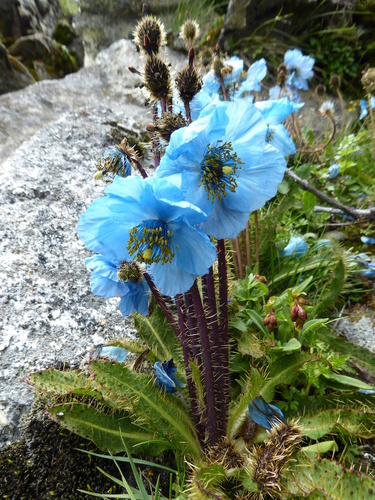
(c) Elizabeth Byers, some rights reserved (CC BY-NC), uploaded by Elizabeth Byers

(c) Suresh Ghimire, some rights reserved (CC BY-NC)

(c) Jasmine Star Outdoor Photography, some rights reserved (CC BY-NC)
What to Eat
Edible parts: Seeds
The seeds are eaten raw.
Where to Find It
It is a temperate plant. In Nepal it grows between 3,000-5,000 m above sea level.
Asia, Bhutan, China, Himalayas, India, Myanmar, Northeastern India, SE Asia, Sikkim, Tibet,
How to Identify
A prickly herb. It has a long slender taproot. The leaves are mostly at the base and in a ring. They are narrowly oblong, and have bristly spines. The leaf stalks are 2-4 cm long. The flowers are light blue. They are in spike-like clusters on the leafless stems. The fruit capsules are oval to round and have bristle spines. They have 5-6 valves.
Medicinal Uses
Meconopsis horridula is used in Chinese traditional herbal medicine because of its anti-inflammatory and analgesic qualities. As such, they are widely harvested. Although one plant produces many seeds, germination is low in natural and laboratory settings. As the demand for this plant increases, more and more plants are likely to be uprooted.
Wikipedia
Source ↗Meconopsis horridula, the prickly blue poppy, is a flowering plant from the family Papaveraceae. It grows in high altitudes. The height of the plant varies from 20 cm to 1m. It is a monocarpic, dicot plant.
Names & Synonyms
Ajak tser-ngon, Tiki, Tser-ngon, Tserzom
References (1)
- Ghimire, S. K., et al, 2008, Non-Timber Forest Products of Nepal Himalaya. WWF Nepal p 108