Lithocarpus clementianus
(King ex Hook.f.) A. Camus
FagaceaeSeeds/Nuts

gbif · cc0
President and Fellows of Harvard College
President and Fellows of Harvard College

gbif · cc0
President and Fellows of Harvard College
President and Fellows of Harvard College

gbif · cc0
President and Fellows of Harvard College
President and Fellows of Harvard College
What to Eat
Edible parts: Nuts
Where to Find It
It is a tropical plant. It grows in the rainforest. It grows up to 1,800 m above sea level.
Asia, Malaysia, SE Asia, Thailand,
Countries: United Arab Emirates, Afghanistan, Armenia, Azerbaijan, Bangladesh, Bahrain, Brunei, Bhutan, China, Georgia, Indonesia, Israel, India, Iraq, Iran, Jordan, Japan, Kyrgyzstan, Cambodia, North Korea, South Korea, Kuwait, Kazakhstan, Laos, Lebanon, Sri Lanka, Myanmar, Mongolia, Maldives, Malaysia, Nepal, Oman, Philippines, Pakistan, Qatar, Saudi Arabia, Singapore, Syria, Thailand, Tajikistan, Timor-Leste, Turkmenistan, Turkey, Taiwan, Uzbekistan, Vietnam, Yemen
How to Identify
A tree. It grows 36 m tall. The trunk is 70 cm across. The bark is brownish and cracked. The leaves are rough and 19 cm long. The acorns are purplish and round and 1.5 cm across.
Wikipedia
Source ↗Lithocarpus clementianus is a tree in the beech family Fagaceae. It is named for Governor Cecil Clementi Smith of the Straits Settlements (former British territories in Malaya).
Names & Synonyms
Pasania clementiana (King ex Hook.f.) GambleQuercus clementiana King ex Hook.f.Synaedrys clementiana (King ex Hook.f.) Koidz.
References (1)
- Castillo, C., 2013, The Archaeobotany of Khao Sam Kaeo and Phu Khao Thong: The Agriculture of Late Prehistoric Southern Thailand. Ph. D. thesis University College, London p 378
More from Fagaceae

Castanea alnifolia
Bush chinkapin, Florida chinkapin, Trailing chinkapin, Downy chinquapin

Castanea crenata
Japanese chestnut

Castanea dentata
American chestnut, American sweet chestnut

Castanea henryi
Zhui li, Conic chestnut
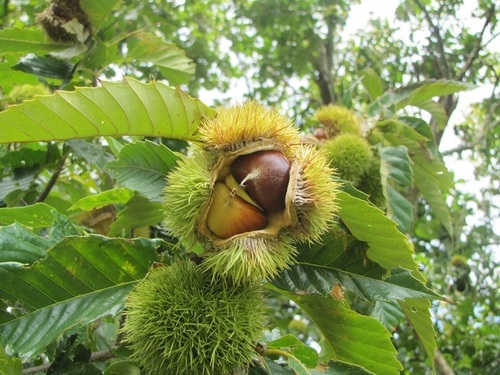
Castanea mollissima
Chinese chestnut

Castanea ozarkensis
Ozark chinkapin, Ozark chestnut