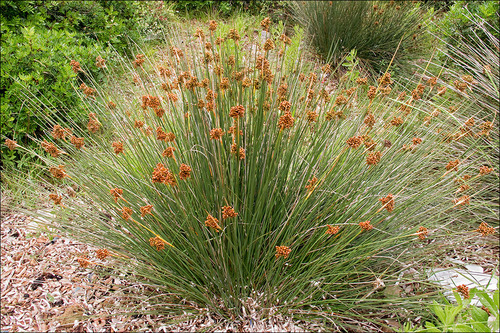
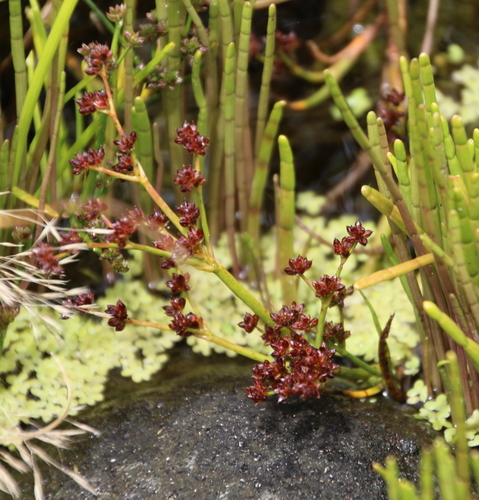
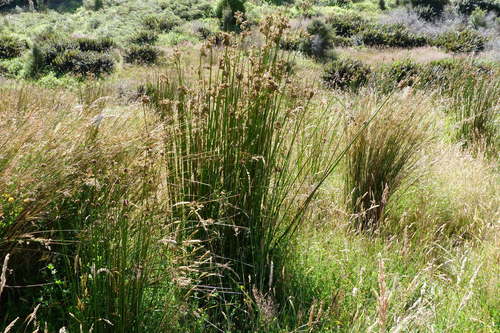
Juncus kraussii
Hochst.
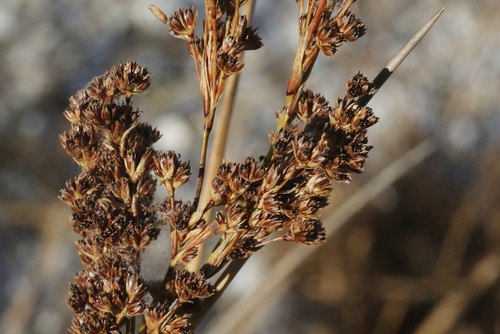
(c) James Bailey, some rights reserved (CC BY-NC), uploaded by James Bailey

(c) Noah Vale, some rights reserved (CC BY-NC)

(c) Noah Vale, some rights reserved (CC BY-NC)
What to Eat
Edible parts: Stems, Root
Juncus kraussii is harvested and weaved to produce traditional sleeping mats, baskets, beer strainers, and other craftwork items in many Zulu areas of South Africa. The plant is in great demand because of its economic value and has been extensively harvested in the wild. It is now cultivated in many areas and is harvested yearly for a period of seven years in total. The stems and leaves of Juncus kraussii were used by Indigenous Australians for fibre, for string, fishing lines, woven rugs and woven baskets. It is commonly used today for stabilisation of the banks of estuaries, around salt marshes and riparian zones next to sites developed for human use. It is also used in biofiltration systems and rain gardens.
Where to Find It
It is a subtropical plant.
Africa, South Africa, Southern Africa,
How to Identify
A rush.
Wikipedia
Source ↗Juncus kraussii commonly known as salt marsh rush, sea rush, jointed rush, matting rush or dune slack rush, is of the monocot family Juncaceae and genus Juncus. It grows in salt marshes, estuarine and coastal areas. This species is ideal as a stabiliser in estuary banks and riparian zones that adjoin developed areas; it prevents erosion and also provides an excellent fibre for weaving. The plant is named after a German naturalist and museum curator, Christian Krauss, who travelled to South Africa.
Names & Synonyms
Krap-my-nie
References (4)
- De Vynk, J. C., et al, 2016, Indigenous edible plant use by contemporary Khoe-San descendants of South Africa's Cape South Coast. South African Journal of Botany. 102 (2016) 60-69
- Ruiters-Welcome, A. K., 2019, Food plants of southern Africa. Ph.D. thesis. Univ. of Johannesburg p 69
- Welcome, A. K. & Van Wyk, B.-E., 2019, An inventory and analysis of the food plants of southern Africa. South African Journal of Botany 122 (2019) 136–179
- World Checklist of Useful Plant Species 2020. Royal Botanic Gardens, Kew