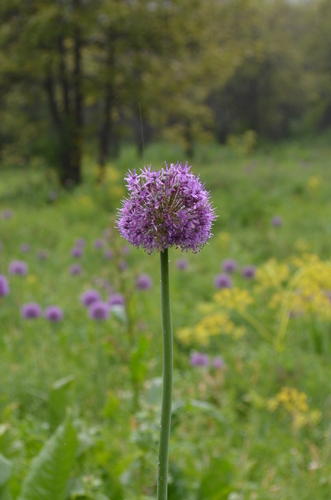
Allium blandum
Wall.

Botanical Research Institute of Texas

Royal Botanic Gardens, Kew

Royal Botanic Gardens, Kew
What to Eat
Edible parts: Leaves
The young leaves are eaten and have a spicy flavor.
Where to Find It
It is a temperate plant. It grows in the Himalayas between 2,550-5,100 m above sea level.
Asia, China, Himalayas, India, Nepal, Tajikistan, Tibet,
How to Identify
An onion herb. The bulbs usually occur singly. They are narrowly oval and 1.5-2 cm across. The leaves are narrow and 7-10 mm wide. They are flat.
Wikipedia
Source ↗Allium blandum is a species of onion native to northern India, Pakistan, Afghanistan, Tajikistan, Nepal and the Xinjiang region of western China. It grows in the mountains at elevations of 3000–5000 m. Allium blandum produces an egg-shaped bulb up to 2 cm in diameter. Scape is round in cross-section, up to 30 cm tall. Leaves are narrow, flat, up to 20 cm long. Umbel is spherical with many red flowers.
Names & Synonyms
Dum
References (2)
- Badwar, R. R., & Fernandez, R. R., 2011, Edible Wild Plants of the Himachal Pradesh State by IHBT, Himalayas, Daya Publishing House,. Delhi, India
- Wild edible plants of Himachal Pradesh