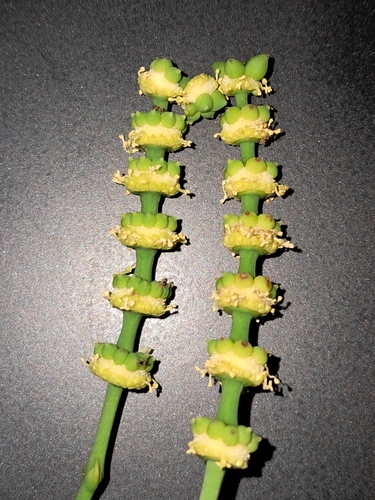
Gnetum pendulum
C. Y. Cheng
GnetaceaeSeeds/Nuts

gbif · cc0
President and Fellows of Harvard College
President and Fellows of Harvard College
What to Eat
Edible parts: Seed, Nut
The seeds are cooked and eaten.
Where to Find It
It is a tropical plant.
Asia, China, Tibet,
Countries: United Arab Emirates, Afghanistan, Armenia, Azerbaijan, Bangladesh, Bahrain, Brunei, Bhutan, China, Georgia, Indonesia, Israel, India, Iraq, Iran, Jordan, Japan, Kyrgyzstan, Cambodia, North Korea, South Korea, Kuwait, Kazakhstan, Laos, Lebanon, Sri Lanka, Myanmar, Mongolia, Maldives, Malaysia, Nepal, Oman, Philippines, Pakistan, Qatar, Saudi Arabia, Singapore, Syria, Thailand, Tajikistan, Timor-Leste, Turkmenistan, Turkey, Taiwan, Uzbekistan, Vietnam, Yemen
How to Identify
A large vine. The bark is greyish brown. The leaf stalk is 1.5 cm long. The leaves are narrowly oblong. They are 10-18 cm long by 4-7 cm wide. The base is rounded and they taper to the tip. The male flowers are at the end. They are branched 3 or 4 times and there are 5 or more spikes. There are 12-21 female flowers in a ring. The seeds are 3-4 cm long by 1.8 cm wide. They tend to hang down.
Names & Synonyms
Gyong-ga-sa
References (2)
- Li, S., et al, 2020, Monpa, memory, and change: an ethnobotanical study of plant use in Mêdog County, South-east Tibet, China. Journal of Ethnobiology and Ethnomedicine. (2020) 16:5 p 19
- Luo, B., et al, 2019, Wild edible plants collected by Hani from terraced rice paddy agroecosystem in Honghe Prefecture, Yunnan, China. Journal of Ethnobiology and Ethnomedicine 15:56