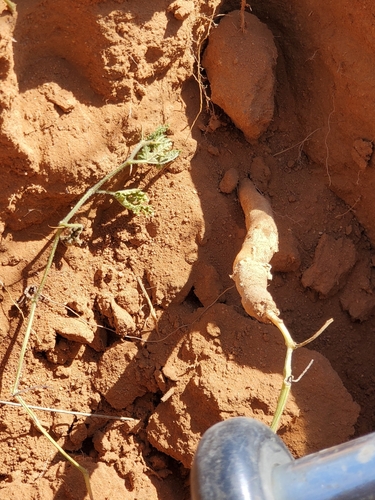
Coccinia mackenii
Naudin ex C. Huber

(c) Roddy CJ Ward, some rights reserved (CC BY-NC), uploaded by Roddy CJ Ward

(c) Gail Bowers-Winters, some rights reserved (CC BY-NC)
What to Eat
Edible parts: Fruit, Leaves
The genus Coccinia is best known for C. grandis, commonly known as "ivy gourd". Its fruits can be eaten raw when ripe or cooked when unripe. In the latter case, it is used in curries. Young leaves and shoots are also edible. All used plants are a good source of carotenoids. The tuber of Coccinia abyssinica is cooked and a source of starch for the Oromo people in Ethiopia. Local culinary uses also exist. However, many species and also populations within species can be bitter due to cucurbitacins. Coccinia grandis is also well known in ayurvedic medicine for diabetes treatment, and modern research seems to confirm that it might be of value in that application.
Where to Find It
It is a subtropical plant.
Africa, Eswatini, Mozambique, South Africa, Southern Africa, Swaziland,
How to Identify
A climbing herb. It can be 8 m long. It keeps growing from year to year. The tendrils are divided into 2. The leaves are round to oblong. The flowers are pale yellow. The fruit are oblong. They are red when ripe. They are 5-8 cm long by 2-3.5 cm wide. The seeds a dirty white and rough. They are 7-8 mm long by 3-4 mm wide and 1.5 mm thick.
Other Information
It is cultivated.
Names & Synonyms
Gomo
References (3)
- Holstein, N., 2015, Monograph of Coccinia (Cucurbitaceae). PhytoKeys 54: 1–166
- Welcome, A. K. & Van Wyk, B.-E., 2019, An inventory and analysis of the food plants of southern Africa. South African Journal of Botany 122 (2019) 136–179
- World Checklist of Useful Plant Species 2020. Royal Botanic Gardens, Kew