Cucurbita cordata
S. Watson
Coyote melon
(c) Enrique Flores García, some rights reserved (CC BY-NC), uploaded by Enrique Flores García

(c) Glenn Ehrenberg, some rights reserved (CC BY-NC), uploaded by Glenn Ehrenberg

(c) jrebman, some rights reserved (CC BY-NC), uploaded by jrebman
What to Eat
Edible parts: Seeds ?
The seeds are reportedly edible.
Where to Find It
It is a subtropical plant. It grows in hot arid regions.
Mexico, North America, USA,
How to Identify
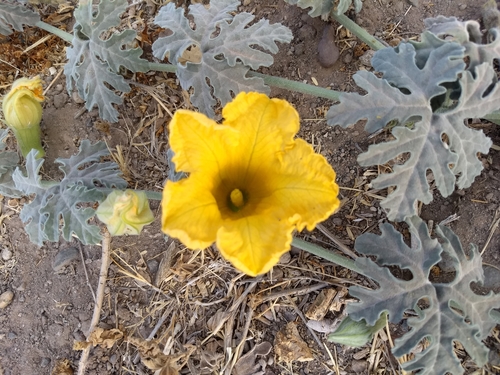
Coyote melon is a sprawling herb in the Cucurbitaceae (pumpkin) family, native to subtropical and hot arid regions.
Wikipedia
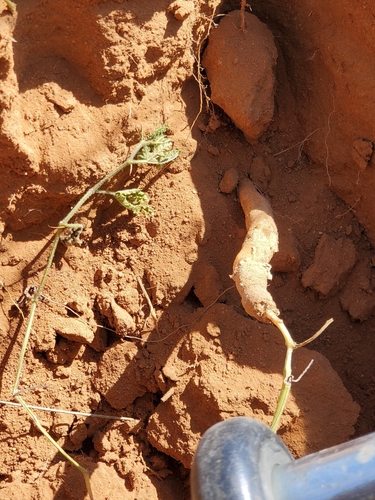
Source ↗Cucurbita cordata is a species of flowering plant in the squash family. It is similar to Cucurbita californica, Cucurbita cylindrata, Cucurbita digitata, and Cucurbita palmata and all these species hybridize readily. These species form the only restricted xerophyte species group in the genus Cucurbita. Each member of this species group is native to the Southwestern United States and Northwestern Mexico where they are relatively uncommon. Each group member is found in hot, arid regions with low rainfall. They prefer soil that is loose, gravelly, and well-drained. C. cordata is found only in the vicinity of Bahía de los Ángeles, Baja California. Botanists Bemis and Whitaker suggest that C. cordata and C. cylindrata may be a case of sympatric speciation. The juvenile leaves of C. cylindrata, C. cordata, C. digitata, and C. palmata show a high degree of similarity, but their mature leaves are visibly different, as are their root structures. C. cordata fruits are gray green, striped, and round. It was first identified by Sereno Watson in 1889.
References (1)
- World Checklist of Useful Plant Species 2020. Royal Botanic Gardens, Kew