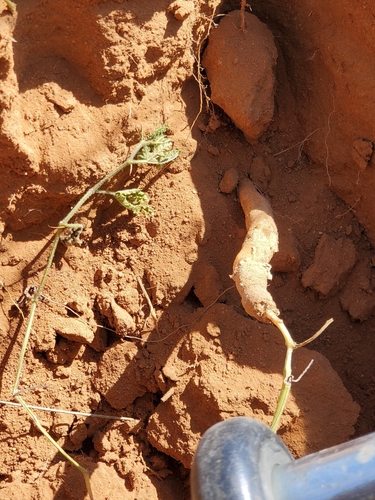
Cucumis anguria
L.
West Indian Gherkin
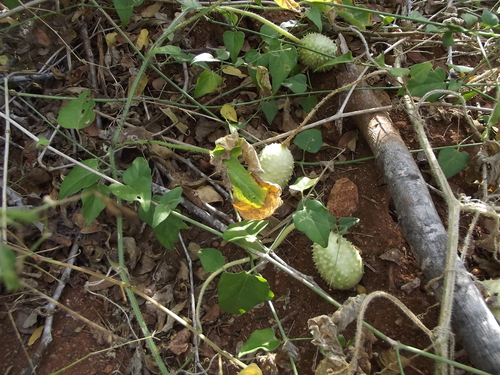
(c) J. Fernando Pío León, some rights reserved (CC BY-NC)
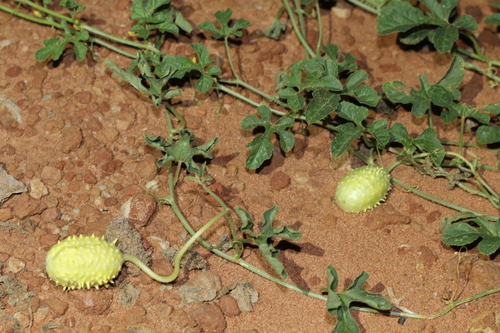
(c) Germaine Alexander Parada, some rights reserved (CC BY-NC), uploaded by Germaine Alexander Parada
What to Eat
Edible parts: Fruit, Seeds, Leaves, Vegetable
The fruit can be eaten raw, cooked, or pickled, and has an agreeable cucumber flavour with no bitterness. It works well in salads or savoury dishes. Pickling in vinegar is popular, and the fruit absorbs a large quantity of vinegar when prepared this way. Fruit size reaches up to 5cm long and 4cm wide. Seeds can be eaten raw; they are rich in oil with a nutty flavour, but are fiddly to use as they are small and covered with a fibrous seedcoat. Young leaves are edible when cooked.
Known Hazards
Where to Find It
A tropical plant. An edible variety is cultivated in tropical America. It grows between 200-1,500 m above sea level. It can grow in arid places. It suits hardiness zones 9-12.
Africa, Angola, Anguilla, Antigua and Barbuda, Argentina, Australia, Barbados, Botswana, Brazil, Britain, Burkina Faso, Cape Verde, Caribbean, Cayman Islands, Central Africa, Central America, Colombia, Congo, Costa Rica, Cuba, Dominican Republic, East Africa, Ecuador, Eswatini, Ethiopia, Europe, France, Guiana, Grenada, Guadeloupe, Guatemala, Guianas, Guinea-Bissau, Guyana, Haiti, Honduras, India, Jamaica, Madagascar, Malawi, Marquesas, Martinique, Mauritius, Mexico, Mozambique, Namibia, Netherlands Antilles, Nicaragua, Niue, Norfolk Island, North America, Pacific, Panama, Paraguay, Peru, Puerto Rico, Reunion, Senegal, Sierra Leone, South Africa, Southern Africa, South America, St Lucia, St. Vincent and Grenadines, Suriname, Swaziland, Tanzania, USA, Venezuela, West Africa, West Indies, Zambia, Zimbabwe,
How to Identify
A pumpkin family plant. It is a trailing or climbing herb. It grows 3 m long. It is rough to touch. The leaves are broadly oval and 4-10 cm long by 5-11 cm wide. They have 3-5 deep lobes. The leaves have fine teeth along the edge. It has separate male and female flowers on the same plant. There are 1-10 male flowers with stalks 4-30 mm long. The female flowers occur singly. The stalks are 1-10 cm long. The fruit are broadly oblong and 4-7 cm long. They are covered with soft curved prickles. They ripen to yellow-green with darker bands along them. The seed are 4-6 mm long. The flesh is firm and white.
Nutrition Score: 26/100
| Part | Moisture | kJ | kcal | Protein | Vit A | Vit C | Iron | Zinc |
|---|---|---|---|---|---|---|---|---|
| Fruit | 93 | 71 | 17 | 1.4 | — | 50 | 0.6 | — |
How to Grow
Requires a rich, well-drained moisture retentive soil and a very warm, sunny and sheltered position. A frost-tender annual plant, the gherkin is frequently cultivated for its fruit in warm temperate and tropical areas of the world, but it only really succeeds in Britain when grown under protection. There are many named varieties.
Propagation: Sow seed in early to mid spring in a greenhouse in rich soil; germination should occur within 2 weeks. Sow 2 or 3 seeds per pot and thin to the strongest plant. Grow on quickly and plant out after the last expected frosts, providing cloche or frame protection for at least the first few weeks if growing outdoors.
Medicinal Uses
The seeds are vermifuge. They are ground into a fine flour, made into an emulsion with water, and eaten. A purge must then be taken to expel tapeworms or other parasites from the body.
Other Uses
No other uses are known.
Wikipedia
Source ↗Cucumis anguria, commonly known as maroon cucumber, West Indian gherkin, maxixe, burr gherkin, cackrey, and West Indian gourd, is a vine that is indigenous to Africa, but has become naturalized in the New World, and is cultivated in many places. It is similar and related to the common cucumber (C. sativus) and its cultivars are known as gherkins.
Other Information
It is a commercially cultivated vegetable.
Notes
There are about 25 Cucumis species. There is an original bitter kind growing wild in Africa.
Names & Synonyms
Bur cucumber, Cassongo, Chikanyanga, Chikopa, Chipokolo, Cocombro, Goareberry gourd, Ingolowe, Jerusalem cucumber, Kasongwe, Konmonm kouli, Muchacha, Muhawa, Pepineto, Pepino de monte, Pepino silvestre, Ti konkonm
References (48)
- Altschul, S.V.R., 1973, Drugs and Foods from Little-known Plants. Notes in Harvard University Herbaria. Harvard Univ. Press. Massachusetts. no. 4370
- Bodkin, F., 1991, Encyclopedia Botanica. Cornstalk publishing, p 305
- Brouk, B., 1975, Plants Consumed by Man. Academic Press, London. p 105
- Busson, 1965,
- Cundall, P., (ed.), 2004, Gardening Australia: flora: the gardener's bible. ABC Books. p 440
- Ekman Herbarium records Haiti
- Esquinas-Alcazar, et al, 1983, Genetic Resources of Cucurbitaceae. International Board of Plant Genetic Resources.
- Facciola, S., 1998, Cornucopia 2: a Source Book of Edible Plants. Kampong Publications, p 85
- Flora of Australia, Volume 8, Lecythidales to Batales, Australian Government Publishing Service, Canberra (1982) p 190
- Flora of Australia Volume 49, Oceanic Islands 1, Australian Government Publishing Service, Canberra. (1994) p 130
- Fowler, D. G., 2007, Zambian Plants: Their Vernacular Names and Uses. Kew. p 22
- Fox, F. W. & Young, M. E. N., 1982, Food from the Veld. Delta Books. p 174
- Grubben, G. J. H. and Denton, O. A. (eds), 2004, Plant Resources of Tropical Africa 2. Vegetables. PROTA, Wageningen, Netherlands. p 238
- Hedrick, U.P., 1919, (Ed.), Sturtevant's edible plants of the world. p 229
- Herklots,
- Jardin, C., 1970, List of Foods Used In Africa, FAO Nutrition Information Document Series No 2.p 71
- Kays, S. J., and Dias, J. C. S., 1995, Common Names of Commercially Cultivated Vegetables of the World in 15 languages. Economic Botany, Vol. 49, No. 2, pp. 115-152
- Kiple, K.F. & Ornelas, K.C., (eds), 2000, The Cambridge World History of Food. CUP p 1765, 1777
- Lazarides, M. & Hince, B., 1993, Handbook of Economic Plants of Australia, CSIRO. p 70
- Lira, R. & Caballero, J., 2002, Ethnobotany of the Wild Mexican Cucurbitaceae. Economic Botany 56(4) pp. 380-398
- Long, C., 2005, Swaziland's Flora - siSwati names and Uses http://www.sntc.org.sz/flora/
- Maroyi, A., 2011, The Gathering and Consumption of Wild Edible Plants in Nhema Communal Area, Midlands Province, Zimbabwe. Ecology of Food and Nutrition 50:6, 506-525
- Maroyi, A., 2013, Use of weeds as traditional vegetables in Shurugwi District, Zimbabwe. Journal of Ethnobiology and Ethnomedicine 9:60
- Paczkowska, G. & Chapman, A.R., 2000, The Western Australian Flora. A Descriptive Catalogue. Western Australian Herbarium. p 221
- Peters, C. R., O'Brien, E. M., and Drummond, R.B., 1992, Edible Wild plants of Sub-saharan Africa. Kew. p 100
- Plants for a Future database, The Field, Penpol, Lostwithiel, Cornwall, PL22 0NG, UK. http://www.scs.leeds.ac.uk/pfaf/
- Plants of Haiti Smithsonian Institute http://botany.si.edu/antilles/West Indies
- Purseglove, J.W., 1968, Tropical Crops Dicotyledons, Longmans. p 108
- Roa, J. A. G. & Boada, D. S. G., 2018, Fundación para el Fortalecimiento de la Fruticultura y Plantas Alimenticias no Convencionales en Colombia.
- Rodin, 1985,
- Royal Botanic Gardens, Kew (1999). Survey of Economic Plants for Arid and Semi-Arid Lands (SEPASAL) database. Published on the Internet; http://www.rbgkew.org.uk/ceb/sepasal/internet [Accessed 16th April 2011]
- Ruiters-Welcome, A. K., 2019, Food plants of southern Africa. Ph.D. thesis. Univ. of Johannesburg p 49
- Sharma, B.B., 2005, Growing fruits and vegetables. Publications Division. Ministry of Information and broadcasting. India. p 172
- Small, E., 2009, Top 100 Food Plants. The world's most important culinary crops. NRC Research Press. p 239
- Sp. pl. 2:1011. 1753
- Stanley, T. D. & Ross, E. M., 1986, Flora of south-eastern Queensland Volume 2. Queensland Government p 15
- Terra, G.J.A., 1973, Tropical Vegetables. Communication 54e Royal Tropical Institute, Amsterdam, p 42
- Tindall, H.D., 1983, Vegetables in the tropics. Macmillan p. 154
- USDA, ARS, National Genetic Resources Program. Germplasm Resources Information Network - (GRIN). [Online Database] National Germplasm Resources Laboratory, Beltsville, Maryland. Available: www.ars-grin.gov/cgi-bin/npgs/html/econ.pl (10 April 2000)
- van Wyk, B., 2005, Food Plants of the World. An illustrated guide. Timber press. p 156
- van Wyk, Be, & Gericke, N., 2007, People's plants. A Guide to Useful Plants of Southern Africa. Briza. p 40
- Vasquez, R. and Gentry, A. H., 1989, Use and Misuse of Forest-harvested Fruits in the Iquitos Area. Conservation Biology 3(4): 350f
- Welcome, A. K. & Van Wyk, B.-E., 2019, An inventory and analysis of the food plants of southern Africa. South African Journal of Botany 122 (2019) 136–179
- Wiersema, J. H. & Leon, B., 2013, World Economic Plants. A Standard Reference CRC Press. 2nd Ed. p 215
- Wilkins-Ellert, M.H., 2004. Cucumis anguria L. [Internet] Record from Protabase. Grubben, G.J.H. & Denton, O.A. (Editors). PROTA (Plant Resources of Tropical Africa), Wageningen, Netherlands. < http://database.prota.org/search.htm>. Accessed 15 October 2009.
- Williamson, J., 2005, Useful Plants of Malawi. 3rd. Edition. Mdadzi Book Trust. p 85
- World Checklist of Useful Plant Species 2020. Royal Botanic Gardens, Kew
- Zeven, A. C. & de West, J. M. J., 1982, Dictionary of cultivated plants and their regions of diversity. Wageningen. p 124