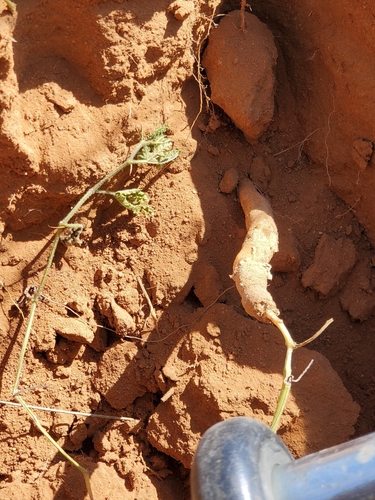
Cucumis dipsaceus
Ehrenb. ex Spach
Teaselgourd, Hedgehog Gourd, Arabian cucumber

(с) Francisco Farriols Sarabia, некоторые права защищены (CC BY), загрузил Francisco Farriols Sarabia
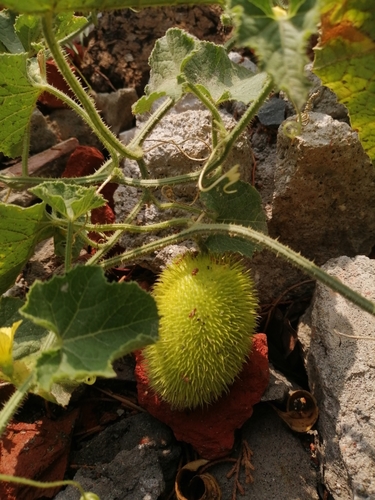
(c) sebas, some rights reserved (CC BY-NC)
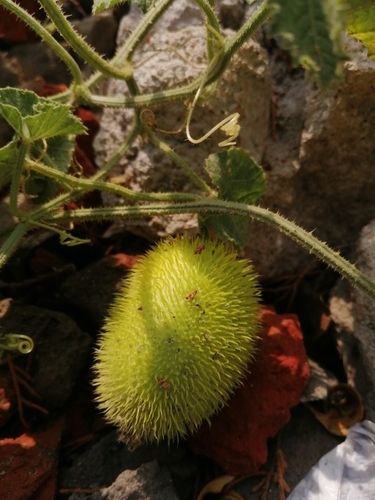
(c) sebas, some rights reserved (CC BY-NC)
What to Eat
Edible parts: Leaves, Seeds, Fruit, Vegetable
The seeds are cooked and eaten. Young leaves are eaten as a vegetable, mashed into food, or dried, pounded into powder, then soaked in hot water, boiled and stirred before eating. The fruit is also eaten. It is often used as a famine food and has low palatability.
Known Hazards
Where to Find It
It is a tropical plant. It is best in light, well-drained soil. It needs a protected, sunny position. It is damaged by frost or drought. It grows between 425-1,800 m above sea level. It can grow in arid places.
Africa, Asia, Australia, Colombia, East Africa, Egypt, Ethiopia, Europe*, Hawaii, India, Kenya, Madagascar, North Africa, Pacific, Somalia, South America, Sudan, Tanzania, Uganda,
How to Identify
A pumpkin family herb. It is an annual plant growing each year from seed. It grows 50 cm high and spreads 2 m wide. The stems are slender and trailing. They have prickles. It has tendrils. The leaves are oval to kidney shaped. They can be 10 cm long. The flowers are funnel shaped and yellow. The fruit are hairy oval berries. They are yellow and 3-7 cm long by 3-4 cm wide.
Nutrition Score: 17/100
| Part | Moisture | kJ | kcal | Protein | Vit A | Vit C | Iron | Zinc |
|---|---|---|---|---|---|---|---|---|
| Leaves raw | 88.9 | 146 | 35 | 1 | — | — | 1 | — |
How to Grow
Plants are grown from seeds.
Medicinal Uses
Medicinally, C. dipsaceus is believed to have topical healing properties, although not widely practiced. Poultice (a moist mass of the plant material wrapped in cloth) is created with the leaves and tendrils of the plant, and placed on surface injuries for the treatment of wounds. The poultices are also used for treatment of soreness and inflammation. When ingested, the fruit itself is thought to treat gastrointestinal diseases, diarrhea, stomach pain, constipation, and meningitis. The roots of the plant when ingested are thought to treat hepatitis and gallstones.
Wikipedia
Source ↗Cucumis dipsaceus, also known as Arabian cucumber or hedgehog cucumber, is an annual climbing herb that can be found in tropical and arid locations. The plant is native to eastern Africa, first found in Sudan, southern Egypt, and Ethiopia. The developed fruits of the plant change from green to yellow and contain many seeds. The hairs that cover the oblong fruits nickname this species the “hedgehog cucumber”. C. dipsaceus has several usages, as fodder, medicine, and human consumption. The cucumber is normally collected in the wild, but has also been domesticated. The young shoots and leaves of the plant are traditionally cooked with groundnut paste, and with coconut milk when available. The fruit of the plant is used medicinally as an analgesic. C. dipsaceus has become invasive all across the Americas. This includes islands in Hawaii, several states in the U.S. and islands in South America as well. There are no known methods of control.
Production
Leaves are collected during the rainy season. They are dried, pounded and stored in airtight containers.
Other Information
It has low palatability. It is often a famine food. It is cultivated.
Notes
There are about 25 Cucumis species.
Names & Synonyms
Alaskau, Bequnba, Burate-harre, Dhahanata, Ekaleruk, Googo, Hachirindo, Hashupata, Hunduhundu, Kakashut, Kasasalya, Katanga, Kikungi, Kyambatwa, Lisapi, Mullampanrivelari, Utumbu
References (30)
- Addis, G., Asfaw, Z & Woldu, Z., 2013, Ethnobotany of Wild and Semi-wild Edible Plants of Konso Ethnic Community, South Ethiopia. Ethnobotany Research and Applications. 11:121-141
- Addis, G., et al, 2013, The Role of Wild and Semi-wild Edible Plants in Household Food Sovereignty in Hamer and Konso Communities, South Ethiopia. Ethnobotany Research & Applications. 11:251-271
- Bodkin, F., 1991, Encyclopedia Botanica. Cornstalk publishing, p 305
- Chandran, R., et al, Nutritional Composition and Antioxidant Properties of Cucumis dipsaceus leaf. The Scientific World Journal. Volume 2013.
- Facciola, S., 1998, Cornucopia 2: a Source Book of Edible Plants. Kampong Publications, p 85
- Food Composition Tables for use in Africa FAO http://www.fao.org/infoods/directory No. 824
- Goode, P., 1989, Edible Plants of Uganda. FAO p 30
- Grivetti, L. E., 1980, Agricultural development: present and potential role of edible wild plants. Part 2: Sub-Saharan Africa, Report to the Department of State Agency for International Development. p 49
- Grubben, G. J. H. and Denton, O. A. (eds), 2004, Plant Resources of Tropical Africa 2. Vegetables. PROTA, Wageningen, Netherlands. p 560
- Hist. nat. veg. 6:211. 1838
- Jardin, C., 1970, List of Foods Used In Africa, FAO Nutrition Information Document Series No 2.p 71
- Kidane, B., et al, 2014, Wild and semi-wild leafy vegetables used by the Maale and Ari ethnic communities in southern Ethiopia. Genetic Resour Crop Evol. Springer. p 8
- Kunkel,
- Lulekal, E., et al, 2011, Wild edible plants in Ethiopia: a review on their potential to combat food insecurity. Afrika Focus - Vol. 24, No 2. pp 71-121
- Martin, F.W. & Ruberte, R.M., 1979, Edible Leaves of the Tropics. Antillian College Press, Mayaguez, Puerto Rico. p 189
- Maundu, P. et al, 1999, Traditional Food Plants of Kenya. National Museum of Kenya. 288p
- Morgan, W. T. W., 1981, Ethnobotany of the Turkana: Use of plants by a Pastoral People and Their Livestock in Kenya. Economic Botany 35(1):96-130
- Mutie, F. G., 2020, Conservation of Wild Food Plants and Their Potential for Combatting Food Insecurity in Kenya as Exemplified by the Drylands of Kitui County. Plants 2020, 9, 1017
- Mutie, F. M., et al, 2023, Important Medicinal and Food Taxa (Orders and Families) in Kenya, Based on Three Quantitative Approaches. Plants 2023, 12, 1145
- Njoroge, G. & Newton, L. E. 1994, Edible and Poisonous Species of Cucurbitaceaea in the Central Highlands of Kenya. Journal of East African Natural History. 83:101-115
- Ocho, D. L., et al, 2012, Assessing the levels of food shortage using the traffic light metaphor by analyzing the gathering and consumption of wild food plants, crop parts and crop residues in Konso, Ethiopia. Journal of Ethnobiology and Ethnomedicine 8:30
- Peters, C. R., O'Brien, E. M., and Drummond, R.B., 1992, Edible Wild plants of Sub-saharan Africa. Kew. p 100
- Roa, J. A. G. & Boada, D. S. G., 2018, Fundación para el Fortalecimiento de la Fruticultura y Plantas Alimenticias no Convencionales en Colombia.
- Royal Botanic Gardens, Kew (1999). Survey of Economic Plants for Arid and Semi-Arid Lands (SEPASAL) database. Published on the Internet; http://www.rbgkew.org.uk/ceb/sepasal/internet [Accessed 16th April 2011]
- Ruffo, C. K., Birnie, A. & Tengnas, B., 2002, Edible Wild Plants of Tanzania. RELMA p 242
- Sarvalingam, A., et al, 2014, Wild edible plant resources used by the Irulas of the Maruthamalai Hills, Southern Western Ghats, Coimbatore, Tamil Nadu. Indian Journal of Natural Products and Resources 5(2):198-201
- Terra, G.J.A., 1973, Tropical Vegetables. Communication 54e Royal Tropical Institute, Amsterdam, p 42
- World Checklist of Useful Plant Species 2020. Royal Botanic Gardens, Kew
- Yimer, A., et al, 2021, Ethnobotanical study of wild edible plants used by Meinit Ethnic Community at Bench-Maji Zone, Southwest Ethiopia. Research Square. p 5
- Zeven, A. C. & de West, J. M. J., 1982, Dictionary of cultivated plants and their regions of diversity. Wageningen. p 124