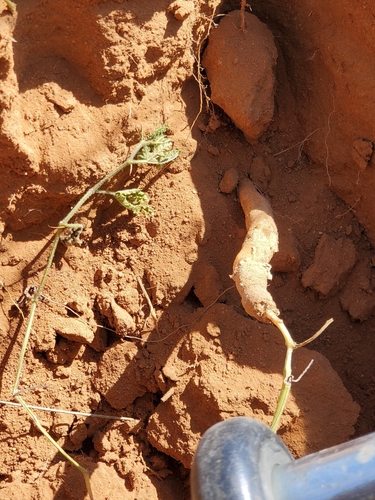
Cucumis hystrix
Chakravarty
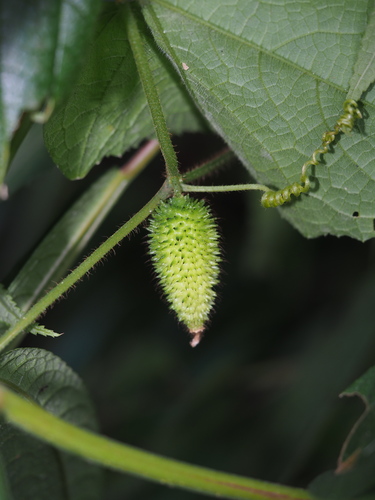
(c) 小铖/Smalltown, some rights reserved (CC BY-NC), uploaded by 小铖/Smalltown
What to Eat
Edible parts: Fruit, Vegetable, Leaves
The fruits are eaten fresh as a vegetable and used in salads, while the leaves are boiled and eaten.
Where to Find It
It is a tropical plant. It grows in forests between 800-1,500 m above sea level. In Yunnan.
Asia, Bangladesh, China, India, Indochina, Laos, Myanmar, SE Asia, Thailand,
How to Identify
A pumpkin family plant. It is a vine. The stems are angular. It has simple, narrow tendrils. The leaves are oval or triangle shaped and 6-13 cm long by 6-10 cm wide. They have 3-5 irregular lobes. There are teeth along the edge. Male and female flowers occur singly. They are yellow. The fruit are oblong and 4-5 cm long by 1-2 cm wide. The seeds are narrowly oval.
Wikipedia
Source ↗Cucumis hystrix is a monoecious annual climbing vine in the family Cucurbitaceae. The specific epithet (hystrix) is Neo-Latin for "porcupine".
Other Information
It is sold in local markets.
Notes
There are about 25 Cucumis species.
Names & Synonyms
A yao shuo kuo, Dian song, Kanta shasha, Lu gua biu
References (6)
- BARC, 2016, State of Biodiversity for Food and Agriculture in Bangladesh. Bangladesh Agricultural Research Council.
- Cao, Y., et al, 2020, Ethnobotanical study on wild edible plants used by three trans-boundary ethnic groups in Jiangcheng County, Pu’er, Southwest China. Journal of Ethnobiology and Ethnomedicine (2020) 16:66
- Ghorbani, A., et al, 2012, A comparison of the wild food plant use knowledge of ethnic minorities in Naban River Watershed Nature Reserve, Yunnan, SW China. Journal of Ethnobiology and Ethnomedicine; 8:17
- J. Bombay Nat. Hist. Soc. 50(4):896. 1952
- Xu, You-Kai, et al, 2004, Wild Vegetable Resources and Market Survey in Xishuangbanna, Southwest China. Economic Botany. 58(4): 647-667.
- Yang, Si-Lin and Walters, T. W., 1992, Ethnobotany and the Economic role of the Cucurbitaceae of China. Economic Botany, Vol. 46, No. 4, pp. 349-367