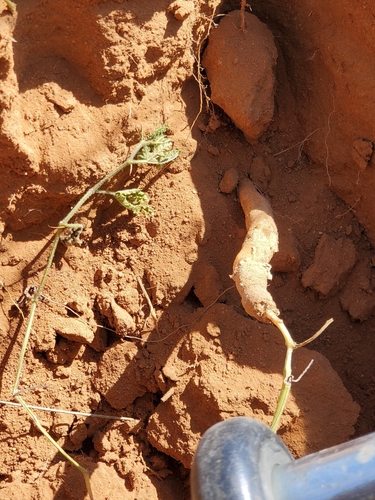
Cucumis prophetarum
L.
Wild cucumber, Mandera cucumber
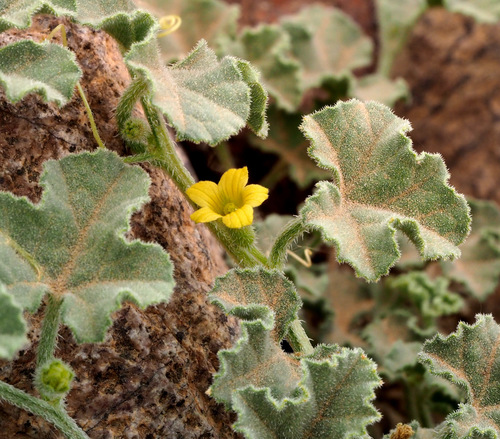
(c) Ron Frumkin, some rights reserved (CC BY-NC), uploaded by Ron Frumkin
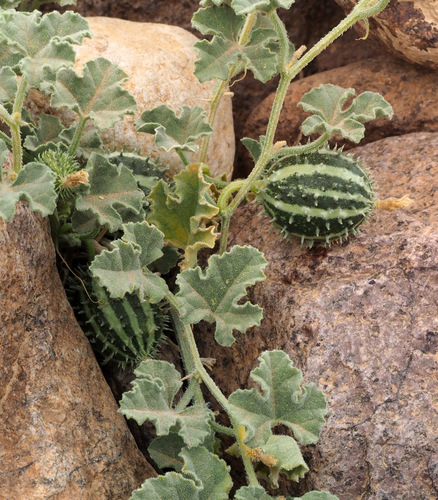
(c) Ron Frumkin, some rights reserved (CC BY-NC), uploaded by Ron Frumkin
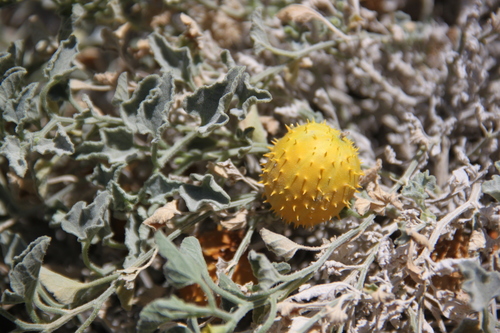
(c) marinat17, some rights reserved (CC BY-NC), uploaded by marinat17
What to Eat
Edible parts: Leaves, Fruit
Unripe fruit are pickled. Ripe fruit, though bitter, are boiled or cut into pieces, dried, and cooked as a vegetable. The leaves are also eaten cooked.
Where to Find It
It is a tropical plant. It grows between 3-2,400 m altitude. It can grow in stony, sand or clay soils. It can grow in alkaline soils. It is often over limestone material. It grows in areas with an annual rainfall of 400 mm. It can grow in arid places.
Afghanistan, Africa, Angola, Arabia, Bahrain, Burkina Faso, Central Africa, Chad, Congo, East Africa, Egypt, Ethiopia, Europe, India, Iran, Iraq, Israel, Jordan, Kenya, Mali, Mauritania, Mediterranean, Middle East, Niger, Nigeria, North Africa, Oman, Pakistan, Palestine, Rwanda, Sahel, Saudi Arabia, Senegal, Socotra, Somalia, South Africa, Spain, Sudan, Syria, Tanzania, Uganda, United Arab Emirates, UAE, USA, West Africa, Yemen, Zambia,
How to Identify
A herb. It is a pumpkin family plant. It can lie along the ground or be climbing. The stems are slender. The tendrils are simple and short. It has a taproot. The leaves are oval or round and 2-4 cm long. They can have 3-5 lobes. Male and female flowers are separate. Male flowers occur in groups of 2 or 3 and female flowers occur singly. The fruit are oval and hairy. They have soft bristles. They have yellow and green stripes along them. They are 3-4 cm long by 2-3 cm wide. The seeds are pale. There are 2 subspecies.
Nutrition Score: 47/100
| Part | Moisture | kJ | kcal | Protein | Vit A | Vit C | Iron | Zinc |
|---|---|---|---|---|---|---|---|---|
| Fruit | 81.8 | 583 | 139 | 12.7 | — | — | — | — |
How to Grow
A plant of low to moderate elevations in the drier areas of the tropics. It grows in Tanzania in areas where the mean annual rainfall is in the range 600 - 1,300mm.
Medicinal Uses
The fruit has a bitter flavor when raw and is sometimes boiled or pickled and the leaves are cooked and served with a staple. The fruit is eaten across its native range and occasionally cultivated and sold in local markets. The fruit is also used in folk medicine in Saudi Arabia to treat liver disorders.
Wikipedia
Source ↗Cucumis prophetarum is a dioecious and prostrate or climbing perennial vine in the family Cucurbitaceae. The specific epithet (prophetarum) comes from Latin propheta, meaning "prophet".
Production
Fruit are available during the dry season.
Notes
There are about 25 Cucumis species.
Names & Synonyms
Attanga, Dog's melon, Ekeleruk, Ekolese, Fagus al kulab, Globe cucumber, Katende, Tegesrarit, Yemder-inbway
References (20)
- Cent. pl. I:33. 1755 (Amoen. acad. 4:295. 1759)
- CRÉAC'H,
- Facciola, S., 1998, Cornucopia 2: a Source Book of Edible Plants. Kampong Publications, p 86
- Glover, et al, 1981,
- Harris, F. M. A. and Mohammed, S., 2003, Relying on Nature: Wild Foods in Northern Nigeria. Ambio Vol. 32 No. 1. p 25-30
- Hedrick, U.P., 1919, (Ed.), Sturtevant's edible plants of the world. p 235
- Jardin, C., 1970, List of Foods Used In Africa, FAO Nutrition Information Document Series No 2.p 72
- Malaisse, F., 1997, Se nourrir en floret claire africaine. Approche ecologique et nutritionnelle. CTA., p 61 (Subsp dissectus)
- Martin, F.W. & Ruberte, R.M., 1979, Edible Leaves of the Tropics. Antillian College Press, Mayaguez, Puerto Rico. p 189
- Maundu, P. et al, 1999, Traditional Food Plants of Kenya. National Museum of Kenya. 288p
- Molla, A., Ethiopian Plant Names. http://www.ethiopic.com/aplants.htm
- Mutie, F. M., et al, 2023, Important Medicinal and Food Taxa (Orders and Families) in Kenya, Based on Three Quantitative Approaches. Plants 2023, 12, 1145
- Narayanan Ratheesh, M. K. et al, 2011, Wild edible plants used by the Kattunaikka, Paniya and Kuruma tribes of Wayanad District, Kerala, India. Journal of Medicinal Plants Research Vol. 5(15), pp. 3520-3529
- Njoroge, G. & Newton, L. E. 1994, Edible and Poisonous Species of Cucurbitaceaea in the Central Highlands of Kenya. Journal of East African Natural History. 83:101-115
- Peters, C. R., O'Brien, E. M., and Drummond, R.B., 1992, Edible Wild plants of Sub-saharan Africa. Kew. p 101
- Royal Botanic Gardens, Kew (1999). Survey of Economic Plants for Arid and Semi-Arid Lands (SEPASAL) database. Published on the Internet; http://www.rbgkew.org.uk/ceb/sepasal/internet [Accessed 16th April 2011]
- Ruiters-Welcome, A. K., 2019, Food plants of southern Africa. Ph.D. thesis. Univ. of Johannesburg p 49
- Terra, G.J.A., 1973, Tropical Vegetables. Communication 54e Royal Tropical Institute, Amsterdam, p 42
- Welcome, A. K. & Van Wyk, B.-E., 2019, An inventory and analysis of the food plants of southern Africa. South African Journal of Botany 122 (2019) 136–179
- World Checklist of Useful Plant Species 2020. Royal Botanic Gardens, Kew