Cucumis trigonus
Roxb.
(c) Amar Bharathy, some rights reserved (CC BY), uploaded by Amar Bharathy

(c) GnanVi, some rights reserved (CC BY-NC)

(c) GnanVi, some rights reserved (CC BY-NC)
What to Eat
Edible parts: Fruit
The ripe fruit are eaten raw, and the unripe fruit are boiled and eaten as a vegetable.
Known Hazards
Where to Find It
A tropical plant. It grows in open areas or low scrub.
Asia, Australia, India, Indochina, Myanmar, Northeastern India, SE Asia, Vietnam,
How to Identify
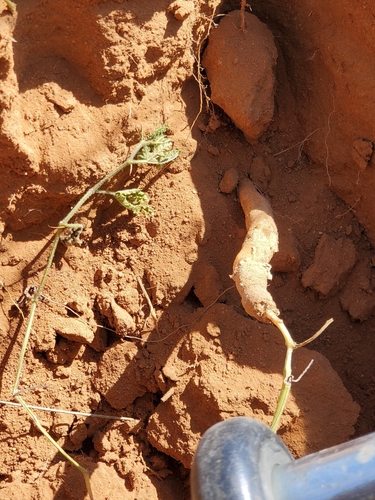
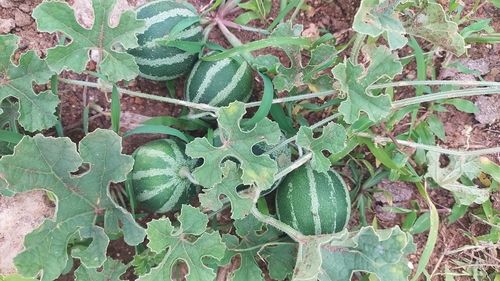
A pumpkin family plant. It is a perennial climber. It grows from a persistent root stock. The stems are 4 sided and hairy. The leaves have 5 lobes and teeth along the edge. The fruit are berries. These are slightly triangular. They are 4 cm across and green with white stripes.
Nutrition Score: 11/100
| Part | Moisture | kJ | kcal | Protein | Vit A | Vit C | Iron | Zinc |
|---|---|---|---|---|---|---|---|---|
| Fruit | 95.6 | — | — | 2 | — | — | — | — |
Other Information
The ripe fruit are popular.
Notes
There are about 25 Cucumis species.
Names & Synonyms
Adavipuchcha, Bhakura, Bislambhi, Boomarrah, Fangma tial, Ghimaru, Gomuk, Jangalindrayan, Karit, Karita, Kasit, Kattutumatti, Kodibudama, Mekke kayi, Nga-pyok-thakwa, Pahetula, Panch mahals, Thaisim, Vishala
References (12)
- Ambasta, S.P. (Ed.), 2000, The Useful Plants of India. CSIR India. p 149
- Cribb, A.B. & J.W., 1976, Wild Food in Australia, Fontana. p 64
- Fl. ind. ed. 1832, 3:722. 1832
- GAMMIE,
- IRVINE,
- Maiden, J. H., 1889, The Useful Native Plants of Australia (including Tasmania). The Technology Museum of NSW, Sydney. p 20
- Medhi, P. & Borthakur, S. K., 2012, Phytoresources from North Cachur Hills of Assam -3: Edible plants sold at Hflong market. Indian Journal or Natural Products and Resources. 3(1) pp 84-109
- Morley, B.D., & Toelken, H.R., (Eds), 1983, Flowering Plants in Australia. Rigby. p 100
- Patiri, B. & Borah, A., 2007, Wild Edible Plants of Assam. Geethaki Publishers. p 62
- Pham-Hoang Ho, 1999, An Illustrated Flora of Vietnam. Nha Xuat Ban Tre. p 570
- Rajasab, A. H. et al, 2004, Documentation of folk knowledge on edible wild plants of North Karnataka. Indian Journal of Traditional Knowledge. Vol 3(4) pp 419-429
- Sen, R., et al, 1985, Ethnobotanical Uses of Herbaria - 4 J. Econ. Tax. Bot. Vol 6. No.2 pp 331-335