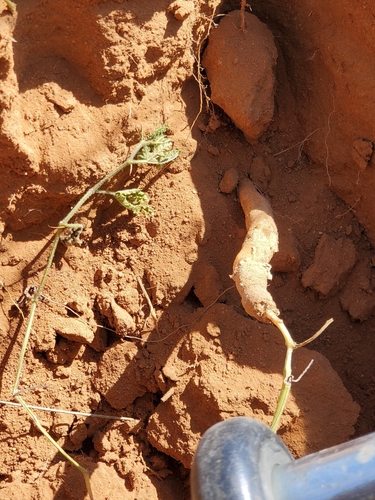
Cucurbita digitata
A. Gray
Coyote gourd, Fingerleaf gourd

(c) Katja Schulz, some rights reserved (CC BY)

(c) Jerry Oldenettel, some rights reserved (CC BY-NC-SA)

(c) Jerry Oldenettel, some rights reserved (CC BY-NC-SA)
What to Eat
Edible parts: Root, Seeds, Caution
Oil. Edibility Summary. The edible, practical, and historically important part is the mature seed. The fruit flesh and pulp are the risky part because wild Cucurbita can contain cucurbitacins—extremely bitter compounds associated with gastrointestinal poisoning—and those compounds are not reliably removed by cooking because they are heat-stable. Edible Uses & Rating. The seeds rate as good-to-excellent when fully mature, cleaned, and roasted, because they can approach the eating quality of pumpkin seeds when bitterness is absent. The fruit flesh is a poor choice and should be considered unsafe unless you have authoritative, locality-specific knowledge and a clear absence of extreme bitterness; the conservative recommendation is “seeds only.” Taste, Processing & Kitchen Notes. When the gourd is fully mature, and the pulp has begun to dry, the seeds are typically olive-green with tan shells and roast up with a familiar, nutty “pepita-like” flavor and a high-calorie, oily feel. When gourds are gathered too early, seeds can taste acrid, thin, or under-oiled; maturity is the difference between “excellent snack” and “not worth it.” In the kitchen, treat them like pumpkin seeds: rinse clean, dry thoroughly, then roast until fragrant, watching carefully near the end so they do not scorch. Seasonality (Phenology). Vines grow, flower in summer, and fruits mature toward mid to late autumn. Your easiest harvest window is when fruits have yellowed and are beginning to dry, because seed extraction becomes simpler as the pulp loses its slipperiness. Safety & Cautions (Food Use). Wild Cucurbita can contain cucurbitacins, which are intensely bitter, associated with poisoning, and are not reliably destroyed by heat. The single most practical safety tool is your tongue: if seeds (or any associated pulp residue) taste unusually and aggressively bitter, do not eat them. Avoid tasting or consuming the flesh and pulp as a “trial,” because that is the portion most associated with problematic bitterness in wild gourds. Harvest & Processing Workflow. Harvest fully mature gourds in autumn when they are yellowing to tan and the interior is trending dry. Crack the rind, remove the seed mass, and wash repeatedly until all pulp residue is gone, because pulp clings and can carry bitterness. Dry the cleaned seeds completely, then roast in a pan or oven until aromatic; eat seeds whole in the shells (spitting shells if desired) or crack for cleaner eating and storage. Cultivar/Selection Notes. This is a wild species rather than a standard garden cultivar group, so “named selections” are uncommon. If you are selecting plants informally for future foraging returns, the best practical “selection trait” is plants that consistently set many fruits and that produce seeds with no hint of bitterness when fully mature. Look-Alikes & Confusion Risks. In the Southwest, confusion is mainly with other wild gourds (Cucurbita foetidissima and Cucurbita palmata). Leaf shape is the fastest separator: fingerleaf gourd has deep, narrow, finger-like lobes; coyote gourd is palmately lobed but not as narrowly “fingered,” and buffalo gourd tends toward a more triangular leaf outline with less dramatic lobing. All wild gourds share the core safety issue—do not generalize edibility of flesh from one to another. Traditional/Indigenous Use Summary. Across the Southwest, wild gourds were used primarily for their seeds as a calorie-dense food, while the bitter, toxic potential of the flesh limited its safe use. Your notes align with the broader pattern that seeds were the principal traditional food product. Carbon Farming Solutions - Staple Crop: protein-oil (The term staple crop typically refers to a food that is eaten routinely and accounts for a dominant part of people's diets in a particular region of the world). The fruit is bitter and generally not edible. The fruit is a dark green squash, rounded or nearly rounded, with mottling and distinct white stripes. A few animals may eat the flesh while trying to get at the seeds. Each white seed is about a centimeter long and at 35% protein and 50% fat is a nutritious food.
Known Hazards
Where to Find It
It is a subtropical plant. It grows between 300-1,500 m above sea level.
Mexico, North America, USA,
How to Identify
A pumpkin family plant. It is a hairy vine. It can grow 10 m long and form roots at the nodes. The tendrils have 2-5 branches. The leaves have 5 finger like lobes. The flowers are yellow and curling and 5 cm across. The fruit is almost round and dark green. It is 7-10 cm across. It is mottled with white stripes. The seeds are about 1 cm long. They are dull white with thickened raised edges.
How to Grow
Growing Conditions. Fingerleaf gourd favors heat, sun, and open ground with room to sprawl, responding quickly to summer moisture. Like many desert-adapted vines, it is most vigorous where soils drain well and where seasonal rains or intermittent flows provide pulses of water. Habitat & Range. It is characteristic of desert and arid-zone settings in the broader Southwest, showing up in washes, floodplains, disturbed ground, and open flats where the vines can run across bare soil and low vegetation. Size & Landscape Performance. In landscape terms, it behaves as a coarse-textured, seasonal sprawler with big leaves and conspicuous yellow flowers, more useful for habitat gardens, erosion-prone banks, and “wild corner” plantings than for tidy beds. It can smother small neighbors and is best given a defined zone. Cultivation (Horticulture). If grown intentionally, treat it as a warm-season squash relative: plant after frost in warm soil, provide full sun, and avoid excessive nitrogen, which encourages excessive vine growth at the expense of fruit. In mild-winter climates, it may resprout from the rootstock, whereas in colder sites it is typically grown as an annual. Pests & Problems. As a Cucurbita, it can attract general cucurbit pests (chewing insects, sap-feeders) and fungal issues in humid spells, though desert aridity often limits severe outbreaks. Fruit set and seed fill are usually more limited by water timing than by pests. Identification & Habit. It is a low, sprawling vine with alternate leaves, tendrils at the nodes, rough hairs on foliage, showy yellow unisexual flowers (male and female on the same plant), and hard-shelled, round pepos. Pollinators. Fingerleaf gourd is pollinated by bees that work early-opening squash-type flowers, including specialist squash bees (in the genera Peponapis and Xenoglossa) as well as generalist bees when present. Specialist squash bees are widely recognized as expert pollinators of Cucurbita (squash, pumpkins, and gourds). Climate: subtropical. Humidity: arid to semi-arid. A hairy vining plant similar in appearance to its close relative Cucurbita palmata but the lobes of its leaves are usually more slender. It is a prostrate vine, rarely climbing, with a deep root and slender branches. These species form the only restricted xerophyte species group in the genus Cucurbita. Carbon Farming Solutions - Cultivation: new crop. Management: standard (Describes the non-destructive management systems that are used in cultivation). Fingerleaf gourd (Cucurbita digitata) is in the gourd family (Cucurbitaceae), genus Cucurbita, and is commonly called fingerleaf gourd or wild gourd. Because it is a warm-season desert vine with a perennial rootstock but frost-tender aboveground growth, published “USDA hardiness zones” are inconsistent across gardening references; in practice it behaves like a perennial only where winters are mild and soils stay well-drained, and like an annual where winter freezes kill the vines back hard. A realistic working estimate is USDA Zones 8–11 as a long-lived rootstock in sheltered sites, with top growth re-sprouting after frost where the crown survives. Individual vines typically sprawl low and wide rather than “stand tall,” commonly running roughly 1–3 m across (sometimes more where moisture and support allow), with negligible standing height beyond the leaf canopy unless it climbs onto shrubs.
Propagation: Propagation is primarily by seed. For intentional establishment, sow mature seed in warm soil. For wild-tending, leaving some mature fruits to fully dry and break down naturally encourages reseeding.
Medicinal Uses
A poultice made from mashed fresh or dried root has been used in traditional medicine to treat skin sores, ulcers, and similar skin complaints. The seeds have been used as a vermifuge to expel intestinal worms and parasites. The roots and stems have also been used in traditional remedies for their laxative properties. The fruit pulp of this species is considered poisonous to mammals if ingested in large quantities, due to high levels of cucurbitacin, which can cause severe stomach cramps, diarrhoea, and collapse.
Other Uses
A seed oil can be extracted from the seeds, as with other Cucurbita species. The flowers provide nectar and pollen to squash-adapted bees. The tough fruits act as protective seed containers that can persist into the dry season, extending the window for seed availability. Animals generally avoid the bitter fruit pulp, which can indirectly protect the seed crop for human harvest. The roots contain large amounts of saponins that can be used to make a soap solution for washing clothes.
Wikipedia
Source ↗Cucurbita digitata is a species of flowering plant in the squash family known by the common names fingerleaf gourd and bitter squash. It is similar to Cucurbita californica, Cucurbita cordata, Cucurbita cylindrata, and Cucurbita palmata and all these species hybridize readily. These species form the only restricted xerophyte species group in the genus Cucurbita. Each member of this species group is native to the Southwestern United States and Northwestern Mexico where they are relatively uncommon. Each group member is found in hot, arid regions with low rainfall. They prefer soil that is loose, gravelly, and well-drained. C. digitata is native to northern Baja California at higher elevations, northern Sonora, Mexico, southern Arizona, and southwestern New Mexico. The juvenile leaves of C. cylindrata, C. cordata, C. digitata, and C. palmata show a high degree of similarity, but their mature leaves are visibly different, as are their root structures. C. palmata and C. digitata are sympatric, with C. palmata separating the ranges of C. digitata at the juncture of Baja California, California, and Arizona. C. digitata fruits are clear green mottle that turns yellow at maturity, striped, and round. It was first identified by Asa Gray in 1853.
Notes
There are 25 Cucurbita species.
Names & Synonyms
Calabacillo, Fingerleaf gourd, Menoncillo
References (8)
- Felger, R.S., Ancient Crops for the Twenty first century, in Rickie, G.A., (ed), 1979, New Agricultural Crops, AAAS Selected Symposium 38. Westview Press, Colarado. p 10
- Flora of North America. www.eFloras.org
- Kermath, B. M., et al, 2014, Food Plants in the Americas: A survey of the domesticated, cultivated and wild plants used for Human food in North, Central and South America and the Caribbean. On line draft. p 282
- Nabhan, G.P. & Felger, R.S., Wild desert relatives of crops: their direct uses as food in Wickens, G.E., Goodin, J.R., and Field, D.V.,(Eds.) 1985, Plants for Arid Lands. Unwin Hyman, London, p
- Nee, M., 1990, The Domestication of Cucurbita (Cucurbitaceae). Economic Botany, Vol. 44, No. 3, Supplement: New Perspectives on the Origin and Evolution of New World Domesticated Plants. pp. 56-68
- Pl. wright. 2:60. 1853 (Smithsonian Contr. Knowl. 5, Art. 6)
- Tozer, F., 2007, The Uses of Wild Plants. Green Man Publishing. p 74
- World Checklist of Useful Plant Species 2020. Royal Botanic Gardens, Kew