Cussonia paniculata
Ecklon & Zeyher
Cabbage Tree, Mountain cabbage tree
(c) David Hoare, some rights reserved (CC BY-NC-SA), uploaded by David Hoare

(c) Richard Gill, some rights reserved (CC BY-NC)

(c) Richard Gill, some rights reserved (CC BY-NC)
What to Eat
Edible parts: Root, Fruit, Leaves
The thick tuberous root is peeled and eaten as an emergency food or for moisture. The ripe fruit is also edible.
Where to Find It
It is native to South Africa. It grows inland and up to 2100 m altitude. It often grows in rocky places. It cannot tolerate heavy frosts. It is drought tolerant. It can grow in arid places. It suits hardiness zones 9-11. Melbourne Botanical Gardens. Wittunga Botanical Gardens.
Africa, Australia, Botswana, Eswatini, Lesotho, South Africa*, Southern Africa, Swaziland, Zambia,
How to Identify
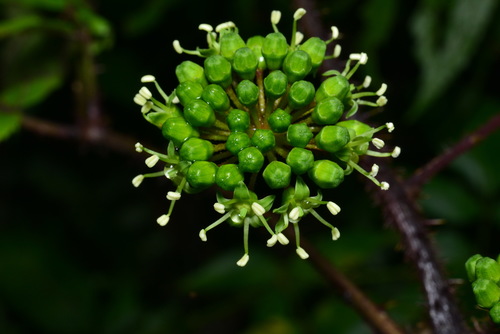
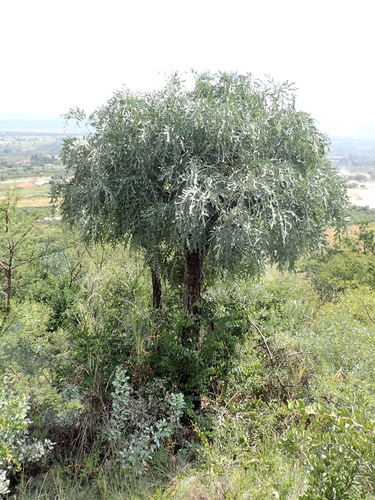
A small tree. It grows up to 5 m tall and has few branches. The trunk is rough, brown and corky. The bark is grey and cracked along its length. The trunk can be 60 cm across. The branches have prominent leaf scars. The leaves can be 60 cm across. They are made up of 7-9 leaflets arranged like a fan. The leaflets are entire and lobed. The form segments with constrictions between them. Each leaflet is 10-30 cm long by 2-6 cm wide. They are a pale blue-grey. The edges are toothed. The flowers are small and green. They occur in densely flowers spikes. These are 2.5-5 cm long. They are branched. The fruit is fleshy and 6 cm across. They are purple when mature.
How to Grow
Plants can be grown from cuttings. They can also be grown from fresh seeds.
Propagation: Seed - best sown as soon as possible because it loses much of its viability within 3 months. However, seed sown in summer months will germinate faster (in about 4 weeks) than seed sown in winter (7 weeks to germination). Sow the seed in seed trays in a semi-shaded position, ensuring at least 15cm depth of soil to allow the small tubers to form. Do not allow seed to become waterlogged or dry out. Seedlings can be transplanted at about 4 months, but be very careful not to damage the fleshy roots when transplanting. Plants can be grown from cuttings, but this is inadvisable because they do not make the proper, fleshy, underground rootstock that forms when plants are grown from seed
Medicinal Uses
The leaf is used ethnomedically to treat dysmenorrhea.
Other Uses
The wood is soft and light and was used for the brake-blocks of wagons.
Wikipedia
Source ↗Cussonia paniculata, also known as kiepersol, is a large evergreen shrub or small tree up to 5 metres (16 ft) in height native to South Africa. The plant has large and bold textured grey foliage.
Production
It is fairly slow growing.
Notes
There are 20 Cussonia species. They occur in South Africa.
Names & Synonyms
Bergkiepersol, Highveld Cabbage tree, Hoeveldse kiepersol, Motsetse, Umsenge
References (21)
- Barwick, M., 2004, Tropical and Subtropical Trees. A Worldwide Encyclopedic Guide. Thames and Hudson p 138
- Bodkin, F., 1991, Encyclopedia Botanica. Cornstalk publishing, p 308
- Cundall, P., (ed.), 2004, Gardening Australia: flora: the gardener's bible. ABC Books. p 447
- Enum. pl. afric. austral. 355. 1837
- Etherington, K., & Imwold, D., (Eds), 2001, Botanica's Trees & Shrubs. The illustrated A-Z of over 8500 trees and shrubs. Random House, Australia. p 247
- Fox, F. W. & Young, M. E. N., 1982, Food from the Veld. Delta Books. p 97
- Hibbert, M., 2002, The Aussie Plant Finder 2002, Florilegium. p 78
- Jardin, C., 1970, List of Foods Used In Africa, FAO Nutrition Information Document Series No 2.p 13
- Joffe, P., 2007, Creative Gardening with Indigenous Plants. A South African Guide. Briza. p 68
- Long, C., 2005, Swaziland's Flora - siSwati names and Uses http://www.sntc.org.sz/flora/ (As subsp. sinuata)
- Palgrave, K.C., 1996, Trees of Southern Africa. Struik Publishers. p 702
- Peters, C. R., O'Brien, E. M., and Drummond, R.B., 1992, Edible Wild plants of Sub-saharan Africa. Kew. p 61
- Royal Botanic Gardens, Kew (1999). Survey of Economic Plants for Arid and Semi-Arid Lands (SEPASAL) database. Published on the Internet; http://www.rbgkew.org.uk/ceb/sepasal/internet [Accessed 28th March 2011]
- Ruiters-Welcome, A. K., 2019, Food plants of southern Africa. Ph.D. thesis. Univ. of Johannesburg p 28
- Ryan, S., 2008, Dicksonia. Rare Plants Manual. Hyland House. p 20
- Swaziland's Flora Database http://www.sntc.org.sz/flora
- van Wyk, B, van Wyk, P, and van Wyk B., 2000, Photographic guide to Trees of Southern Africa. Briza. p 110
- van Wyk, Be., & Gericke, N., 2007, People's plants. A Guide to Useful Plants of Southern Africa. Briza. p 84
- Vinnicombe, 1976,
- Welcome, A. K. & Van Wyk, B.-E., 2019, An inventory and analysis of the food plants of southern Africa. South African Journal of Botany 122 (2019) 136–179
- World Checklist of Useful Plant Species 2020. Royal Botanic Gardens, Kew