Dombeya acutangula
Cav.
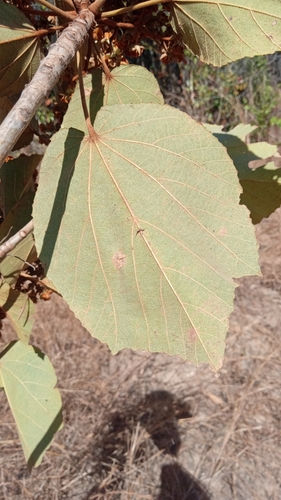
(c) David Rabehevitra, some rights reserved (CC BY-NC), uploaded by David Rabehevitra
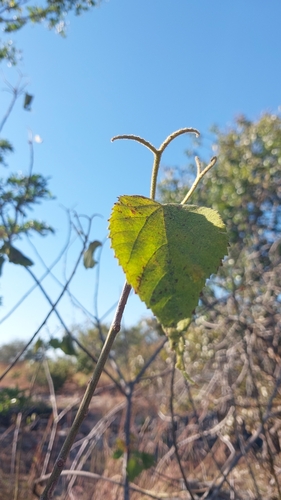
(c) nomentsoa, some rights reserved (CC BY-NC)
What to Eat
Edible parts: ?
Where to Find It
It is a tropical plant. It grows from sea level to 1,500 m above sea level.
Africa, Asia, Haiti, Laos, Madagascar, Malawi, Mauritius, Mozambique, Pakistan, Reunion, Rodrigues, SE Asia, Tanzania, Thailand, West Indies, Zambia,
How to Identify
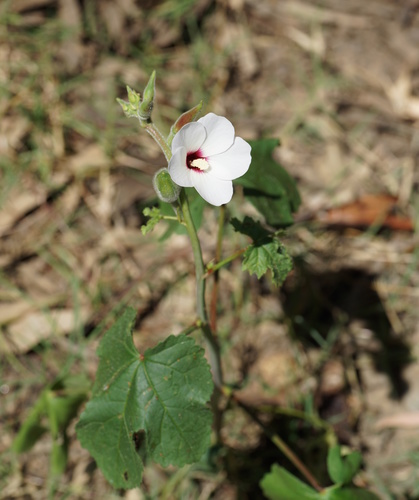
A shrub or small tree. The leaves are broadly oval and 6-16 cm long and wide. The base is heart shaped and there are teeth along the edge. They can have 3-5 lobes. The flowers are pinkish and 2-3 cm across. They are in small clusters. The fruit is oblong and 5 sided. They are 5-8 cm long by 3-4 mm wide.
How to Grow
In cultivation, species in this genus generally grow best in a moist but well-drained, fertile soil and a position in full sun or partial shade.
Propagation: Seed is very small but can be extracted from fully ripened, dry flower heads. Its viability declines within 3 months, so fresh seed has to be used for sowing. Seed is to be sown in properly drained seedbeds. Seedlings emerge in about 3 weeks. Cuttings of semi-ripe wood, preferably with some bottom heat to encourage rooting.
Medicinal Uses
The leaves are astringent. They are taken as an infusion, though the report is not specific regarding which ailments are treated, but it does say that they are little used at present. The leaves contain alkaloids and phenols..
Other Uses
A fibre obtained from the bark is used for cordage.
Wikipedia
Source ↗Dombeya acutangula, the bois bete or mahot tantan, is a species of flowering plant in the family Malvaceae. It is native to the Mascarene Islands (Mauritius, Réunion, and Rodrigues), and Madagascar, Malawi, Mozambique, Tanzania, and Zambia. It has charming pale (white or light pink) flowers in small clusters. On Mauritius it grows in forests from 300 to 500 meters elevation. It is almost extinct on the island due to habitat loss; some 50 plants remain in the wild, growing in a narrowly circumscribed area at Corps de garde, Trois Mamelles, Yemen, Magenta and Chamarel.
Notes
It has also been put in the family Sterculiaceae.
Names & Synonyms
Bois bete, Mahot tantan
References (1)
- World Checklist of Useful Plant Species 2020. Royal Botanic Gardens, Kew