Lithocarpus indutus
(Blume) Rehder
FagaceaeFruit

gbif · cc0
President and Fellows of Harvard College
President and Fellows of Harvard College

gbif · cc0
President and Fellows of Harvard College
President and Fellows of Harvard College

gbif · cc0
President and Fellows of Harvard College
President and Fellows of Harvard College
What to Eat
Edible parts: Fruit
The fruit is eaten.
Where to Find It
It is a tropical plant.
Asia, Indonesia, Malaysia, Philippines, SE Asia,
Countries: United Arab Emirates, Afghanistan, Armenia, Azerbaijan, Bangladesh, Bahrain, Brunei, Bhutan, China, Georgia, Indonesia, Israel, India, Iraq, Iran, Jordan, Japan, Kyrgyzstan, Cambodia, North Korea, South Korea, Kuwait, Kazakhstan, Laos, Lebanon, Sri Lanka, Myanmar, Mongolia, Maldives, Malaysia, Nepal, Oman, Philippines, Pakistan, Qatar, Saudi Arabia, Singapore, Syria, Thailand, Tajikistan, Timor-Leste, Turkmenistan, Turkey, Taiwan, Uzbekistan, Vietnam, Yemen
How to Identify
A tree. It grows 20-45 m tall. The trunk can be 50-150 cm across. The young branches have a grey brown coating. The leaves are simple and broad. They are 18-20 cm long by 7-9 cm wide.
Wikipedia
Source ↗Lithocarpus indutus is a species of plant in the family Fagaceae. Some common names it goes by are bataruwa, pasang bodas, and pasang balung. It is a tree endemic to Java in Indonesia. It is a vulnerable species threatened by habitat loss.
Names & Synonyms
Bataruwa, Pasang balung, Pasang bodas
Cyclobalanus induta (Blume) Oerst.Pasania induta (Blume) S. MooreQuercus induta BlumeQuercus induta var. microcarpa A. DC.Synaedrys induta (Blume) Koidz.
References (1)
- Suwardi, A. B., et al, 2020, Wild edible fruits generate substantial income for local people of the Gunung Leuser National Park, Aceh Tamiang Region. Ethnobotany Research & Applications 20:11
More from Fagaceae

Castanea alnifolia
Bush chinkapin, Florida chinkapin, Trailing chinkapin, Downy chinquapin

Castanea crenata
Japanese chestnut

Castanea dentata
American chestnut, American sweet chestnut

Castanea henryi
Zhui li, Conic chestnut
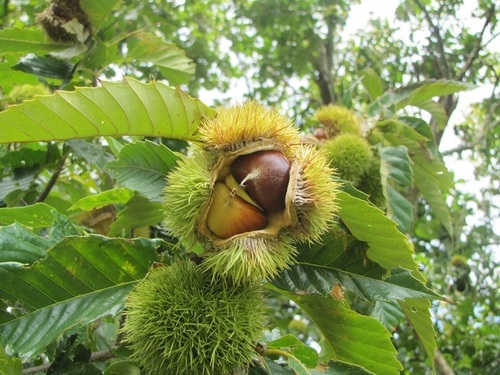
Castanea mollissima
Chinese chestnut

Castanea ozarkensis
Ozark chinkapin, Ozark chestnut