Cyathodes glauca
Labill.
Purple cheeseberry, Handsome cheeseberry

(c) Tindo2, some rights reserved (CC BY-NC)
(c) jsam0017, some rights reserved (CC BY-NC)
What to Eat
Edible parts: Fruit
The fruit can be eaten raw or cooked and has a sweet, mealy flesh.
Where to Find It
A warm temperate plant. A Tasmanian endemic plant. It suits cool places. It grows in hills and mountains. It needs well drained moist soil. It suits hardiness zones 8-10. Tasmanian Herbarium. Arboretum Tasmania. In Hobart Botanical gardens.
Australia*, Tasmania*,
How to Identify
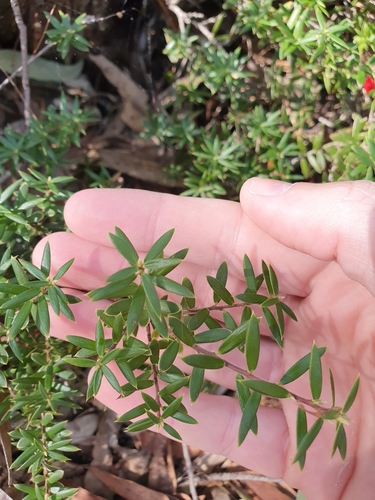
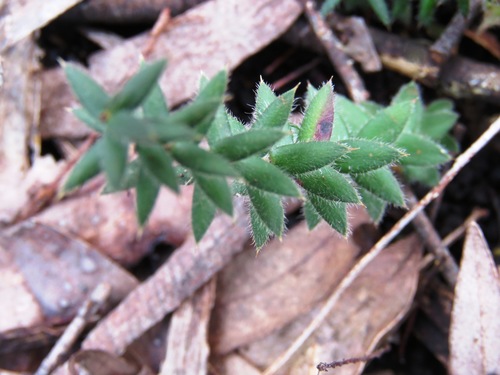
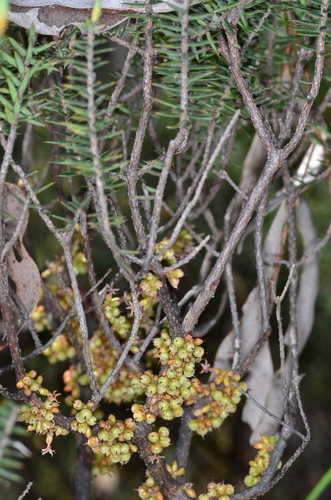
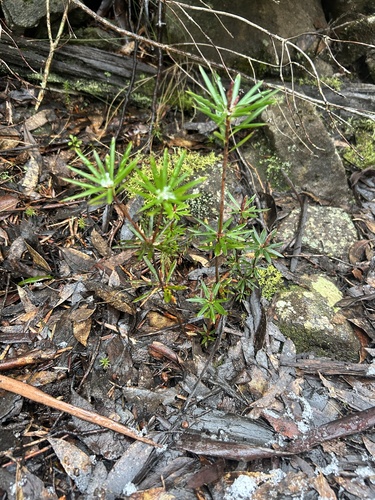
A small bush. It can be 1-2 m tall but can be 10 m tall when among other vegetation. The leaves are sword shaped. The leaves are 1.5-3 cm long by 0.3-0.5 cm wide. They are clustered in false rings. The flowers occur in clusters amongst the leaves. They are like tubes and 1 cm long. They are white and are at the tips of the branches. The fruit are red. They are flattened. They are 0.8 cm across. The fruit remain hanging on the plant.
How to Grow
Requires a moist well-drained lime-free humus rich soil in a sheltered site in partial or dappled shade. Plants are very susceptible to drought. A good rock garden plant. Slow growing. This species is not very hardy in Britain, though it might succeed outdoors in the mildest areas of the country. Otherwise it is best grown in a cold greenhouse. Plants are hardy to at least -7°c in Australian gardens though this cannot be translated directly to British gardens because of our cooler summers and longer, colder and wetter winters. Plants are said to grow best in areas with moderate winters and cool moist summers. Plants have very fine root systems and great care must be taken when transplanting them.
Propagation: Surface-sow in an ericaceous soil mix in February or March in a cold frame, without excluding light. Germination can occur within one to two months at 18°C but often takes three to five years. Scarification reduces germination time, and two or three cycles of four to six weeks of cold stratification alternated with four weeks of warm stratification can help; sowing seed as soon as it is ripe may also be beneficial. Seedlings are very slow to form roots and must be potted up with great care. Grow on in the greenhouse for at least their first two growing seasons, then plant into permanent positions in late spring or early summer. Cuttings of half-ripe wood can be taken in July or August in a frame, though neither easy nor reliable. Air layering is another option. Plants can also be divided as they come into growth in spring — it is best not to dig up the main clump but to tease out small, well-rooted divisions from the sides. Pot these up in light shade in a greenhouse, grow through their first summer under cover, and plant out in late spring after the last expected frosts.
Medicinal Uses
None known
Other Uses
None known
Wikipedia
Source ↗Cyathodes glauca, the purple cheeseberry, is a woody shrub or small tree common in Tasmania, Australia. It belongs to the heath family, Ericaceae. 'Heath' refers to open, shrub-like communities, which survive on well-drained and poor quality soils. The genus name Cyathodes is in reference to the flower, describing it as 'cup-shaped'. The specific epithet glauca is 'glaucous', which means bluish-grey or green, referring to the distinguishable, lighter colour on the underside of the leaves.
Production
Flowers occur from December to January.
Notes
There are about 15 Cyathodes species.
References (11)
- Bodkin, F., 1991, Encyclopedia Botanica. Cornstalk publishing, p 310
- Cochrane, G.R., et al, 1980, Flowers and Plants of Victoria and Tasmania. Reed. p 113
- Collier, P., 1993, Woodland Wild flowers of Tasmania. Plant Identikit. Society for growing Australian Plants Tasmania Region. Hobart. p 35
- Cundall, P., (ed.), 2004, Gardening Australia: flora: the gardener's bible. ABC Books. p 448
- Gilfedder, L et al, 2003, The Nature of the Midlands. Midlands Bushweb. PO Box 156 Longford, Tasmania. p 101
- Hibbert, M., 2002, The Aussie Plant Finder 2002, Florilegium. p 78
- Minchin, R.F., Tasmanian Wildflowers. A Field Guide. Volume one. Regal Publications, Launceston p 90
- Nov. Holl. pl. 1:57, t. 81. 1805
- Plants for a Future database, The Field, Penpol, Lostwithiel, Cornwall, PL22 0NG, UK. http://www.scs.leeds.ac.uk/pfaf/
- Tasmanian Herbarium Vascular Plants list p 25
- Whiting, J. et al, 2004, Tasmania's Natural Flora. Tasmania's Natural Flora Editorial Committee PO Box 194, Ulverstone, Tasmania, Australia 7315 p 110