Hypericum bellum
H. L. Li
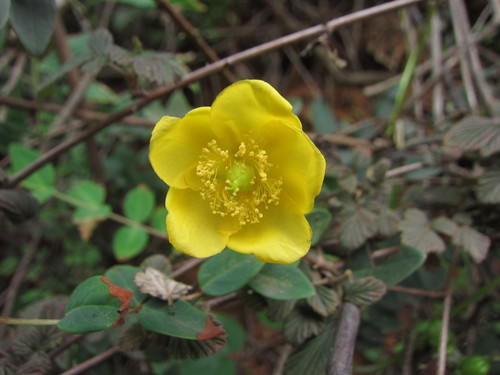
(c) sunwenhao90, some rights reserved (CC BY-NC), uploaded by sunwenhao90

Wikimedia Commons - Leonora Enking from West Sussex, England

Wikimedia Commons - Leonora (Ellie) Enking from East Preston, United Kingdom
What to Eat
Edible parts: Fruit
None known.
Where to Find It
It is a subtropical plant. It grows between 1,900-3,200 m above sea level. In Sichuan and Yunnan. It suits USDA hardiness zones 5-9.
Asia, China, Himalayas, India, Myanmar, SE Asia, Tibet,
How to Identify
A shrub. It grows 1 m tall. It is densely branched. The small branches are reddish. The leaves are oval and 1-4 cm long by 0.5-3 cm wide. The flowers are yellow.
How to Grow
Easily grown in any reasonably good well-drained but moisture retentive soil. Succeeds in sun or semi-shade but flowers better in a sunny position. Tolerates chalk. A very ornamental plant, it is hardy to about -10°c. Plants in this genus are notably resistant to honey fungus.
Propagation: Seed - sow in spring in a greenhouse, barely covering the seed. Germination usually occurs within 1–3 months at 10°C. Prick seedlings into individual pots when large enough to handle and grow on in a greenhouse for their first winter. Plant out in late spring or early summer after the last expected frosts. Cuttings of half-ripe wood, 10–12cm with a heel, taken in July/August in a frame; plant out the following spring. Careful division of old suckering shrubs during the dormant season is also possible.
Medicinal Uses
Used as a febrifuge and vermifuge, and also in the treatment of hepatitis, colds, dysentery, and dermatitis.
Other Uses
Makes a good ground cover.
Wikipedia
Source ↗Hypericum bellum is a species of flowering plant in the family Hypericaceae. It is a shrub known as mei li jin si tao in Chinese. It comes from the Sichuan, Xizang, and Yunnan regions of China, as well as India. It is a dense plant with downy leaves that grows up to a meter (39 inches) tall.
Names & Synonyms
Kor-ma-shing, Mei li jin si tao
References (1)
- Li, S., et al, 2020, Monpa, memory, and change: an ethnobotanical study of plant use in Mêdog County, South-east Tibet, China. Journal of Ethnobiology and Ethnomedicine. (2020) 16:5 p 19


