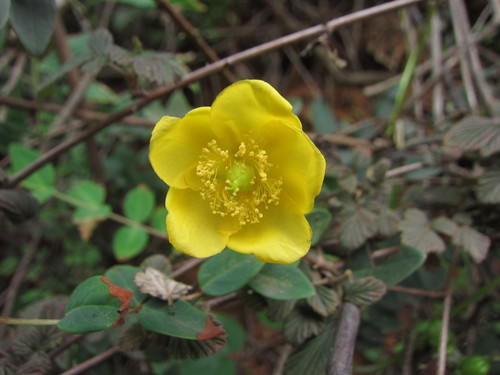
Hypericum erectum
Thunb.

(c) Svetlana Nesterova, some rights reserved (CC BY-NC), uploaded by Svetlana Nesterova

(c) Marco Mussita, some rights reserved (CC BY), uploaded by Marco Mussita
What to Eat
Edible parts: Leaves
Leaves and stems. No more details.
Where to Find It
E. Asia - China, Japan, Korea.
TEMPERATE ASIA: Russian Federation (Kurile Islands, Sakhalin), China (Anhui Sheng, Fujian Sheng, Guangdong Sheng, Guangxi Zhuangzu Zizhiqu, Guizhou Sheng, Hubei Sheng, Hunan Sheng, Jiangsu Sheng, Sichuan Sheng, Zhejiang Sheng), Japan (Hokkaidô, Honshu, Kyushu, Ryukyu Islands, Shikoku), Korea, South, Taiwan
How to Identify
Hypericum erectum is a PERENNIAL growing to 0.6 m (2ft). See above for USDA hardiness. It is hardy to UK zone 6. It is in flower from July to August, and the seeds ripen from August to September. The species is hermaphrodite (has both male and female organs) and is pollinated by Insects. The plant is self-fertile. Suitable for: light (sandy), medium (loamy) and heavy (clay) soils and prefers well-drained soil. Suitable pH: mildly acid, neutral and basic (mildly alkaline) soils. It can grow in semi-shade (light woodland) or no shade. It prefers moist soil.
How to Grow
Easily grown in any reasonably good well-drained but moisture retentive soil. Succeeds in sun or semi-shade but flowers better in a sunny position. One report says that the plant is vigorous but not quite hardy in Britain. This seems to be a mistake, other reports say that it is hardy to zone 6, tolerating winter temperatures down to -15°c or lower.
Propagation: Seed - sow spring in a greenhouse and only just cover the seed. Germination usually takes place within 1 - 3 months at 10°c. When they are large enough to handle, prick the seedlings out into individual pots and grow them on in the greenhouse for their first winter. Plant them out into their permanent positions in late spring or early summer, after the last expected frosts. Division in spring. Larger clumps can be replanted direct into their permanent positions, though it is best to pot up smaller clumps and grow them on in a cold frame until they are rooting well. Plant them out in the spring.
Medicinal Uses
Astringent Galactogogue. The leaves and flowering tops are galactogogue. The stems are rich in tannin and are used in the treatment of arthritis, lumbago, neuralgia and rheumatism.