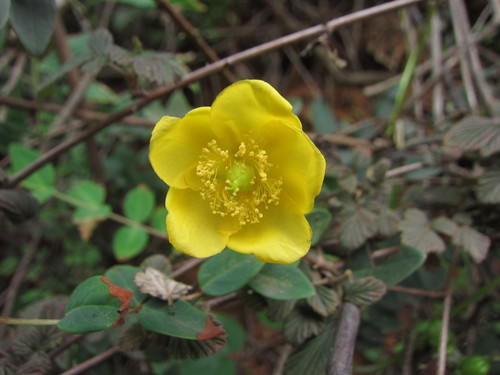
Hypericum ascyron
L.
Great Saint John's Wort

(c) Junichi HASHIMOTO, some rights reserved (CC BY-ND)

(c) nuphar, some rights reserved (CC BY-NC), uploaded by nuphar

(c) Chase Mathey, some rights reserved (CC BY-NC), uploaded by Chase Mathey
What to Eat
Edible parts: Leaves, Shoots
Tea. Young leaves, shoot tips and flowering buds - cooked. The leaves are a tea substitute.
Where to Find It
N. America - Quebec to Manitoba, south to Kansas, Iowa and Missouri. E. Asia.
TEMPERATE ASIA: Russian Federation (Buryatia, Gorno-Altay, Hakasija, Respublika, Tyva, Respublika, Altay, Krasnoyarsk, Chita, Irkutsk, Kemerovskaja oblast), Kazakhstan (east), Mongolia, Russian Federation (Kurile Islands, Habarovskij kraj, Primorye, Amur, Kamcatskij kraj, Sakhalin), China (Anhui Sheng, Fujian Sheng, Gansu Sheng, Guangdong Sheng, Guangxi Zhuangzu Zizhiqu, Guizhou Sheng, Hainan Sheng, Hebei Sheng, Heilongjiang Sheng, Henan Sheng, Hubei Sheng, Hunan Sheng, Jiangsu Sheng, Jiangxi Sheng, Jilin Sheng, Liaoning Sheng, Nei Mongol Zizhiqu, Ningxia Huizi Zizhiqu, Shaanxi Sheng, Shandong Sheng, Shanxi Sheng, Sichuan Sheng, Xinjiang Uygur Zizhiqu, Yunnan Sheng, Zhejiang Sheng), Korea, Japan (Hokkaidô, Honshu, Kyushu, Shikoku), Taiwan TROPICAL ASIA: Vietnam (north) NORTHERN AMERICA: Canada (Québec, Ontario), United States (Connecticut, Indiana, Maine, Massachusetts, Michigan, New Hampshire, New York, Ohio, Pennsylvania, Vermont, Illinois, Iowa, Minnesota, Wisconsin, Maryland)
How to Identify
Hypericum ascyron is a PERENNIAL growing to 1.5 m (5ft). See above for USDA hardiness. It is hardy to UK zone 3. It is in flower from July to August. The species is hermaphrodite (has both male and female organs) and is pollinated by Insects. The plant is self-fertile. Suitable for: light (sandy), medium (loamy) and heavy (clay) soils and prefers well-drained soil. Suitable pH: mildly acid, neutral and basic (mildly alkaline) soils. It can grow in semi-shade (light woodland) or no shade. It prefers moist soil.
How to Grow
Easily grown in any reasonably good well-drained but moisture retentive soil. Succeeds in sun or semi-shade but flowers better in a sunny position.
Propagation: Seed - sow spring in a greenhouse and only just cover the seed. The seed usually germinates in 1 - 3 months at 10°c. When they are large enough to handle, prick the seedlings out into individual pots and grow them on in the greenhouse for their first winter. Plant them out into their permanent positions in late spring or early summer, after the last expected frosts. Division in spring. Very easy, larger clumps can be replanted direct into their permanent positions, though it is best to pot up smaller clumps and grow them on in a cold frame until they are rooting well. Plant them out in the spring.
Medicinal Uses
Depurative Emmenagogue Febrifuge Poultice Stings VD Vulnerary. The fruit is emmenagogue and is also used to treat skin complaints and gonorrhoea. The whole plant is depurative, febrifuge, poultice and vulnerary. A decoction is used in the treatment of boils and abscesses, headaches and stomach ache and vomiting. The root is considered to be specific for use in treating the first stages of consumption. A powder made from the boiled root has been applied as a poultice to draw the poison out of a snake bite.