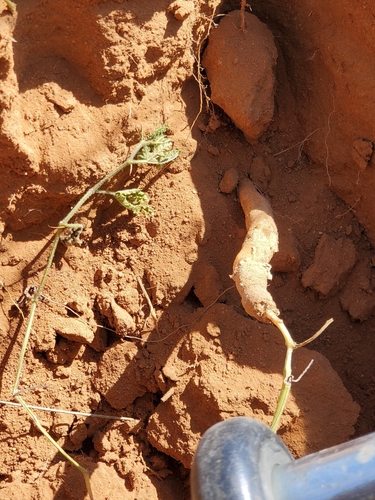
Cyclanthera pedata
(L.) Schrad.
Calabash gourd

(c) AnneTanne, some rights reserved (CC BY-NC-SA)

(c) Ombrosoparacloucycle, some rights reserved (CC BY-NC-SA)
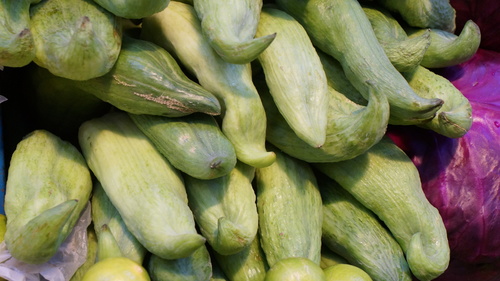
(c) danplant, some rights reserved (CC BY-NC), uploaded by danplant
What to Eat
Edible parts: Leaves, Fruit, Flowers, Vegetable
Young, immature fruits can be eaten raw or cooked and have a cucumber-like flavour, though without the crispness. Older fruits are cooked and can be stuffed in the same way as marrows — the large seed cavity makes them well suited to this, which may have inspired the local Spanish name pepino de rellenar ('stuffing cucumber'). Mature fruits are also cooked with oil and vinegar or added to soups and stews. The fruit measures roughly 6–15cm long and 6cm wide. Leaves and tender young shoots can be cooked and used as greens.
Where to Find It
A tropical plant. It occurs in the Andes. It can be grown in warm temperate places. In the tropics it grows between 2,000-3,000 m above sea level. They grow in Nepal to about 2500 m altitude. In Argentina it grows between 500-2,800 m above sea level. In Yunnan.
Africa, Andes*, Argentina, Asia, Bhutan, Bolivia, Brazil, Caribbean, Central America, China, Colombia, Costa Rica, East Africa, Ecuador, Guatemala, Himalayas, Honduras, India, Mexico, Nepal, Nicaragua, North America, Northeastern India, Panama, Peru, Philippines, Reunion, SE Asia, Sikkim, South America*, Tibet, Venezuela,
How to Identify
A creeping pumpkin family plant. It can easily grow 2 m long. It climbs using tendrils. These can be divided twice or many times. The leaves are lobed and have teeth along the edge. The flowers occur in the axils of leaves. The flowers are small and cream coloured. The fruit are like small cucumbers. They can have stout prickles. They are edible. There are 10 seeds in each fruit.
Nutrition Score: 12/100
| Part | Moisture | kJ | kcal | Protein | Vit A | Vit C | Iron | Zinc |
|---|---|---|---|---|---|---|---|---|
| Fruit | 94 | — | — | 0.6 | — | 14 | 0.8 | — |
How to Grow
Plants are grown from seed. A spacing of 90 cm is suitable. Plants should be staked.
Propagation: Sow seed in mid-spring in a rich compost in a warm greenhouse or warm sheltered spot. Place 2 or 3 seeds per pot and thin to the strongest seedling. Plant out after the last expected frost with protection such as a cloche until plants are growing well. A spacing of 90cm is appropriate, and plants should be staked.
Medicinal Uses
A tea made from the seeds is used to treat high blood pressure. The dried, powdered seeds are taken in 1-gram doses as a remedy for intestinal parasites, typically followed by a laxative to ensure the parasites are expelled. The seeds and fruits are recommended for gastrointestinal disorders. The fruits are diuretic and, when boiled in milk and gargled, serve as a treatment for tonsillitis. Fruit juice is recommended for high blood cholesterol, hypertension, tonsillitis, arteriosclerosis, circulatory problems, and diabetes. The fruits and leaves can be boiled in olive oil and applied externally as a topical anti-inflammatory and analgesic. The leaves are considered hypoglycaemic and prepared as a decoction for treating diabetes. Research in Peru has shown the plant can lower blood cholesterol in humans, with one trial showing an 18.3% reduction over 12 months and other trials showing even larger reductions.
Other Uses
The roots are used to clean the teeth.
Wikipedia
Source ↗Cyclanthera pedata, known as caigua, is a herbaceous vine grown for its edible fruit, which is predominantly used as a vegetable. It is known from cultivation only, and its use goes back many centuries as evidenced by ancient phytomorphic ceramics from Peru depicting the fruits.
Production
It flowers in 40-55 days and fruit can be harvested in 80-90 days. There are normally several harvests of fruit.
Other Information
It is a commercially cultivated vegetable.
Names & Synonyms
Achocha, Achokcha, Achoqcha, Achuccha, Acochca, Barela, Bottle gourd, Caiba, Caigua, Caihua, Caygua, Cayhua, Cayua, Kaikua, Korila, Lady's-slipper, Lamthabi, Meetha karela, Patal, Pepino de rellenar, Prickle cyclanthera, Slipper gourd, Stuffing cucumber
References (34)
- Bennett, B. C., 1990, Useful Plants of Amazonian Ecuador. US Agency for International Development. Fifth Progress Report. New York Botanical Gardens. p 40
- Castillo, R. O., 1995, Plant Genetic Resources in the Andes: Impact, Conservation, and Management. Crop Science 35:355-360
- Esquinas-Alcazar, et al, 1983, Genetic Resources of Cucurbitaceae. International Board of Plant Genetic Resources.
- Facciola, S., 1998, Cornucopia 2: a Source Book of Edible Plants. Kampong Publications, p 87
- FAO, 1993, Valor Nutritivo Y Usis en Alimantacion humana de Algunis Cultivos Autoctonos Subexplotados de Mesoamerica. FAO, Santiago, Chile. p 54
- Grubben, G. J. H. and Denton, O. A. (eds), 2004, Plant Resources of Tropical Africa 2. Vegetables. PROTA, Wageningen, Netherlands. p 277
- Hermandez Bermejo, J.E., and Leon, J. (Eds.), 1994, Neglected Crops. 1492 from a different perspective. FAO Plant Production and Protection Series No 26. FAO, Rome. p18
- Ind. sem. hort. acad. goetting. 1831; Linnaea 8: Litt. 23. 1833
- Kays, S. J., and Dias, J. C. S., 1995, Common Names of Commercially Cultivated Vegetables of the World in 15 languages. Economic Botany, Vol. 49, No. 2, pp. 115-152
- Kermath, B. M., et al, 2014, Food Plants in the Americas: A survey of the domesticated, cultivated and wild plants used for Human food in North, Central and South America and the Caribbean. On line draft. p 288
- Kew Plants of the World Online
- Kiple, K.F. & Ornelas, K.C., (eds), 2000, The Cambridge World History of Food. CUP p 1797
- Konsam, S., et al, 2016, Assessment of wild leafy vegetables traditionally consumed by the ethnic communities of Manipur, northeast India. Journal of Ethnobiology and Ethnomedicine, 12:9
- Kuhnlein, H. V., et al, 2009, Indigenous Peoples' food systems. FAO Rome p 82
- Macbride, J. F., 1937, Flora of Peru. Vol. 8, Part 6 No. 2 p 372
- Manandhar, N.P., 2002, Plants and People of Nepal. Timber Press. Portland, Oregon. p 182
- Martin, F.W. & Ruberte, R.M., 1979, Edible Leaves of the Tropics. Antillian College Press, Mayaguez, Puerto Rico. p 189
- Medhi, P. & Borthakur, S. K., 2012, Phytoresources from North Cachur Hills of Assam -3: Edible plants sold at Hflong market. Indian Journal or Natural Products and Resources. 3(1) pp 84-109
- Plants for a Future database, The Field, Penpol, Lostwithiel, Cornwall, PL22 0NG, UK. http://www.scs.leeds.ac.uk/pfaf/
- Purseglove, J.W., 1968, Tropical Crops Dicotyledons, Longmans. p 100
- Roa, J. A. G. & Boada, D. S. G., 2018, Fundación para el Fortalecimiento de la Fruticultura y Plantas Alimenticias no Convencionales en Colombia.
- Sharma, B.B., 2005, Growing fruits and vegetables. Publications Division. Ministry of Information and broadcasting. India. p 187
- Smith, N., Mori, S.A., et al, 2004, Flowering Plants of the Neotropics. Princeton. p 121
- Tapia, M. E., The role of under-utilised plant species with regard to increased food security and improved health of poor poeople, in mountain regions. IIAP-PNUD/Peru
- Terra, G.J.A., 1973, Tropical Vegetables. Communication 54e Royal Tropical Institute, Amsterdam, p 43
- Torre, de la, L., et al, 2008, Enciclopedia de las Plantas Útiles del Ecuador. Herbario QCA. Pontificia Universidad Católica del Ecuador. p 299
- USDA, ARS, National Genetic Resources Program. Germplasm Resources Information Network - (GRIN). [Online Database] National Germplasm Resources Laboratory, Beltsville, Maryland. Available: www.ars-grin.gov/cgi-bin/npgs/html/econ.pl (10 April 2000)
- Vael, L., 2015, Ethnobotanical study of the plant use in the natural landscape of two mestizo communities in the Ucayali region of the Peruvian Amazon. Universiteit Gent.
- van Wyk, B., 2005, Food Plants of the World. An illustrated guide. Timber press. p 160
- Vasquez, R. and Gentry, A. H., 1989, Use and Misuse of Forest-harvested Fruits in the Iquitos Area. Conservation Biology 3(4): 350f
- Walters, T. W., 1989, Historical Overview on Domesticated Plants in China with Special Emphasis on the Cucurbitaceae. Economic Botany 43(3): 297-313
- Wiersema, J. H. & Leon, B., 2013, World Economic Plants. A Standard Reference CRC Press. 2nd Ed. p 223
- World Checklist of Useful Plant Species 2020. Royal Botanic Gardens, Kew
- Yang, Si-Lin and Walters, T. W., 1992, Ethnobotany and the Economic role of the Cucurbitaceae of China. Economic Botany, Vol. 46, No. 4, pp. 349-367