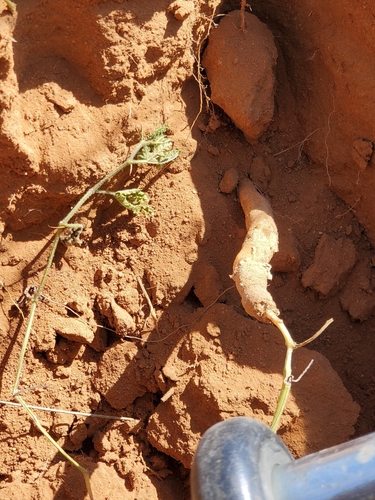
Gomphogyne cissiformis
Griffith

Wikimedia Commons (via Wikimedia Commons)
What to Eat
Edible parts: Fruit
The fruit are eaten.
Where to Find It
It is a subtropical plant. It grows in the mountains between 2,100-2,800 m above sea level.
Asia, Bhutan, China, India, Nepal, Northeastern India,
How to Identify
A pumpkin family herb. The stems can be slightly hairy. The leaves have leaflets. The middle leaflet is 4-6 cm long by 1.5-2 cm wide. The side leaflets are shorter. The fruit are pale green and shaped like a top. They are 12-16 mm long by 8-11 mm wide.
Nutrition Score: 28/100
| Part | Moisture | kJ | kcal | Protein | Vit A | Vit C | Iron | Zinc |
|---|---|---|---|---|---|---|---|---|
| Fruit | 96.1 | 361 | — | 18.8 | — | — | 0.1 | 0.2 |
Wikipedia
Source ↗Gomphogyne cissiformis is a species of flowering plant in the family Cucurbitaceae, native to the Himalayas, Assam, Yunnan, and Vietnam. A climber, it is typically found in mountain forests, at elevations from 2,100 to 2,800 m (6,900 to 9,200 ft). Its fruit is edible and is collected in the wild by local peoples.
Names & Synonyms
Zhui xing guo
References (2)
- Flora of China
- Seal, T., et al, 2014, Nutritional potential of wild edible fruits traditionally used by the local people of Meghalaya state in India. Indian Journal of Natural Products and Resources. Vol. 5(4) December 2014 pp. 359-364