Quercus kerrii
Craib
(c) Wangworn Sankamethawee, some rights reserved (CC BY-NC), uploaded by Wangworn Sankamethawee

(c) Wangworn Sankamethawee, some rights reserved (CC BY-NC), uploaded by Wangworn Sankamethawee
(c) 呂一起(Lu i-chi), some rights reserved (CC BY), uploaded by 呂一起(Lu i-chi)
What to Eat
Edible parts: Fruit, Acorn, Seed
The fruit (the acorn) is edible in the cooked state. The oblate seed is 7 - 12mm long and 20 - 28mm wide. The seed is usually cooked before eating, though it can also be eaten raw. It can be eaten whole, though it is more commonly dried, then ground into a powder and used as a thickening in stews etc or mixed with cereals for making bread. In some species, especially many of those classified as 'white oaks', the seeds are low in tannins and have a more or less sweet and agreeable flavour. The seed of most species, however, have a very bitter flavour, due especially to the presence of tannins. In these species there are various processes that can remove or at least reduce the amount of these bitter substances (although other water-soluble substances, including some minerals, will also be removed). Tannins are water-soluble and therefore the easiest way to remove or reduce tannin levels is by soaking in water. A few different methods are listed:- A traditional method of preparing the seed was to bury it in boggy ground overwinter and allow the wet soil to gradually leach the tannins. The germinating seed was dug up in the spring when it would have lost most of its astringency and bitterness. Another method was to wrap the seeds in a cloth bag and place them in a stream for several weeks. Drying the seed and grinding it to a powder before soaking speeds up the process. The fastest method is to use hot water, by cooking the powder and changing the water several times until the cooking water is no longer bitter. Alternatively, you can use cold water (which is reported to produce the best quality flour). In this case, you soak the powdered seed in cold water for 12 - 24 hours then discard the water. Repeat this process for a number of times until the soak water is no longer bitter. The roasted seed of many Quercus species has been used as a coffee substitute.
Known Hazards
Where to Find It
It is a tropical plant. It grows between 100-1,800 m above sea level in southern China.
Asia, Bangladesh, Cambodia, China, Laos, Myanmar, SE Asia, Thailand, Vietnam,
How to Identify
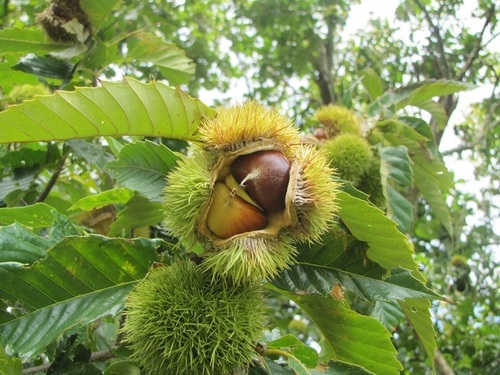
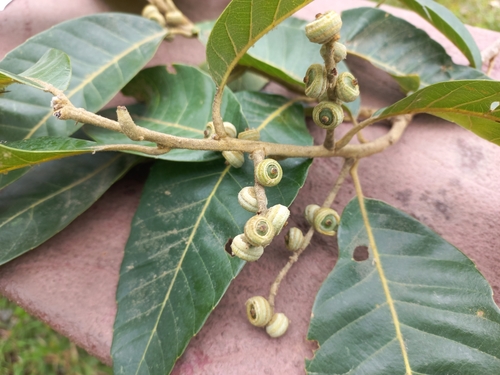
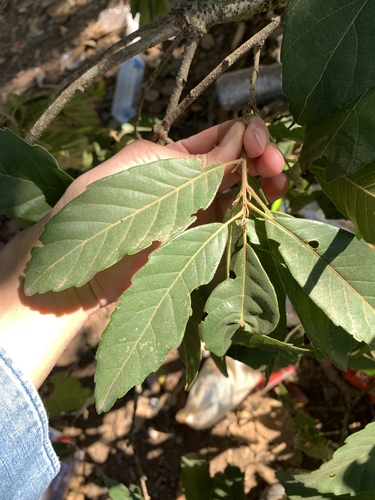
A tree. It loses its leaves during the year. It grows 15-40 m tall. The trunk has buttresses near the base. The seed or acorn is 7-12 mm long by 20-28 mm wide.
How to Grow
Plants can be grown from fresh seed. It does not transplant easily so is best sown in its final location.
Propagation: Seed - it quickly loses viability if it is allowed to dry out. It can be stored moist and cool, but is best sown as soon as it is ripe in an outdoor seed bed, though it must be protected from mice, squirrels etc. Small quantities of seed can be sown in deep pots in a cold frame. Plants produce a deep taproot and need to be planted out into their permanent positions as soon as possible, in fact seed sown in situ will produce the best trees. Trees should not be left in a nursery bed for more than 2 growing seasons without being moved or they will transplant very badly.
Medicinal Uses
The cooked acorns are edible. The seeds are usually cooked before being eaten, although they can also be eaten raw. The seeds also can be eaten in whole, but is more likely to be dried, grounded into a powder, and added to stews or cereals. The roasted seeds of many Quercus species have been used as a coffee substitute. Extracts of this species are used to heal cuts. It can be used to treat toothache and gum problems. It is also used as an infusion to treat acute diarrhea, dysentery and haemorrhages. It produces oak galls, which are used as rich source of tannin and dyestuff which is used by many cultures to make ink. The pale yellow wood is used for constriction and fuel.
Other Uses
The leaves of most species in this genus are more or less rich in tannins. A mulch of the partially decayed leaves can be placed around vulnerable plants in order to repel slugs, snails, grubs etc, and these will in time break down to add humus and nutrients to the soil. Fresh leaves should be used with caution, however, since as these decay they utilize some of the nitrogen in the soil and thus can inhibit plant growth.. Oak galls are excrescences that are sometimes produced in great numbers on the tree and are caused by the activity of the larvae of different insects. The insects live inside these galls, obtaining their nutrient therein. When the insect pupates and leaves, the gall can be used as a rich source of tannin, that can also be used as a dyestuff and is also used by many cultures to make ink. The bark of oak trees is also usually rich in tannins and can be used as a dyestuff and for waterproofing rope. The wood is pale yellow. It is used in construction. The wood is used for fuel.
Wikipedia
Source ↗Quercus kerrii is an uncommon Asian species of tree in the family Fagaceae. It is native to Thailand and Vietnam. There are also populations in southern China that according to some authors belong to Q. kerrii but considered by others to belong to a different species, Q. helferiana. Quercus kerrii is placed in subgenus Cerris, section Cyclobalanopsis. Its Chinese name is mao ye qing gang.
Names & Synonyms
References (1)
- Ferns, Useful Tropical Plants
More from Fagaceae