Davidsonia sp.
What to Eat
The berries are edible.
Where to Find It
Fruit,
How to Identify
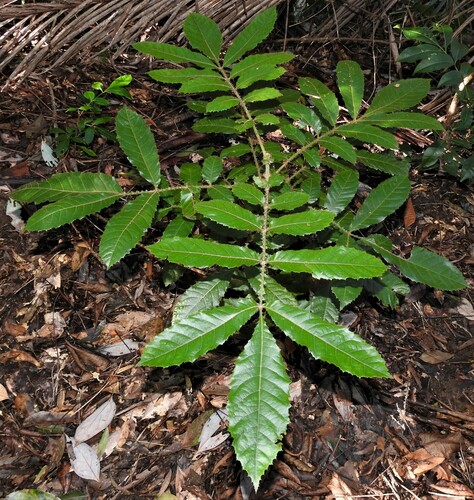
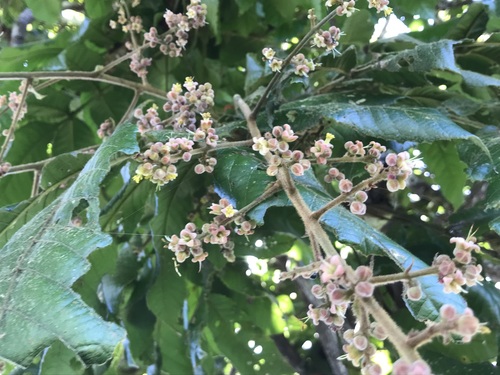
A tall shrub 6–8 m high with a spread of 2–3 m, native to the Cunoniaceae family. It has grayish-brown, somewhat flaky bark, alternate compound leaves 20–30 cm long divided into 5–9 oval or sword-shaped leaflets with sharp irregular teeth. Hanging flower panicles produce purplish-black berries 3–4 cm long and 4.5–5 cm wide with bright red, juicy interior.
How to Grow
It can be grown from suckers.
Other Information
Cunoniaceae
Notes
A tall shrub 6-8 m high. It spreads 2-3 m wide. It forms suckers. The bark is greyish-brown and somewhat flaky. The leaves are 20-30 cm long and divided into leaflets along the stalk. They are alternate. There are 5-9 leaflets and these are 7-20 cm long by 3-6 cm wide. They are oval or sword shaped. They have irregular sharp teeth along the edge. The flower panicles are 8-15 cm long. They hang down. The flowers are 0.6 cm across and red or pink. The fruit is a berry 3-4 cm long and 4.5-5 cm wide. It is purplish-black. It has short brown hairs. It is bright red and juicy inside. There are 2 flat seeds. The fruit are edible.
Names & Synonyms
References (2)
- Elliot, W.R., & Jones, D.L., 1984, Encyclopedia of Australian Plants suitable for cultivation. Vol 3. Lothian. p 200
- Lyle, S., 2006, Discovering fruit and nuts. Land Links. p 178