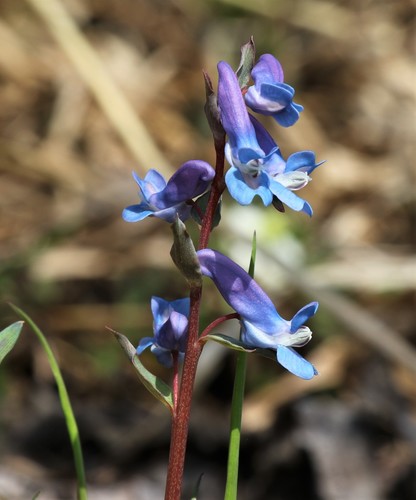
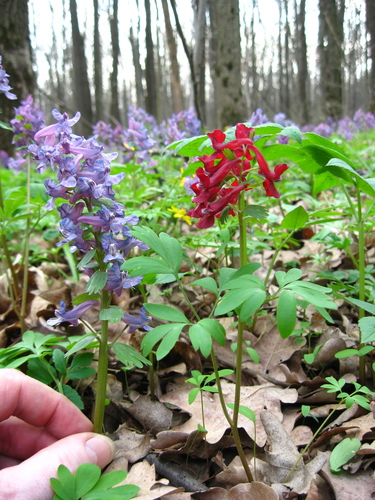
Dicentra canadensis
(Goldie) Walp.
Squirrel corn

(c) Mark Eanes, some rights reserved (CC BY), uploaded by Mark Eanes

(c) ponddweller, some rights reserved (CC BY-NC)
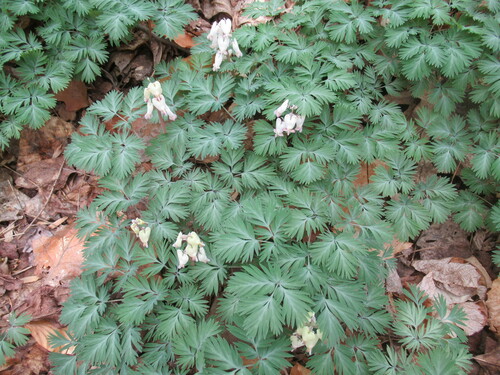
(c) Carol Mullen, some rights reserved (CC BY-NC), uploaded by Carol Mullen
What to Eat
Edible parts: Root, Caution
The root is edible, though no further details are available.
Where to Find It
It is best in rich, well-drained soils. It needs an open sunny position. It is resistant to frost but damaged by drought.
Asia, Australia, Europe, India, North America, Turkey, Türkiye, USA*,
How to Identify
A plant that keeps growing from year to year. It grows 25 cm high and spreads 30 cm wide. It develops tubers. The stems are slender and arch over. The leaves are divided along the stalk into a number of lobes. The leaflets are wedge shaped. The flowers are greenish-white and have purple tinges. They are heart shaped and hang down.
How to Grow
It is grown from seeds.
Propagation: Seed: best sown as soon as ripe in a cold frame; stored seed should be sown in early spring. Germination typically takes 1–6 months at 15°C. Two weeks of warm stratification at 18°C followed by six weeks at 2°C can shorten germination time. Prick out into individual pots when large enough and grow on in the greenhouse through the first winter, then plant out in late spring or early summer after the last expected frosts. Division in early spring — larger clumps can go directly into permanent positions, though it is better to pot up smaller clumps in a cold frame until rooting well, then plant out in spring. Root cuttings 7–10cm long can be taken and placed in sandy soil in a cold frame.
Medicinal Uses
The dried tubers are alterative, diuretic, and tonic. They are used in the treatment of chronic cutaneous conditions, syphilis, scrofula, and some menstrual complaints.
Other Uses
No other uses are known for this plant.
Wikipedia
Source ↗Dicentra canadensis, the squirrel corn, is a flowering plant from eastern North America with oddly shaped white flowers and finely divided leaves.
Notes
There are about 20 Dicentra species. These have previously been in the Fumaraceae.
References (5)
- Ambasta, S.P. (Ed.), 2000, The Useful Plants of India. CSIR India. p 169
- Beckstrom-Sternberg, Stephen M., and James A. Duke. "The Foodplant Database." http://probe.nalusda.gov:8300/cgi-bin/browse/foodplantdb.(ACEDB version 4.0 - data version July 1994)
- Bodkin, F., 1991, Encyclopedia Botanica. Cornstalk publishing, p 338
- Plants for a Future database, The Field, Penpol, Lostwithiel, Cornwall, PL22 0NG, UK. http://www.scs.leeds.ac.uk/pfaf/
- Repert. bot. syst. 1:118. 1842