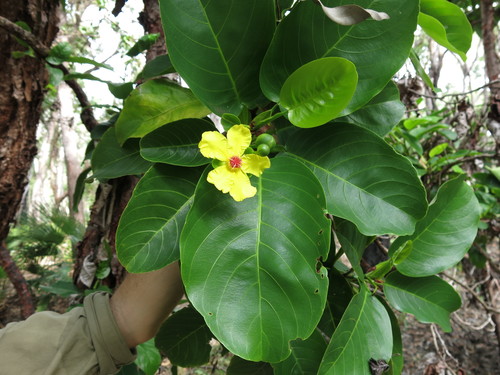
Dillenia serrata
Thunb.
Dengilo

(c) Andi Siady Hamzah, some rights reserved (CC BY-NC), uploaded by Andi Siady Hamzah

Wikimedia Commons - KlutzyKarenAnimations

President and Fellows of Harvard College
What to Eat
Edible parts: Fruit
Fruit - raw. A sweetish, acid flavour. It can be used fresh, or pickled as a substitute for lemons. The fruit is about the size of an orange. The berry-like fruit is about 35mm long and 60mm in diameter.
Where to Find It
A tropical plant. It grows in primary forest up to 200 m above sea level.
Asia, Indonesia*, Malaysia, SE Asia,
How to Identify
A tree. It grows 30 m high. The trunk is 70 cm across. The leaves are sword shaped and 20-45 cm long by 8-19 cm wide. There are wings on the leaf stalks. The flowers are 7.5 cm across. The fruit are the size of an orange. They are flattened and 3.5 cm high by 6 cm wide. There can be 5 seeds. The seeds are black.
Other Uses
The wood is used in boat making.
Wikipedia
Source ↗Dillenia serrata is a plant species in the Dilleniaceae family. They are native to countries in South and South-East Asia. They commonly go by the name, elephant apple, similar to most other species in the Dillenia genus.
Notes
There are about 60 Dillenia species.
Names & Synonyms
Dongi, Menampa
References (4)
- Hedrick, U.P., 1919, (Ed.), Sturtevant's edible plants of the world. p 271
- Mead, D., 2014, Types of 'dillenia' on Sulawesi. Sulawesi Language Alliance.
- PROSEA (Plant Resources of South East Asia) handbook, Volume 2, 1991, Edible fruits and nuts.
- World Checklist of Useful Plant Species 2020. Royal Botanic Gardens, Kew