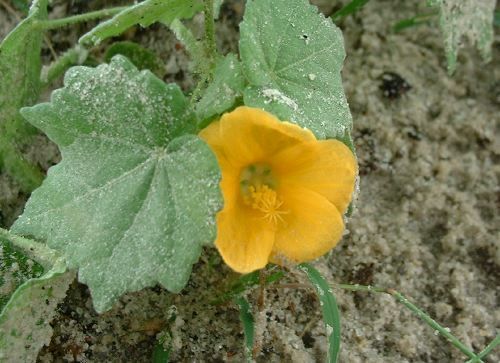
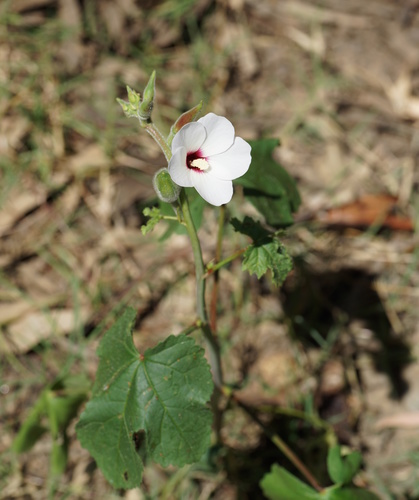
Diplodiscus paniculatus
Turcz.
Calobo, Balubo, Balobo, Barobo

Wikimedia Commons - JDipterocarpus

Wikimedia Commons - JDipterocarpus

President and Fellows of Harvard College
What to Eat
Edible parts: Fruit, Seeds
The seed kernels are boiled or roasted and eaten. Seeds are rich in starch.
Where to Find It
A tropical plant. They are very common and widely distributed in the Philippines in the forests from northern Luzon to southern Mindanao at low and medium altitudes.
Asia, Pacific, Philippines*, SE Asia,
How to Identify
A medium sized tree. It grows 20 m high. The trunk can be 80 cm across. It is an irregular shape and has buttresses at the base. The leaves are alternate. They are smooth and pointed at both ends. The flowers are small and whitish or yellow. They are borne in large compound flower arrangements. The fruit is an almost round capsule. It is 2 cm across. There are ridges along it. The fruit are yellowish when ripe. The seeds are rich in starch.
Other Uses
The bark is used for making rope. The wood is used for light construction and household utensils.
Wikipedia
Source ↗Diplodiscus paniculatus is a species of flowering plant in the family Malvaceae sensu lato or Tiliaceae. It is found only in the Philippines. It is threatened by habitat loss.
Notes
The family may be Tiliaceae. Also put in the family Brownlowiaceae.
Names & Synonyms
Baroba
References (12)
- Brown, W.H., 1920, Wild Food Plants of the Philippines. Bureau of Forestry Bulletin No. 21 Manila. p 110
- Bull. Soc. Imp. Naturalistes Moscou 31(1):235. 1858
- Carig, Elizabeth T., 2020, Guidebook on Native Trees within the Quirino Forest Landscape. Plaridel, Bulacan, St. Andrew Publishing House. p 32
- Coronel, R.E., 1982, Fruit Collections in the Philippines. IBPGR Newsletter p 6
- Davis, S.D., Heywood, V.H., & Hamilton, A.C. (eds), 1994, Centres of plant Diversity. WWF. Vol 1 or 2. p 388
- Ferns, Useful Tropical Plants
- Lugod, G.C. and de Padua L.S., 1979, Wild Food Plants in the Philippines. Vol. 1. Univ. of Philippines Los Banos. p 74
- Menninger, E.A., 1977, Edible Nuts of the World. Horticultural Books. Florida p 116
- Monsalud, M.R., Tongacan, A.L., Lopez, F.R., & Lagrimas, M.Q., 1966, Edible Wild Plants in Philippine Forests. Philippine Journal of Science. p 550
- Verheij, E. W. M. and Coronel, R.E., (Eds.), 1991, Plant Resources of South-East Asia. PROSEA No 2. Edible fruits and nuts. Pudoc Wageningen. p 329
- Wickens, G.E., 1995, Edible Nuts. FAO Non-wood forest products. FAO, Rome. p157
- World Checklist of Useful Plant Species 2020. Royal Botanic Gardens, Kew