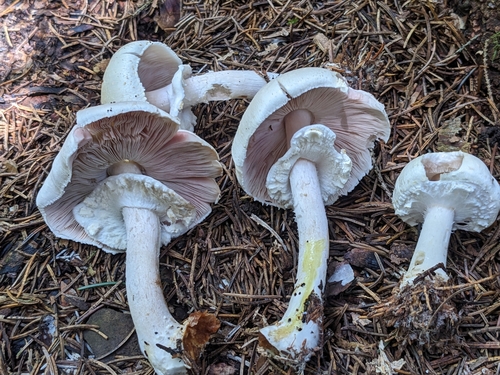
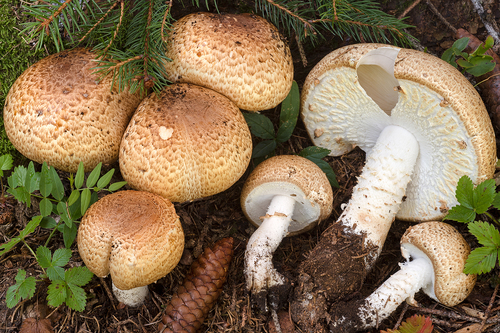
Agaricus bisporus
(J. E. Lange) Imbach
Meadow mushroom, Button mushroom, Champignon

This image was created by user I. G. Safonov (IGSafonov) at Mushroom Observer, a source for mycological images.You can contact this user here. (via Wikimedia Commons)

Takeaway (via Wikimedia Commons)

Wikimedia Commons (via Wikimedia Commons)

(c) Adam J. Searcy, some rights reserved (CC BY), uploaded by Adam J. Searcy

(c) pavel ivashkov, some rights reserved (CC BY-NC-SA)

(c) Christian Schwarz, some rights reserved (CC BY-NC), uploaded by Christian Schwarz
What to Eat
Edible parts: Mushroom, Herb, Spice, Fungus, Vegetable
The fruiting bodies are eaten fresh in salads, sauces, stews, and gravies. They are commonly sautéed, stuffed, marinated, and fried.
Where to Find It
It grows in most temperate regions.
Africa, Armenia, Asia, Australia, Benin, Britain, Bulgaria, Caucasus, Central America, Central Asia, China, Denmark, East Africa, Europe, France, Guatemala, Himalayas, Hong Kong, India, Iraq, Italy, Korea, Kyrgyzstan, Madagascar, Malawi, Malaysia, Mediterranean, Mexico, Middle East, Morocco, Nepal, North Africa, North America, Norway, Palestine, Poland, Scandinavia, SE Asia, Spain, Tanzania, Tasmania, Turkey, Türkiye, USA, West Africa,
How to Identify
A mushroom in the Agaricaceae family that grows in most temperate regions and is widely sold in local markets.
Nutrition Score: 23/100
| Part | Moisture | kJ | kcal | Protein | Vit A | Vit C | Iron | Zinc |
|---|---|---|---|---|---|---|---|---|
| Flesh + Stem raw | 91.5 | 53 | 13 | 1.8 | 30 | 3 | 1 | 0.1 |
Wikipedia
Source ↗Agaricus bisporus, commonly known as the cultivated mushroom, is a basidiomycete mushroom native to grasslands in Eurasia and North America. It is cultivated in more than 70 countries and is one of the most commonly and widely consumed mushrooms in the world. It has two color states while immature – white and brown – both of which have various names, with additional names for the mature state, such as chestnut, portobello, portabellini, button, cremini, and champignon de Paris. Some poisonous lookalikes in the wild, such as Entoloma sinuatum, may appear similar. Agaricus bisporus often grows in rich soil and compost.
Other Information
It is sold in local markets.
Notes
There are about 300 Agaricus species.
Names & Synonyms
Gobre, Gobryauu, Hara take, Mashirumu, Seta, Shuangbao mogu, Yang gu
References (28)
- Aziz, F. H. & Toma, F. M., 2012, First Observations on the Mushroom in Mountain Area of Iraqi Kurdistan Region. Journal of Advanced Laboratory Research in Biology 3(4)
- Boa, E. R., Wild edible fungi and their importance to people. FAO Non Wood Forest Products Booklet 17
- Buyck, B., 2008, The Edible Mushrooms of Madagascar: An Evolving Enigma. Economic Botany 62(3) pp. 509-520
- Chin, H. F., 1999, Malaysian Vegetables in Colour. Tropical Press. p 106
- Cribb, A.B. & J.W., 1976, Wild Food in Australia, Fontana. p 198
- Devkota, S., 2008, Distribution and Status of Highland mushrooms: A study from Dolpa, Nepal. J.Nat.Hist.Mus.Vol.23,2008, 51-59
- Dongol, et al, 1995, Edible Mushrooms in Nepal
- Facciola, S., 1998, Cornucopia 2: a Source Book of Edible Plants. Kampong Publications, p 249
- Hall, I. R., et al, 2003, Edible and Poisonous Mushrooms of the World. Timber Press. p 313
- Hinnawi, N. S. A., 2010, An ethnobotanical study of wild edible plants in the Northern West Bank "Palestine". An-Najah National University. p 96
- Hu, Shiu-ying, 2005, Food Plants of China. The Chinese University Press. p 266
- Jordan, P., 2000, The Mushroom Guide and Identifier, Hermes House, p 29
- Kasper-Pakosz, R., et al, 2016, Wild and native plants and mushrooms sold in the open-air markets of south- eastern Poland. Journal of Ethnobiology and Ethnomedicine 12:45
- Kaufmann, B. et al, 1999, The Great Encyclopedia of Mushrooms. Konemann. p 163
- Kiple, K.F. & Ornelas, K.C., (eds), 2000, The Cambridge World History of Food. CUP p 318, 1818
- Kumar, R. & Saikia, P., 2020, Wild edible plants of Jharkhand and their utilitarian perspectives. Indian Journal of Traditional Knowledge Vol 19 (2), April 2020, pp 237-250
- Kybal, J., 1980, Herbs and Spices, A Hamlyn Colour Guide, Hamlyn Sydney. p 18
- Latiff, A. et al, 1996, Distribution of minerals in the pileus and stalk of some selected edible mushrooms. Food Chemistry 56 (2): 115-121
- Mulherin, J., 1994, Spices and natural flavourings. Tiger Books, London. p 59
- Nanagulyan, S., et al, 2020, Wild plants and fungi sold in the markets of Yerevan (Armenia). Journal of Ethnobiology and Ethnomedicine 16:26
- Pace, G., 1998, Mushrooms of the world. Firefly books. p 43 (As Psalliota bispora)
- Prafulla, S., 2017, Wild Food Diversity of Nawegaon-Nagzira Tiger Reserve in Gondia-Bhandara district of Maharashtra, India. Int. J. of Life Sciences, 2017, Vol. 5 (4): 620-626
- Schneider, E., 2001, Vegetables from Amaranth to Zucchini: The essential reference. HarperCollins. p 221
- Stoyneva-Gartner, M.P. & Uzunov, B.A., 2015, An Ethnobiological Glance on Globalization Impact on the Traditional Use of Algae and Fungi as Food in Bulgaria. J Nutr Food Sci 2015, 5:5
- Sunrinrut, P. et al, 1987, Protein, amino acids and some major and trace elements in Thai and Norwegian mushrooms. Plant Foods for Human Nutrition. 37:117-125
- Thatoi, H. & Singdevsachan, S. K., 2014, Diversity, nutritional composition and medicinal potential of Indian mushrooms: A review. Afr. J. Biotechnol. Vol. 13(4), pp. 523-545
- Tibuhwa, 2013, Wild Mushroom - an underutilized healthy food resource and income generator: experience from Tanzania rural areas. Journal of Ethnobiology and Ethnomedicine 9:49
- Yildiz, A et al, 2005, Organic elements and protein in some macrofungi of south east Anatolia in Turkey. Food Chemistry 89: 605-609