Elaeis oleifera
(Kunth) Cortés
American oil palm
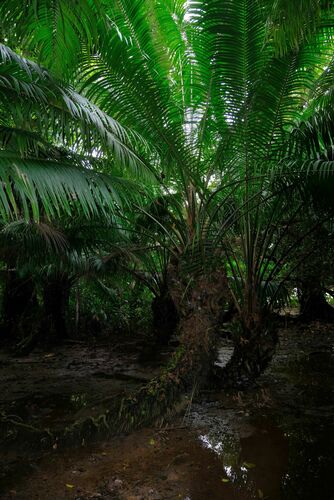
(c) Nick Helme, some rights reserved (CC BY-NC), uploaded by Nick Helme
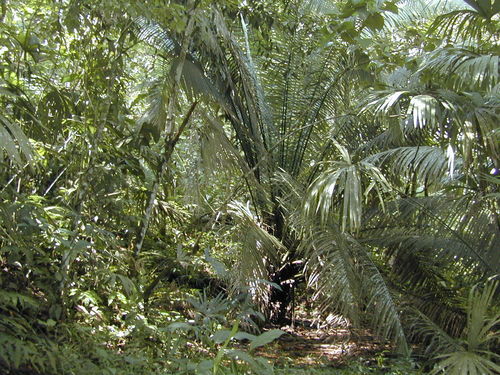
(c) Jens-Christian Svenning, some rights reserved (CC BY)

(c) Forest and Kim Starr, some rights reserved (CC BY)
What to Eat
Edible parts: Fruit - Oil
Two types of oil are obtained from this plant: palm oil from the fruit and palm kernel oil from the seed. Both have a wide range of culinary uses including making margarine, ice cream, and cooking oil.
Where to Find It
It grows in tropical locations. Plants required plenty of water. It can grow in flooded conditions. It suits hardiness zones 11-12.
Amazon, Asia, Australia, Brazil, Central America, Colombia, Costa Rica, Ecuador, French Guiana, Guianas, Guyana, Honduras, Indonesia, Nicaragua, Panama, Peru, SE Asia, South America, Suriname, Venezuela,
How to Identify
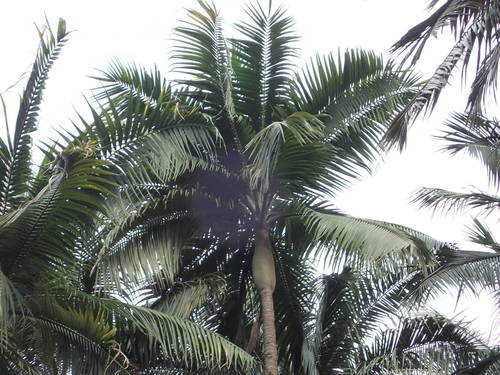
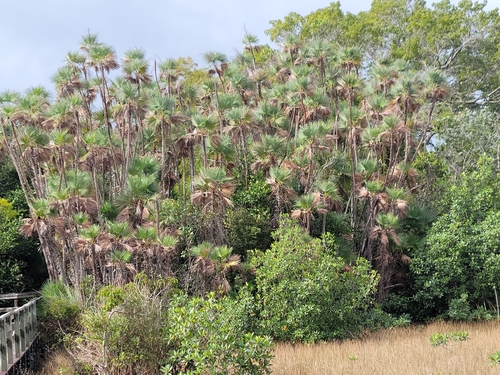
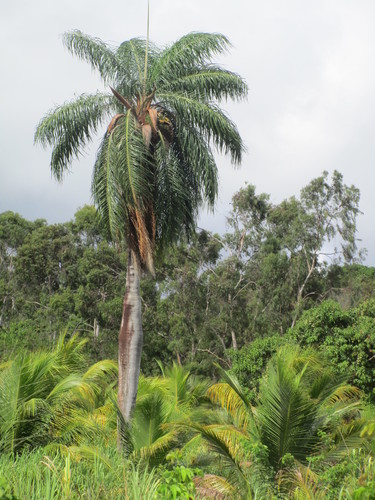
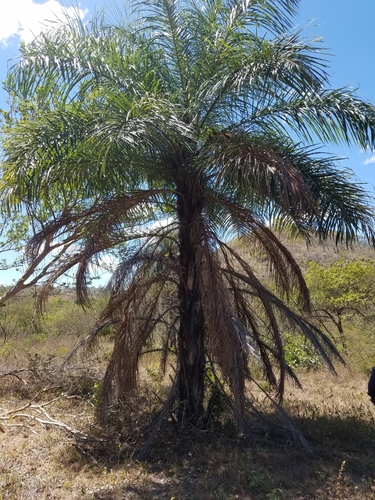
A palm with a creeping trunk. It extends for several metres before turning upright. The erect trunk is about 2-4 m high. The trunk is covered with the remains of the leaf bases and spiny leaf stalks. The leaves are about 4 m long. The leaflets are often about 1 m long. The fruit are dark orange. They are in congested heads. They are 2-3 cm long and 1.5-2 cm wide. The fruit have oily flesh.
How to Grow
A plant of the lowland, moist tropics, where it is found at elevations up to 510 metres. It grows best in areas where annual daytime temperatures are within the range 20 - 30°c, but can tolerate 14 - 34°c. It can be killed by temperatures of 8°c or lower. It prefers a mean annual rainfall in the range 1,400 - 2,500mm, but tolerates 700 - 3,500mm. Plants grow well in full sun, even when small. Requires a humus-rich, well-drained soil, but is not fussy as to soil type. Prefers a pH in the range 5.5 - 6.5, tolerating 5 - 7.3. A slow growing tree. Plants can commence bearing just 3 years after the seed has germinated. The plant produces both male and female flowers, but not usually at the same time. An individual inflorescence will be all male or all female flowers; after a series of inflorescences of one sex the plant will then produce a series of inflorescences of the opposite sex.
Propagation: Pre-soak seed for 24 hours in warm water and sow in containers. Germination takes 2–5 months.
Medicinal Uses
The oil extracted from the pulp is applied externally to treat rheumatism, stimulate hair growth, combat dandruff, and repel insects. Hairs from the leaf axils are said to be haemostatic.
Other Uses
The two oils — palm oil from the fruit and palm kernel oil from the seed — contain a high proportion of unsaturated fatty acids and are used in making soaps, detergents, shampoos, cosmetics, hair creams, lubricating oil additives, and fluxes. The oil can also be applied to the body as an insect repellent.
Wikipedia
Source ↗Elaeis oleifera is a species of palm commonly called the American oil palm. It is native to South and Central America from Honduras to northern Brazil. Unlike its relative Elaeis guineensis, the African oil palm, it is rarely planted commercially to produce palm oil, but hybrids between the two species are, mainly in efforts to provide disease resistance and to increase the proportion of unsaturated fatty acids in the oil.
Notes
There are 2 Elaeis species.
Names & Synonyms
Batana, Caiaue, Coquito, Corozo, Kelapa sawit amerika, Murisi, Noli, Palmiche, Sabana obe, Ujun
References (29)
- Balick, M.J. and Beck, H.T., (Ed.), 1990, Useful palms of the World. A Synoptic Bibliography. Colombia p 90,
- Chizmar Fernandez, C., et al, 2009, Plantas comestibles de Centroamerica. Instituto de Biodiversidad, Costa Rica. p 96
- Condit, R., et al, 2011, Trees of Panama and Costa Rica. PrincetonField Guides. p 82
- Coe, F. G., and Anderson, G. J., 1996, Ethnobotany of the Garifuna of Eastern Nicaragua. Economic Botany 50(1) pp 71-107
- Coe, F. G. and Anderson, G. J., 1999, Ethnobotany of the Sumu (Ulwa) of Southeastern Nicaragua and Comparisons with Miskitu Plant Lore. Economic Botany Vol. 53. No. 4. pp. 363-386
- Cundall, P., (ed.), 2004, Gardening Australia: flora: the gardener's bible. ABC Books. p 532
- Etherington, K., & Imwold, D., (Eds), 2001, Botanica's Trees & Shrubs. The illustrated A-Z of over 8500 trees and shrubs. Random House, Australia. p 276
- Fl. columb. 1:203. 1897
- Gibbons, M., 2003, A pocket guide to Palms. Chartwell Books. p 104
- Grandtner, M. M., 2008, World Dictionary of Trees. Wood and Forest Science Department. Laval University, Quebec, Qc Canada. (Internet database http://www.WDT.QC.ca)
- Grandtner, M. M. & Chevrette, J., 2013, Dictionary of Trees, Volume 2: South America: Nomenclature, Taxonomy and Ecology. Academic Press p 215
- Hardon, J.J., 1979, Oil palm, in Simmonds, N.W., (ed), Crop Plant Evolution. Longmans. London. p 225
- Henderson, A., Galeano, G and Bernal, R., 1995, Field Guide to the Palms of the Americas. Princeton. p 166
- Janick, J. & Paul, R. E. (Eds.), 2008, The Encyclopedia of Fruit & Nuts. CABI p 127
- Johnson, D.V., 1998, Tropical palms. Non-wood Forest products 10. FAO Rome. p 92
- Jones, D.L., 1994, Palms throughout the World. Smithtonian Institution, Washington. p 212
- Jones, D.L., 2000, Palms of Australia 3rd edition. Reed/New Holland. p 157
- Lopez-Diago, D. & Garcia, N., 2021, Wild edible fruits of Colombia. Biota ColomBiana 22 (2) p 31
- Marcia, M. J., et al, 2011, Palm Uses in Northwestern South America: A Quantitative Review. Bot. Rev. (2011) 77:462-570
- Paz, F. S., et al, 2021, Edible Fruit Plant Species in the Amazon Forest Rely Mostly on Bees and Beetles as Pollinators. Journal of Economic Entomology, XX(XX), 2021, 1–13
- Roa, J. A. G. & Boada, D. S. G., 2018, Fundación para el Fortalecimiento de la Fruticultura y Plantas Alimenticias no Convencionales en Colombia.
- Sukarya, D. G., (Ed.) 2013, 3,500 Plant Species of the Botanic Gardens of Indonesia. LIPI p 777
- Sukenti, K., et al, 2016, Ethnobotanical study on local cuisine of the Sasak tribe in Lombok Island, Indonesia. Journal of Ethnic Foods. 3( 2016) 189-200 p 194
- van Roosmalen, M.G.M., 1985, Fruits of the Guianan Flora. Utrecht Univ. & Wageningen Univ. p 348
- van Wyk, B., 2005, Food Plants of the World. An illustrated guide. Timber press. p 184
- Vasquez, R. and Gentry, A. H., 1989, Use and Misuse of Forest-harvested Fruits in the Iquitos Area. Conservation Biology 3(4): 350f
- Wickens, G.E., 1995, Edible Nuts. FAO Non-wood forest products. FAO, Rome. p165
- Wiersema, J. H. & Leon, B., 2013, World Economic Plants. A Standard Reference CRC Press. 2nd Ed. p 267
- World Checklist of Useful Plant Species 2020. Royal Botanic Gardens, Kew