Eleiodoxa conferta
(Griffith) Burret
Kelubi palm

(c) loupok, some rights reserved (CC BY-NC-ND)

(c) Yopika Anardo, some rights reserved (CC BY-NC)
What to Eat
Edible parts: Fruit, Palm heart, Cabbage
The sour fruit flesh is widely used in cooking as a vegetable for pickles and relishes, and serves as a substitute for tamarind. The sour fruit are pickled and sold commercially in Malaysia. The palm heart is also edible.
Where to Find It
A tropical plant. They form thickets in swampy, lowland areas. It likes a hot tropical climate. It needs plenty of water and rich acidic soil. It cannot tolerate cold or frost.
Asia, Brunei, Indochina, Indonesia, Malaysia, SE Asia, Thailand,
How to Identify
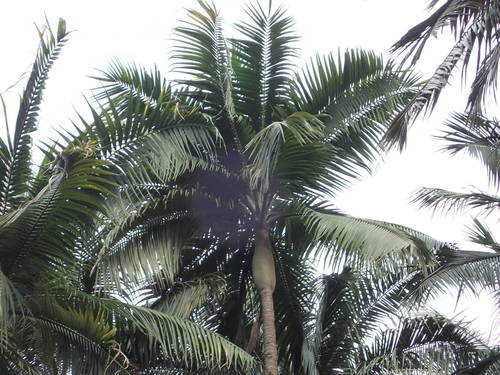
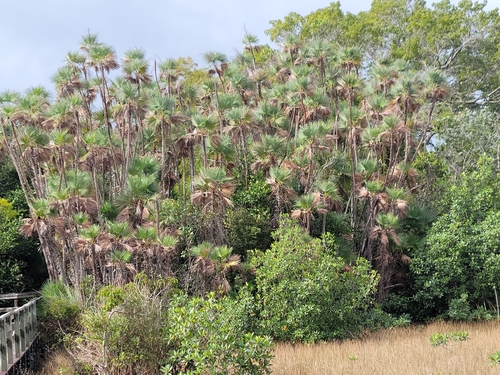
A spiny palm without a trunk. The trunk is under the ground and branches freely forming a spreading clump. It forms clumps and has feather-like leaves. The leaves are 4 m long. They are held stiffly erect and only arch over slightly. The leaf stalks are 3 m long and green. The leaf stalks and midrib are covered with long sharp, black spines. The leaflets are regularly spaced and 1.6 m long. They are narrowly sword shaped and end with a tip cut off at an angle. There are short spines along the edge. The plants are of one sex only. The flowering stalk grows from the underground stem. This stem then dies off. The fruit are about 3 cm long. They are pear shaped and when ripe are dull yellow. The fruit are covered with scales. The sour flesh of the fruit is widely used in cooking.
How to Grow
Plants are grown from seed. Seed are slow and erratic to germinate. Clumps of palms can be divided.
Medicinal Uses
A decoction of the fruit wall is used as a treatment against coughs.
Other Uses
The leaves are used for thatching and are woven into mats.
Other Information
The fruit are pickled and sold in Malaysia. It is cultivated.
Notes
There is only one Eleiodoxa species.
Names & Synonyms
Asam paya, Kra-lu-bi, Kuwai-kuwai, Salak hutan, Som lumphi
References (19)
- Chai, P. P. K. (Ed), et al, 2000, A checklist of Flora, Fauna, Food and Medicinal Plants. Lanjak Entimau Wildlife Sanctuary, Sarawak. Forestry Malaysia & ITTO. p 169
- Davis, S.D., Heywood, V.H., & Hamilton, A.C. (eds), 1994, Centres of plant Diversity. WWF. Vol 2. p 320
- Dransfield, J., et al, 2004, A preliminary checklist to Thai Palms. Thai For. Bull. (Bot.) 32:32-72
- Giesen, W., 2013, Paludiculture: sustainable alternatives on degraded peat land in Indonesia (revised draft)
- Haynes, J., & McLaughlin, J., 2000, Edible palms and Their Uses. University of Florida Fact sheet MCDE-00-50-1 p 6
- Hoe, V. B. & Siong, K. H., 1999, The nutritional value of indigenous fruit and vegetables in Sarawak. Asia Pacific J. Clin. Nutr. 8(1):24-31
- Johnson, D.V., 1998, Tropical palms. Non-wood Forest products 10. FAO Rome. p 46
- Jones, D.L., 1994, Palms throughout the World. Smithtonian Institution, Washington. p 54, 212
- Jones, D.L., 2000, Palms of Australia 3rd edition. Reed/New Holland. p 157
- Macmillan, H.F. (Revised Barlow, H.S., et al) 1991, Tropical Planting and Gardening. Sixth edition. Malayan Nature Society. Kuala Lumpur. p 307
- Milow, P., et al, 2013, Malaysian species of plants with edible fruits or seeds and their evaluation. International Journal of Fruit Science. 14:1, 1-27
- Murakami, A. et al, 2014, Screening for the In Vitro Anti-tumor-promoting Activities of Edible Plants from Malaysia. Bioscience, Biotechnology, and Biochemistry, 64:1, 9-16.
- Norfaizal, , M., et al, 2014, Flora Diversity of Sungai Teris, Karu Wildlife reserve, Pahang, Malaysia. Journal of Wildlife and Parks (2014) 28 : 81-91
- PROSEA (Plant Resources of South East Asia) handbook, Volume 2, 1991, Edible fruits and nuts.
- Riffle, R.L. & Craft, P., 2003, An Encyclopedia of Cultivated Palms. Timber Press. p 335
- Siong, K. H., 2003, Indigenous Fruits of Sarawak. Forest Department Sarawak. p 130
- Soepadmo, E., 1998, Plants. The Encyclopedia of Malaysia. Archipelago press. p 54
- Suwardi, A. B., et al, 2020, Wild edible fruits generate substantial income for local people of the Gunung Leuser National Park, Aceh Tamiang Region. Ethnobotany Research & Applications 20:11
- Zawiah, N. & Othaman, H., 2012, 99 Spesies Buah di FRIM. Institut Penyelidikan Perhutanan Malaysia. p 116