Empetrum rubrum
Vahl. ex Willd.
Eames' Purple Crowberry, South American crowberry

(c) Andrea Schieber, some rights reserved (CC BY-NC-SA)

(c) Sebastián Lescano, some rights reserved (CC BY-NC)
What to Eat
Edible parts: Fruit
The fruit is edible raw or cooked and is thought to have tonic properties.
Where to Find It
It is a temperate plant. In Chile it grows from sea level to 2,600 m altitude. It grows in drier areas with a winter rainfall of 400-800 mm. It is also in humid, constantly wet areas. It grows in full sun. It suits hardiness zone 7. It can tolerate frost and snow. It is best in acid soil with high levels of organic matter.
Antarctic, Argentina, Chile*, Falkland Islands, South America,
How to Identify
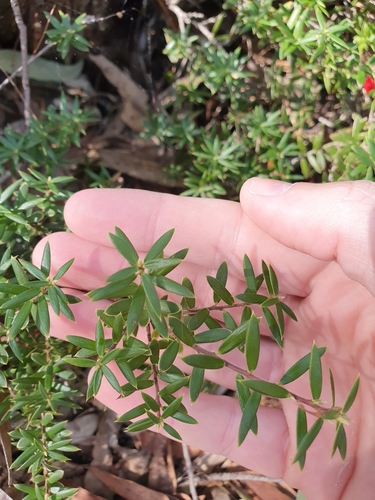
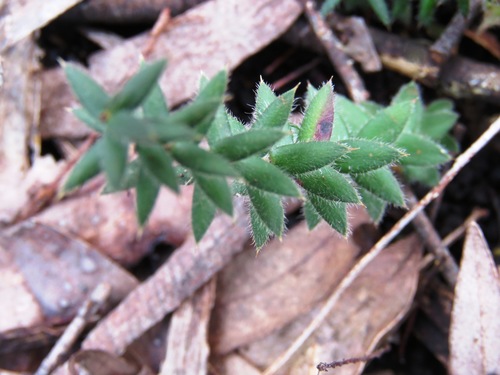
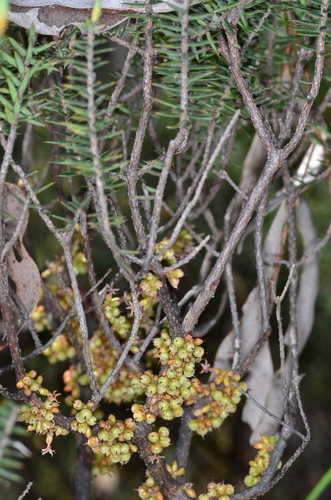
A small shrub. It grows 80 cm high. The leaves are 2-6 cm long by 1-2 cm wide. The flowers are red. They have 6 petals. The fruit are red. They are 4-7 mm across.
How to Grow
A calcifuge plant, it is easily grown in a moist lime-free peaty soil. Tolerates exposed positions, including maritime exposure in Cornwall. This species is closely related to E. nigrum. Dioecious. Male and female plants must be grown if seed is required.
Propagation: Seed is best sown as soon as ripe in a cold frame. Germination can be very slow; stored seed requires 5 months of warm stratification followed by 3 months cold stratification at 5°C. Prick seedlings into individual pots once large enough and grow on under glass for at least their first winter, planting out in late spring or early summer after the last expected frosts. Cuttings of half-ripe wood, 3cm with a heel, taken July/August in a frame take about 3 weeks and give a good percentage. Cuttings of mature wood from the current year's growth, 3cm with a heel, taken in October in a shaded frame also give a good percentage.
Medicinal Uses
Tonic.
Other Uses
Plants can be used as ground cover in exposed locations.
Wikipedia
Source ↗Empetrum rubrum, known as red crowberry or diddle-dee (Chilean Spanish: Murtilla de Magallanes), is a species of plant in the heath family, Ericaceae.
Notes
Also put in the family Empetraceae. It has antioxidant properties.
Names & Synonyms
Brecillo, Diddle-dee, Murtilla de Magallanes, Mutilla, Uvilla, Uvilla de perdicita
References (12)
- Chamorro, M. F., & Ladio, A., 2020, Native and exotic plants with edible fleshy fruits utilized in Patagonia and their role as sources of local functional foods. BMC Complementary Medicine and Therapies. 20:155
- Cordero, S. E., Abello, L. A., & Galvez, F. L., 2017, Plantas silvestres comestibles y medicinales de Chile y otras partes del mundo. CORMA p 57
- Facciola, S., 1998, Cornucopia 2: a Source Book of Edible Plants. Kampong Publications, p 94
- Heywood, V.H., Brummitt, R.K., Culham, A., and Seberg, O. 2007, Flowering Plant Families of the World. Royal Botanical Gardens, Kew. p 141
- Ladio, A., Lozada, M. & M. Weigandt, 2007, Comparison of traditional wild plant knowledge between aboriginal communities inhabiting arid and forest environments in Patagonia, Argentina. Journal of Arid Environments 69 (2007) 695–715
- Leon-Lobos, P., et al, 2022, Patterns of Traditional and Modern Uses of Wild Edible Native Plants of Chile: Challenges and Future Perspectives. Plants (Basel) v 11 (6) Table S1
- Plants for a Future database, The Field, Penpol, Lostwithiel, Cornwall, PL22 0NG, UK. http://www.scs.leeds.ac.uk/pfaf/
- Rapoport, E. H. & Ladio, A. H., 1999, Plantas comestibles. Bosque Volume 20 No. 2. ISSN 0314-8799
- Reis, S. V. and Lipp, F. L., 1982, New Plant Sources for Drugs and Foods from the New York Botanical Garden herbarium. Harvard. p 163
- Upson, R., & Lewis R., 2014, Updated Vascular Plant Checklist and Atlas for the Falkland Islands. Falklands Conservation and Kew.
- Velasquez, P. & Montenegro, G., 2017, Chilean Endemic/Native Plant Resources as Functional and Superfoods. Chp. 6 in Superfood and Functional Food - An Overview of Their Processing and Utilization
- www.chileflora.com