Abelmoschus moschatus subsp. tuberosus
Medik, (Span.) Borss. Waalk.
Climbing hibiscus, Musk mallow

Royal Botanic Garden Edinburgh

GBIF

Florida Museum of Natural History Herbarium - University of Florida
What to Eat
Edible parts: Leaves, Root, Fruit, Vegetable
It has many culinary uses. The seeds are added to coffee; unripe pods ("musk okra"), leaves and new shoots are eaten as vegetables.
Where to Find It
It is a tropical plant. It grows in light well drained soils. It suits a protected lightly shaded position. It is damaged by drought and frost. It must grow where temperatures are above 5°C. It often grows in open forest and amongst annual grasses. It is often near creeks and in depressions on river flats. Because of the thickened root it is able to survive fires and dry periods.
Africa, Asia, Australia*, Central Africa, Central African Republic, CAR, China, Congo DR, East Africa, Indochina, Laos, Madagascar, Pacific, Papua New Guinea, PNG, SE Asia, Taiwan, Vietnam,
How to Identify
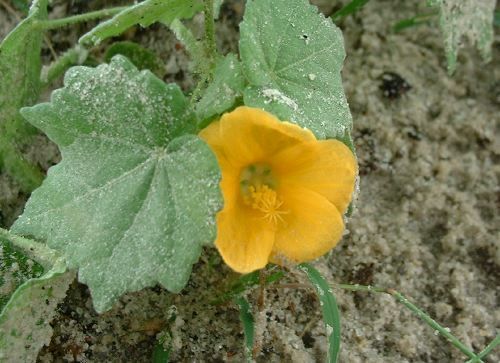
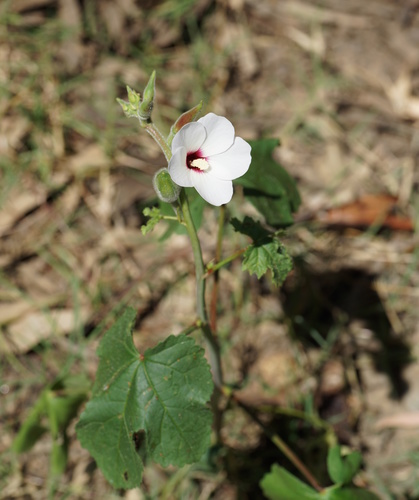
A shrub or small tree. It grows 5 m tall. There are prickles along the stem. The leaves are twice divided and there are 8-18 pairs of pinnae. There are up to 50 pairs of pinnules on each pinnae. The flowers are yellow. They are in large clusters at the ends of branches. The pods are flattened.
How to Grow
It can be grown by seed or cuttings. The underground tubers die off but re-grow. Plants can be transplanted easily during the time when the tops have died back.
Medicinal Uses
Different parts of the plant (latākastūrikā, लताकस्तूरिका, in Sanskrit) have uses in Ayurveda herbal medicine, including as an antispasmodic and to treat gonorrhea. However, use may result in phytophotodermatitis and it has not been proven safe for use during pregnancy and lactation.
Wikipedia
Source ↗Abelmoschus moschatus is an aromatic and species of medicinal plant in the family Malvaceae native to Asia and Australia. It has many common names, including Abelmosk, ambrette, annual hibiscus, Bamia Moschata, Galu Gasturi, muskdana, musk mallow, musk okra, ornamental okra, rose mallow, tropical jewel hibiscus, and Yorka okra.
Production
The plant flowers from December to March in the Southern hemisphere. Fruit occur from January to April. The stem die back each year to a tuberous root. This root tastes like a carrot.
Other Information
The plant is eaten in Australia but it is not known if it is used for food in PNG.
Notes
There are about 15 Abelmoschus species. They are tropical and subtropical.
Names & Synonyms
Jian ye qiu kui, Musk seed, Yabu
References (25)
- Blumea 14(1):93. 1966
- Bodkin, F., 1991, Encyclopedia Botanica. Cornstalk publishing, p 2
- Borrell, O.W., 1989, An Annotated Checklist of the Flora of Kairiru Island, New Guinea. Marcellin College, Victoria Australia. p 96
- Brickell, C. (Ed.), 1999, The Royal Horticultural Society A-Z Encyclopedia of Garden Plants. Convent Garden Books. p 56
- Brock, J., 1993, Native Plants of Northern Australia, Reed. p 54
- Cherikoff V. & Isaacs, J., The Bush Food Handbook. How to gather, grow, process and cook Australian Wild Foods. Ti Tree Press, Australia p 198
- Cribb, A.B. & J.W., 1976, Wild Food in Australia, Fontana. p 135, 159
- Elliot, W.R., & Jones, D.L., 1982, Encyclopedia of Australian Plants suitable for cultivation. Vol 2. Lothian. p 4
- Hiddins, L., 1999, Explore Wild Australia with the Bush Tucker Man. Penguin Books/ABC Books. p 137
- Hinton, B & B., 1982, A Wilderness in Bloom. Wildflowers of tropical Australia. p 35
- Isaacs, J., 1987, Bush Food, Aboriginal Food and Herbal Medicine. Weldons. p 98
- Jardin, C., 1970, List of Foods Used In Africa, FAO Nutrition Information Document Series No 2.p 50
- Jones, D.L. & Gray, B., 1977, Australian Climbing Plants. Reed. p 73
- Lavelle, M., 2008, Wild Flowers of Australia and Oceania. Southwater. p 95
- Lazarides, M. & Hince, B., 1993, Handbook of Economic Plants of Australia, CSIRO. p 1
- Low, T., 1991, Wild Food Plants of Australia. Australian Nature FieldGuide, Angus & Robertson. p 144
- Peekel, P.G., 1984, (Translation E.E.Henty), Flora of the Bismarck Archipelago for Naturalists, Division of Botany, Lae, PNG. p 365, 366
- Paczkowska, G. & Chapman, A.R., 2000, The Western Australian Flora. A Descriptive Catalogue. Western Australian Herbarium. p 285
- Pham-Hoang Ho, 1999, An Illustrated Flora of Vietnam. Nha Xuat Ban Tre. p 529
- Scarth-Johnson, V., 2000, National Treasures. Flowering Plants of Cooktown and Northern Australia. Vera Scarth-Johnson Gallery Association. Cooktown, Australia. p 65
- Townsend, K., 1994, Across the Top. Gardening with Australian Plants in the tropics. Society for Growing Australian Plants, Townsville Branch Inc. p 46
- Townsend, K., 1999, Field Guide to Plants of the Dry Tropics. Society for Growing Australian Plants, Townsville Branch Inc. p 146
- Wheeler, J.R.(ed.), 1992, Flora of the Kimberley Region. CALM, Western Australian Herbarium, p 202
- Wiersema, J. H. & Leon, B., 2013, World Economic Plants. A Standard Reference CFC Press. 2nd Ed. p 1
- Wijayakusuma, H.M.H., et al, 1996, Tanaman Berkhasiat Obat Di Indonesia. Pustaka Kartini. p 79