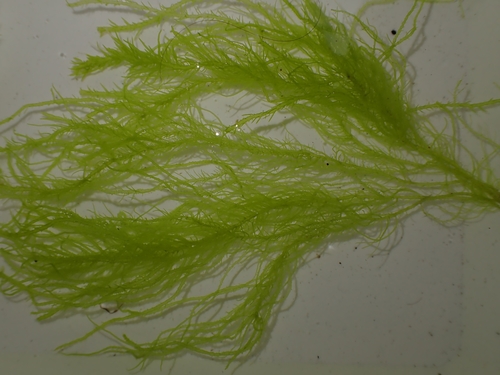
Ulva intestinalis
(L.) Link
Green algae, Green nori, Green guts, Gutweed
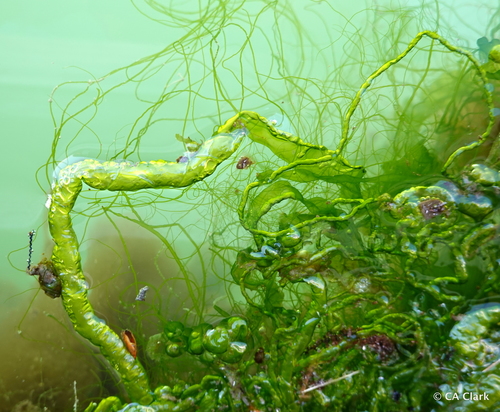
(c) sea-kangaroo, some rights reserved (CC BY-NC-ND), uploaded by sea-kangaroo

(c) Emily Scherer, some rights reserved (CC BY-NC)

(c) Emily Scherer, some rights reserved (CC BY-NC)
What to Eat
Edible parts: Seaweed, Frond, Algae
Eaten raw, cooked, or dried. Commonly steamed with meat, stir-fried, mixed with sesame oil, or used as filling for spring rolls. The dried, toasted, and powdered seaweed serves as a condiment on rice, meat, fish, soups, and vegetables, and can be mixed with cornmeal to make bread. Sold fresh and dry in markets.
Where to Find It
It is distributed almost worldwide. It grows in temperate waters. It can grow in sea water, brackish water and even fresh water. It attaches to rocks and shells and can be floating.
Africa, Antarctica, Asia, Australia, Britain, Canada, China, Egypt, Europe, Ghana, India, Indonesia, Iran, Japan, Korea, Malaysia, Mediterranean, Mexico, Middle East, New Zealand, North America, Norway, Pacific, Papua New Guinea, PNG, Philippines, Scandinavia, SE Asia, Taiwan, Tasmania, West Africa,
How to Identify
It is a green seaweed. It has long filaments. It has fronds that are unbranched tubes. These are irregularly constricted. They can be 25 cm long and 2 cm wide. They can be much smaller.
Nutrition Score: 3/100
| Part | Moisture | kJ | kcal | Protein | Vit A | Vit C | Iron | Zinc |
|---|---|---|---|---|---|---|---|---|
| Seaweed | — | — | 11.3 | — | — | — | — | — |
Wikipedia
Source ↗Ulva intestinalis is a green alga in the family Ulvaceae, known by the common names sea lettuce, green bait weed, gutweed, and grass kelp. Until they were reclassified by genetic work completed in the early 2000s, the tubular members of the sea lettuce genus Ulva were placed in the genus Enteromorpha.
Other Information
It is eaten in many countries. It is sold dry and fresh in markets.
Notes
This seaweed is used as bait for certain fish.
Names & Synonyms
Baitweed, Lumot, Tarmgronske
References (21)
- Breidahl H., 1997, Australian Southern Shores. Lothian. p 56 (As Enteromorpha intestinalis)
- Burkill, H. M., 1985, The useful plants of west tropical Africa, Vol. 5. Kew. (As Enteromorpha intestinalis)
- Burkill, I.H., 1966, A Dictionary of the Economic Products of the Malay Peninsula. Ministry of Agriculture and Cooperatives, Kuala Lumpur, Malaysia. Vol 1 (A-H) p 943 (As Enteromorpha intestinalis)
- Cherry, P., et al, 2019, Risks and benefits of consuming edible seaweeds. Nutrition ReviewsVR Vol. 77(5):307–329
- Crowe, A., 1997, A Field Guide to the Native Edible Plants of New Zealand. Penguin. p 146 (As Enteromorpha intestinalis)
- Facciola, S., 1998, Cornucopia 2: a Source Book of Edible Plants. Kampong Publications, p 261 (As Enteromorpha intestinalis)
- Fuhrer, B.A. et al, 1981, Seaweeds of Australia. Reed. p 89 (As Enteromorpha intestinalis)
- Girard, N. J., 2020, Sustainable Foraging of Wild Edible Plants in Norway. A Biocultural Approach. M. Sc. thesis Norwegian University. p 135
- http://www.seavegetables.com (As Enteromorpha intestinalis)
- Irving, M., 2009, The Forager Handbook, A Guide to the Edible Plants of Britain. Ebury Press p 368 (As Enteromorpha intestinalis)
- Kiple, K.F. & Ornelas, K.C., (eds), 2000, The Cambridge World History of Food. CUP p 234
- Lee, B., 2008, Seaweed Potential as a marine vegetable. RIRDC Publication No. 08/009
- Mabey, R., 1973, Food for Free. A Guide to the edible wild plants of Britain, Collins. p 119 (As Enteromorpha intestinalis)
- Poster ISHS Madurai (As Enteromorpha intestinalis)
- Surey-Gent, S. & Morris G., 1987, Seaweed. A User's Guide. Whirret Books. London. p 24 (As Enteromorpha intestinalis)
- Wang, Wei-Lung and Chiang, Young-Meng, 1994, Potential Economic Seaweeds of Hengchun Peninsula, Taiwan, Economic Botany, Vol. 48, No. 2, pp. 182-189 (As Enteromorpha intestinalis)
- World Checklist of Useful Plant Species 2020. Royal Botanic Gardens, Kew
- Zemke-White, W. L. & Ohno, M., 1999, World seaweed utilisation: An end-of-century summary. Journal of Applied Phycology 11: 369-376 (As Enteromorpha intestinalis)
- Xia, B., and Abbott, I.A., 1987, Edible seaweeds of China and their place in the Chinese diet. Economic Botany 41:341-53(As Enteromorpha intestinalis)
- Zaneveld, J.S., 1950, The economic marine algae of Malaysia and their applications. Proceedings of the Indo-Pacific Fisheries Council, 107-14 (As Enteromorpha intestinalis)
- Zaneveld, J.S., 1955, Economic marine algae of tropical South and East Asia and their utilization. Indo-Pacific Special Publications, No 3 Bangkok.