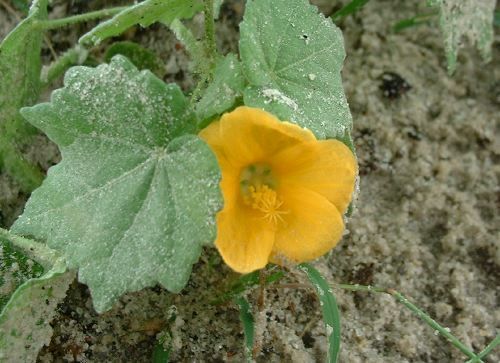
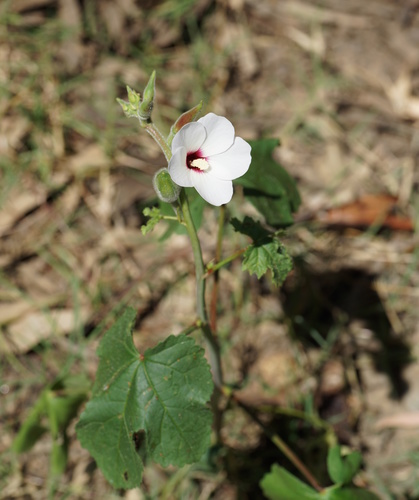
Abutilon x suntense
C.Brickell.

The Trustees of the Natural History Museum, London

Meise Botanic Garden

Royal Botanic Gardens, Kew
What to Eat
Edible parts: Flowers
Flowers - raw. The flowers are up to 6cm in diameter. A mild flavour with a slight sweetness and pleasant mucilaginous texture.
Where to Find It
A hybrid of garden origin, A. ochsenii x A. vitifolium.
A modern hybrid with no known native range. The hybrid formula of this artificial cross is C. ochsenii × C. vitifolium.
How to Identify
Abutilon x suntense is an evergreen Shrub growing to 8 m (26ft) by 5 m (16ft) at a fast rate. See above for USDA hardiness. It is hardy to UK zone 8. It is in leaf all year, in flower from May to June. The species is hermaphrodite (has both male and female organs). Suitable for: light (sandy), medium (loamy) and heavy (clay) soils. Suitable pH: mildly acid, neutral and basic (mildly alkaline) soils. It can grow in semi-shade (light woodland) or no shade. It prefers moist soil.
How to Grow
Requires a sunny position or part day shade in a fertile well-drained soil. Dislikes drought. This species is only hardy in the mildest areas of Britain, tolerating temperatures down to between -5 to -10°c when given the protection of a south or south-west facing wall. It is probably hardier than either of its parents. Plants are often deciduous in cold winters. A deep mulch in winter and tying in growth to the wall will maximise protection in winter. If the plant is cut back by cold weather, it will normally resprout from the base in the spring and can flower on the current year's growth. Plants grow very rapidly for their first few years and need staking if they are not in a sheltered position. Plants tend to be short-lived in Britain, dying suddenly without any apparent cause. This is probably because they flower so profusely that they die of exhaustion. Dead-heading plants to prevent seeding can enhance longevity. Tip-prune young plants to promote a bushy habit, older plants can be cut back hard annually in spring if required. There are some named forms, selected for their ornamental value. Plants in this genus are notably resistant to honey fungus.
Propagation: Seed - sow spring in a greenhouse. Germination should take place within a few weeks. Once the seedlings are large enough to handle, prick them out into individual pots. Grow them on for at least the first winter in a greenhouse and plant out in late spring or early summer, after the last expected frosts. Although this species is a hybrid, seedlings are usually true to type. Cuttings of young shoots, June in a frame. Grow on in the greenhouse for their first winter and plant out in spring after the last expected frosts. Cuttings of half-ripe wood, July/August in a frame. Grow on in the greenhouse for their first winter and plant out in spring after the last expected frosts.
Names & Synonyms
Abutilon × suntense C.D.Brickell is a synonym of Corynabutilon × suntense. The hybrid formula of this artificial cross is C. ochsenii × C. vitifolium.