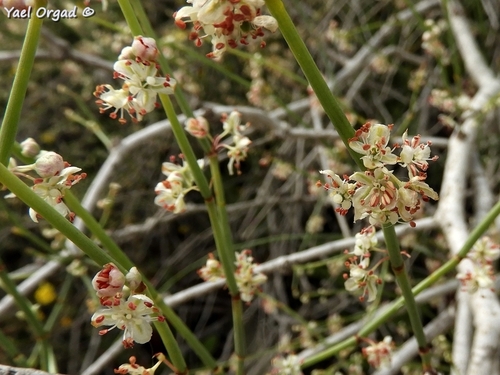
Eriogonum alatum
Torr.
Winged buckwheat

(c) Lena Zappia, some rights reserved (CC BY-NC), uploaded by Lena Zappia

(c) colemanhughes34, some rights reserved (CC BY-NC)

no rights reserved, uploaded by Robbie Hannawacker
What to Eat
Edible parts: Root, Seeds
The root can be eaten raw or dried for later use. Seeds are ground into a powder and made into a mush.
Where to Find It
It is a temperate plant.
North America, USA,
How to Identify
A herb. It often lasts for 2 years. It has a ring of leaves at the base. They are 5-10 cm long and red green. The flowers stems are 50-125 cm tall. The flowers are small and yellow. The seeds have wings.
How to Grow
We have very little information on this species and do not know if it will be hardy in Britain. There are two main forms of the plant, the type variety (Eriogonum alatum var. alatum) is rarely cultivated since an individual plant may go up to seven (or more) years before flowering, after which it dies. It is unclear whether the variety glabriusculum also does this. The notes below are based on the needs of other members of this genus. Requires a loose lean gritty well-drained soil in a very sunny position. Succeeds in dry soils. Tolerates exposed positions. Requires some protection from winter wet. Established plants resent root disturbance.
Propagation: Sow seed as soon as it is ripe in autumn in a sandy compost in a greenhouse. Stored seed can be sown in early spring in a warm greenhouse. Prick seedlings into individual pots once large enough to handle and grow on under glass for at least their first winter. Plant out in late spring or early summer after the last expected frosts. Division in early spring must be done carefully, as the plant resents root disturbance. Work around the edges of the clump without lifting the whole plant, teasing out divisions with as much root as possible, then pot them up and grow in light shade in the greenhouse until well rooted before planting out in summer. Cuttings of greenwood with a heel can also be taken in summer.
Medicinal Uses
The plant has been used to treat pain and to make a lotion for rashes. A cold infusion of the root treats diarrhoea and severe coughs, and has also been used as a mouthwash for sore gums. The powdered root mixed with oil serves as a dressing for a baby's sore navel. The Navajo (Diné) people regard this species as a 'life medicine,' using a mixture of shredded roots and water primarily to treat internal ailments, and also employing it as a ceremonial medicine. The Zuni use it as an emetic for stomachaches.
Other Uses
No other uses are known for this plant.
Wikipedia
Source ↗Eriogonum alatum, with the common names winged buckwheat and winged eriogonum, is a species of buckwheat. The plant is native to the western Great Plains, the Southwestern United States, and Chihuahua state in México.
Notes
There are 150 Eriogonum species.
References (2)
- Moerman, D. F., 2010, Native American Ethnobotany. Timber Press. p 221
- Plants for a Future database, The Field, Penpol, Lostwithiel, Cornwall, PL22 0NG, UK. http://www.scs.leeds.ac.uk/pfaf/