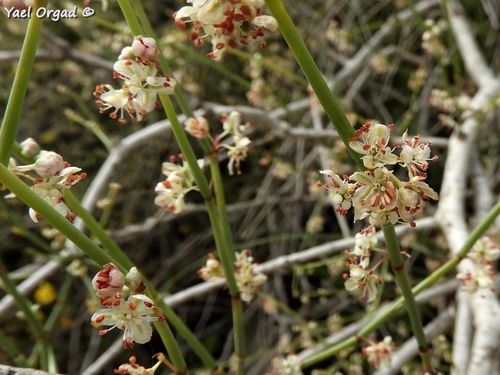
Eriogonum inflatum
Torr. & A. Gray.
American pipeweed, Desert trumpet

(c) lonnyholmes, some rights reserved (CC BY-NC), uploaded by lonnyholmes

(c) W. Terry Hunefeld, some rights reserved (CC BY), uploaded by W. Terry Hunefeld

(c) Liam O'Brien, some rights reserved (CC BY-NC), uploaded by Liam O'Brien
What to Eat
Edible parts: Leaves, Stem, Seeds
Young leaves and stems are tender and can be eaten raw or cooked before the plant flowers. They are most commonly harvested just after emerging from the ground in spring. Seeds are pounded into a powder and eaten dry or mixed with water.
Where to Find It
It is a temperate plant. It grows in arid places.
Central America, Mexico, North America, USA,
How to Identify
A herb. The stem is inflated. It grows 30-90 cm tall. There is a ring of round crinkled leaves at the base. The flowers are very small and yellow and pink.
How to Grow
We have very little information on this species and do not know if it will be hardy in Britain. The notes below are based on the needs of other members of this genus. Requires a loose lean gritty well-drained soil in a very sunny position. Succeeds in dry soils. Tolerates exposed positions. Requires some protection from winter wet. Established plants resent root disturbance.
Propagation: Sow seed as soon as it is ripe in autumn in a sandy compost in a greenhouse. Stored seed can be sown in early spring in a warm greenhouse. Prick seedlings into individual pots once large enough to handle and grow on under glass for at least their first winter. Plant out in late spring or early summer after the last expected frosts. Division in early spring must be done carefully, as the plant resents root disturbance. Work around the edges of the clump without lifting the whole plant, teasing out divisions with as much root as possible, then pot them up and grow in light shade in the greenhouse until well rooted before planting out in summer. Cuttings of greenwood with a heel can also be taken in summer.
Medicinal Uses
The plant is used as a lotion for bear and dog bites.
Other Uses
The hollow stems can be cut at each end and used as drinking tubes.
Wikipedia
Source ↗Eriogonum inflatum, the desert trumpet, is a perennial plant of the family Polygonaceae. The plant possesses very small yellow or pink flowers and an inflated stem just below branching segments. Eriogonum: from the Greek erion, "wool", and gonu, "joint or knee", in reference to the hairy or woolly joints of some of the species of the genus, but not particularly inflatum. It is found in the Mojave Desert and other deserts.
Notes
There are 150 Eriogonum species.
Names & Synonyms
Desert Trumpet, "Pickles"
References (6)
- Beckstrom-Sternberg, Stephen M., and James A. Duke. "The Foodplant Database." http://probe.nalusda.gov:8300/cgi-bin/browse/foodplantdb.(ACEDB version 4.0 - data version July 1994)
- Felger, R. S. 1980, Vegetation and Flora of the Gran Desierti, Sonora, Mexico. Desert Plants 2(2). Arizona-Sonora Desert Museum. p 9
- MacMahon, J.A., 1990, Deserts. Audubon Society Nature Guides. Knopf. p 389 Plate 108
- Moerman, D. F., 2010, Native American Ethnobotany. Timber Press. p 222
- Plants for a Future database, The Field, Penpol, Lostwithiel, Cornwall, PL22 0NG, UK. http://www.scs.leeds.ac.uk/pfaf/
- Saunders, C.F., 1948, Edible and Useful Wild Plants. Dover. New York. p 123