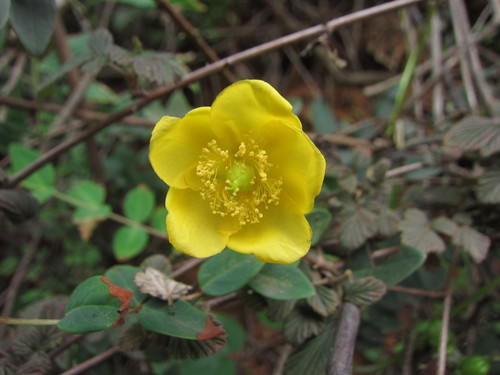
Hypericum perforatum
L.
St. John's Wort, Common St. Johnswort

(c) akolter, some rights reserved (CC BY-NC)

(c) Thomas Gyselinck, some rights reserved (CC BY), uploaded by Thomas Gyselinck

(c) Matt Lavin, some rights reserved (CC BY-SA)
What to Eat
Tea. The herb and the fruit are sometimes used as a tea substitute. The flowers can be used in making mead.
Known Hazards
Where to Find It
Europe, including Britain, south and east to N. Africa, the Azores, Madeira and W. Asia.
TEMPERATE ASIA: Afghanistan, Armenia, Azerbaijan, China, Cyprus, Dagestan, Gansu Sheng, Georgia, Guizhou Sheng, Hebei Sheng, Henan Sheng, Hubei Sheng, Hunan Sheng, Iran, Iraq, Israel, Jiangsu Sheng, Jiangxi Sheng, Karacaevo-Cerkesskaja Respublika, Kazakhstan, Kyrgyzstan, Lebanon, Mongolia, North Ossetia, Russian Federation, Russian Federation-Western Siberia, Shaanxi Sheng, Shandong Sheng, Shanxi Sheng, Sichuan Sheng, Stavropol, Syria, Tajikistan, Turkey, Turkmenistan, Uzbekistan, Western Siberia, Xinjiang Uygur Zizhiqu, Yunnan Sheng,Saudi Arabia (southwest). TROPICAL ASIA: India, Himachal Pradesh, Jammu and Kashmir, Uttar Pradesh, Pakistan (north), EUROPE: Denmark, Finland (south), United Kingdom (U.K.), England, Scotland, Wales, Ireland, Norway (south), Sweden (south), Austria, Belgium, Switzerland, Czech Republic, Germany, Hungary, Netherlands, Poland, Slovakia, Russian Federation-European part, European part, Belarus, Estonia, Russian Federation, Astrakhan, Ukraine (incl. Krym), Albania, Bulgaria, Bosnia and Herzegovina, Greece (incl. Crete), Croatia, Italy (incl. Sardinia, Sicily), North Macedonia, Malta, Montenegro, Romania, Serbia, Slovenia, Andorra, Spain (incl. Baleares), France (incl. Corsica), Gibraltar, Portugal, AFRICA: Spain, Canarias, Portugal, Madeira Islands, Algeria (north), Morocco, Tunisia.
How to Identify
Hypericum perforatum is a PERENNIAL growing to 0.9 m (3ft) by 0.6 m (2ft in) at a medium rate. See above for USDA hardiness. It is hardy to UK zone 3. It is in flower from May to August, and the seeds ripen from July to September. The species is hermaphrodite (has both male and female organs) and is pollinated by Bees, flies. The plant is self-fertile. It is noted for attracting wildlife. Suitable for: light (sandy), medium (loamy) and heavy (clay) soils and prefers well-drained soil. Suitable pH: mildly acid, neutral and basic (mildly alkaline) soils. It can grow in semi-shade (light woodland) or no shade. It prefers dry or moist soil.
How to Grow
Easily grown in any reasonably good well-drained but moisture retentive soil. Succeeds in dry soils. Plants grow well in sun or semi-shade but they flower better when in a sunny position. St. John's wort is often found as a weed in the garden. It grows well in the summer meadow and is a useful plant for attracting insects. The whole plant, especially when in bloom, gives off a most unpleasant smell when handled. Hypericum perforatum is apparently an allotetraploid that would appear to have arisen from a cross between two diploid taxa, viz. H. maculatum subsp. maculatum (Europe to western Siberia) and H. attenuatum (western Siberia to China). In garden design, as well as the above-ground architecture of a plant, root structure considerations help in choosing plants that work together for their optimal soil requirements including nutrients and water. Common St. John’s Wort is generally self-fertile. The flowering tops are typically harvested in mid-summer when the flowers are in full bloom. Common St. John’s Wort usually flowers from late spring to early summer. Common St. John’s Wort grows moderately quickly, reaching maturity within one growing season.
Propagation: Seed - sow in a greenhouse as soon as it is ripe in the autumn or in the spring. It normally germinates in 1 - 3 months at 10°c. Prick out the seedlings into individual pots when they are large enough to handle and plant them out into their permanent positions in the summer. Division in spring or autumn. Very easy, larger clumps can be replanted direct into their permanent positions, though it is best to pot up smaller clumps and grow them on in a cold frame until they are rooting well. Plant them out in the spring.
Medicinal Uses
Analgesic Antidepressant Antiseptic Antispasmodic Aromatic Astringent Cholagogue Digestive Diuretic Expectorant Homeopathy Nervine Resolvent Sedative Stimulant Vermifuge VulnerarySt. John's wort has a long history of herbal use. It fell out of favour in the nineteenth century but recent research has brought it back to prominence as an extremely valuable remedy for nervous problems. In clinical trials about 67% of patients with mild to moderate depression improved when taking this plant. The flowers and leaves are analgesic, antiseptic, antispasmodic, aromatic, astringent, cholagogue, digestive, diuretic, expectorant, nervine, resolvent, sedative, stimulant, vermifuge and vulnerary[4, 9, 13, 21, 165, 218, 222]. The herb is used in treating a wide range of disorders, including pulmonary complaints, bladder problems, diarrhoea and nervous depression. It is also very effectual in treating overnight incontinence of urine in children. Externally, it is used in poultices to dispel herd tumours, caked breasts, bruising etc. The flowering shoots are harvested in early summer and dried for later use. Use the plant with caution and do not prescribe it for patients with chronic depression. The plant was used to procure an abortion by some native North Americans, so it is best not used by pregnant women. See also the notes above on toxicity. A tea or tincture of the fresh flowers is a popular treatment for external ulcers, burns, wounds (especially those with severed nerve tissue), sores, bruises, cramps etc. An infusion of the flowers in olive oil is applied externally to wounds, sores, ulcers, swellings, rheumatism etc. It is also valued in the treatment of sunburn and as a cosmetic preparation to the skin. The plant contains many biologically active compounds including rutin, pectin, choline, sitosterol, hypericin and pseudohypericin. These last two compounds have been shown to have potent anti-retroviral activity without serious side effects and they are being researched in the treatment of AIDS. A homeopathic remedy is made from the fresh whole flowering plant. It is used in the treatment of injuries, bites, stings etc and is said to be the first remedy to consider when nerve-rich areas such as the spine, eyes, fingers etc are injured.
Other Uses
Dye Tannin Agroforestry uses: It can be used for soil improvement and as a companion plant due to its beneficial effects on other plants. It is also valued for its medicinal properties. Yellow, gold and brown dyes are obtained from the flowers and leaves. A red is obtained from the flowers after acidification. A red dye is obtained from the whole plant when infused in oil or alcohol. A yellow is obtained when it is infused in water. The plant is said to contain good quantities of tannin, though exact figures are not available.