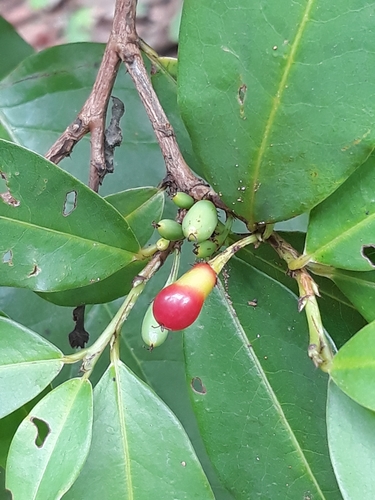
Erythroxylum ellipticum
R. Br. ex Benth.
Kerosene tree, Rosewood tree

(c) Russell Cumming, some rights reserved (CC BY-NC), uploaded by Russell Cumming

(c) Russell Cumming, some rights reserved (CC BY-NC)
What to Eat
Edible parts: Fruit, Gum
The ripe fruits are eaten raw, and the gum is eaten as a sweet.
Where to Find It
It is a tropical plant. It grows in dry scrub in tropical Australia. It is ofte on sandstone and rocky creek beds.
Australia*,
How to Identify
A tall shrub. It grows 6-12 m high and spreads 3-5 m wide. The small branches are flattened. The leaves are oval and thin in texture. The tip is blunt. Leaves are light green and 3-8 cm long by 1-4 cm wide. Flowers are white. They are 0.4 cm across. They occur in clusters of 3-6 in the axils of leaves. The fruit is oblong and red. It is 0.6-0.8 cm long.
How to Grow
Plants can be grown from fresh seed.
Wikipedia
Source ↗Erythroxylum ellipticum is a Northern Australian species of Erythroxylum. It grows as a shrub or tree. It is locally known as kerosene wood or turpentine tree - because its green branches and twigs burn readily. The shrub or tree typically grows to a height of 1 to 5 m (3 ft 3 in to 16 ft 5 in) and produces white-green flowers around November. It is found on rocky hillsides and in creek beds growing in sandstone based soils in the Kimberley region of Western Australia and extending across the top end of the Northern Territory and on parts of Cape York Peninsula in Queensland.
Notes
There are about 250 Erythroxylum species.
Names & Synonyms
Beleman, Burlburl, Marlaliny
References (9)
- Elliot, W.R., & Jones, D.L., 1984, Encyclopedia of Australian Plants suitable for cultivation. Vol 3. Lothian. p 490
- Lazarides, M. & Hince, B., 1993, Handbook of Economic Plants of Australia, CSIRO. p 96
- Levitt, D., 1981, Plants and people. Aboriginal uses of plants on Groote Eylandt. Australian Institute of Aboriginal Studies, Canberra. p 93
- Morley, B.D., & Toelken, H.R., (Eds), 1983, Flowering Plants in Australia. Rigby. p 205
- Paczkowska, G. & Chapman, A.R., 2000, The Western Australian Flora. A Descriptive Catalogue. Western Australian Herbarium. p 243
- Smith, N. M., 1991, Ethnobotanical Field Notes from the Northern Territory, Australia, J. Adelaide Bot. Gard. 14(1): 1-65
- Townsend, K., 1994, Across the Top. Gardening with Australian Plants in the tropics. Society for Growing Australian Plants, Townsville Branch Inc. p 184
- Wheeler, J.R.(ed.), 1992, Flora of the Kimberley Region. CALM, Western Australian Herbarium, p 637
- Wightman, G. & Brown, J., 1994, Jawoyn Plant Identikit, Common Useful Plants in the Katherine Area of Northern Australia. Concervation Commission Northern Territory. p 21