Ledum columbianum
Piper.
Labrador tea

Bailey Herbarium at College of Saint Benedict/Saint John’s University (CSBSJU)

Meise Botanic Garden

Towson University (BALT-)
What to Eat
A tea is made from the leaves. Some caution is advised, see the notes above on toxicity. It would be better to brew the tea in cold water by leaving it in a sunny place, or to make sure that it is brewed for a short time only in an open container. The leaves are used as a flavouring, they are a bayleaf substitute.
Known Hazards
Where to Find It
Western N. America - Washington to California.
NORTHERN AMERICA: Canada (Alberta (southwest), British Columbia (Vancouver Island)), United States (Idaho, Montana (w. & c.), Oregon, Washington, Wyoming, California, Nevada (n.e. & w.), Utah)
How to Identify
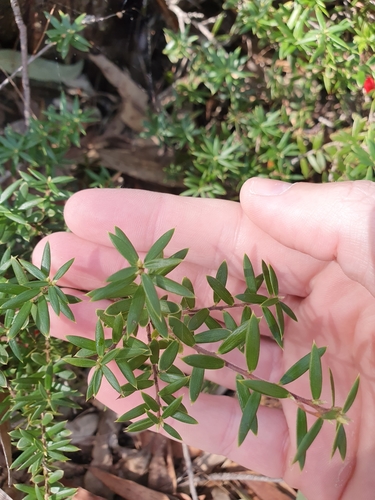
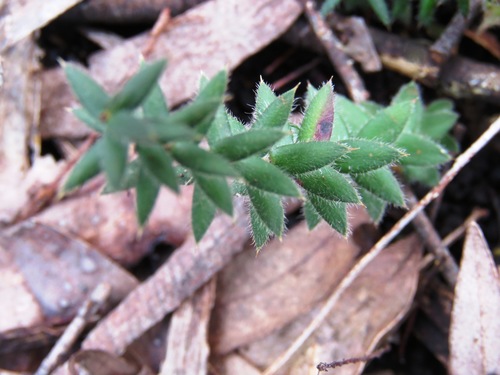
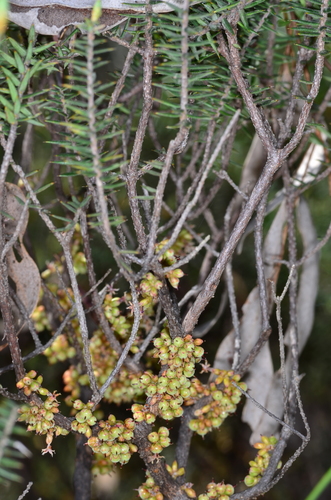
Ledum columbianum is an evergreen Shrub growing to 1 m (3ft 3in). It is in leaf all year, in flower in May. The species is hermaphrodite (has both male and female organs). Suitable for: light (sandy), medium (loamy) and heavy (clay) soils. Suitable pH: mildly acid soils and can grow in very acid soils. It can grow in full shade (deep woodland) or semi-shade (light woodland). It prefers moist soil.
How to Grow
Requires a lime-free loam or peaty soil. Prefers a moist humus-rich acid soil in shade or semi-shade. Plants grow better if they have certain fungal associations in the soil. The best way of providing this is to incorporate some soil from around well-growing established plants into the soil for the new plant. Plants are hardy to about -15°c. The leaves are covered in tiny spots or glands from which a strong, resinous scent is given off. The flowers also have an aromatic perfume. Very closely related to L. glandulosum, and considered to be no more than a sub-species of it by some botanists. Plants benefit from removing the dead flowers before they set seed. This prevents them putting too much energy into seed production at the expense of more flowers and leaves.
Propagation: Seed - surface sow in a shady part of the greenhouse in February or March. Another report says that the seed is best sown in the autumn as soon as it is ripe. Germination is variable and can be quite slow. Prick out the seedlings into individual pots as soon as they are large enough to handle and grow the pots on in a shady frame for 18 months before planting them out into their permanent positions. Cuttings of half-ripe wood, 5 - 8cm with a heel, July/August in a frame. Plant out in spring. Fair percentage. Cuttings of mature wood, November/December in a frame. Layering in the autumn. Takes 12 months. Division.
Medicinal Uses
Astringent Diaphoretic Diuretic Laxative Stomachic. The leaves and young flowering shoots re astringent, diaphoretic, diuretic, laxative and stomachic.
Other Uses
Repellent. The leaves are used to repel moths, mice, rats etc.