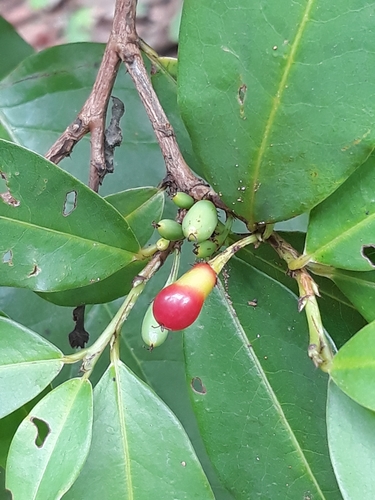
Erythroxylum monogynum
Roxb.
Red cedar
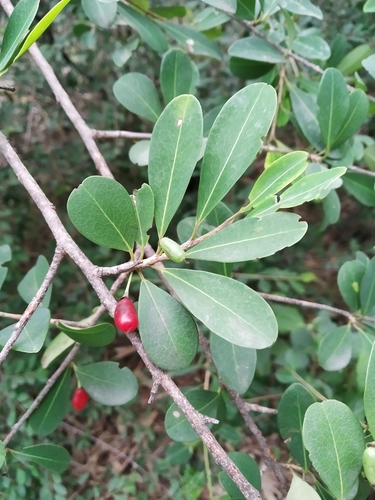
(c) Kulbhushansingh Suryawanshi, some rights reserved (CC BY-NC), uploaded by Kulbhushansingh Suryawanshi
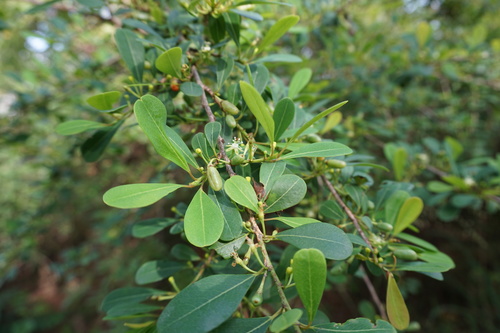
(c) Krishna Anujan, some rights reserved (CC BY-NC)

(c) Steven Severinghaus, some rights reserved (CC BY-NC-SA)
What to Eat
Edible parts: Leaves, Fruit
Leaves - raw or cooked. They are eaten to a considerable extent in times of famine. They contain a bitter tonic principle which might serve to relieve the pangs of hunger. Fruit - a pleasant flavour.
Where to Find It
A tropical plant. It grows in dry evergreen forests. It grows up to 1,000 m above sea level.
Asia, India, Myanmar, SE Asia, Sri Lanka,
How to Identify
A shrub or small tree. It grows 7 m tall. The bark is thick, rough and dark brown. The leaves are wedge shaped and 3-5 cm long. They are dull. The flowers are in the axils of the leaves. They are usually in groups of 1-4. The flowers are small and white or pink. The fruit is bright red and has one seed.
Medicinal Uses
The leaves have been shown to protect the liver.
Other Uses
A tar obtained from the wood by distillation is used for preserving the wood of boats. It is an oil. An essential oil is obtained from the plant. It has been recommended for use in perfumery. It has a sandalwood aroma. The heart-wood is dark reddish brown, the sapwood white. The wood is very hard, heavy, smooth. It takes a beautiful polish. It has a pleasant, resinous scent. It is sometimes used as a substitute for sandal wood (Santalum spp.). The use of this wood as a substitute for sandalwood must be doubted since it is very unlike it either in colour, weight or scent.
Wikipedia
Source ↗Erythroxylum monogynum, the bastard sandal or red cedar, is a tropical tree in the family Erythroxylaceae. It is native to Peninsular India and Sri Lanka. It is a small, evergreen bushy tree reaching 7 m (23 ft) (but sometimes higher). The leaves are simple and alternate. Small white flowers are bisexual with 5–6 sepals, borne March through June; Fruit is a one-seeded drupe. Flowering and fruiting occur throughout the year. The plant is known to have high medicinal value. It is taken to cure many diseases such as stomachache, dyspepsia, fever, and dropsy in Ayurvedic medicine.
Production
In southern India is flowers and fruits throughout the year.
Notes
There are about 250 Erythroxylum species. The leaves have been shown to protect the liver.
Names & Synonyms
Adivi goranti, Bastard sandal, Bsandal, Chemanatti, Chembulinga, Chemmana, Chumbulse, Dasadaram, Dedadaaru, Devadara, Devadaram, Devadaru, Devataru, Gadara, Palayachandanam, Parighadrakamu, Sembulichan, Tevadaram, Vella-devadaram
References (10)
- Ambasta, S.P. (Ed.), 2000, The Useful Plants of India. CSIR India. p 205
- Arinathan, V., et al, 2007, Wild edibles used by Palliyars of the western Ghats, Tamil Nadu. Indian Journal of Traditional Knowledge. 6(1) pp 163-168
- Dobriyal, M. J. R. & Dobriyal, R., 2014, Non Wood Forest Produce an Option for Ethnic Food and Nutritional Security in India. Int. J. of Usuf. Mngt. 15(1):17-37
- Harisha, R. P. & Padmavathy, S., 2013, Knowledge and Use of Wild Edible Plants in Two Communities in Malai Madeshwara Hills, Southern India. International Journal of Botany 9(2): 64-72.
- Pl. Coromandel t. 88. 1798
- Pradhan, R., et al, 2020, Potential Wild Edible Plants and its Significance in Livelihood of Indigenous People of Male Mahadeshwara Hills, Karnataka. Economic Affairs Vol. 64, No. 4 pp. 01-14
- Rajkalkshmi, P. et al, 2001, Total carotenoid and beta-carotene contents of forest green leafy vegetables consumed by tribals of south India. Plant Foods for Human Nutrition 56:225-238
- Reddy, K. N. et al, 2007, Traditional knowledge on wild food plants in Andhra Pradesh. Indian Journal of Traditional Knowledge. Vol. 6(1): 223-229
- Singh, H.B., Arora R.K.,1978, Wild edible Plants of India. Indian Council of Agricultural Research, New Delhi. p 39, 59
- WATT,