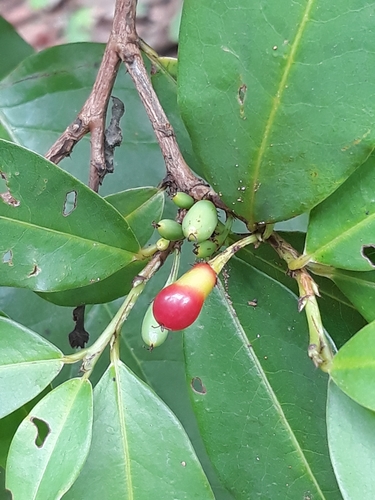
Erythroxylum pictum
E. Mey. ex Sond.
Forest coca tree
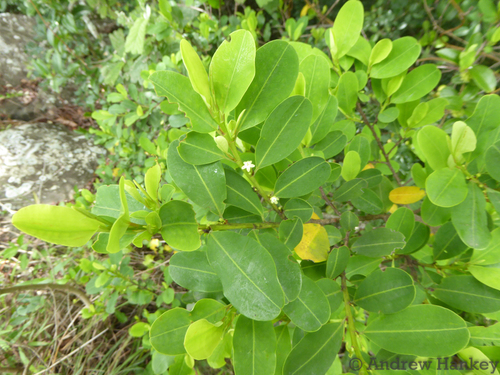
(c) Andrew Hankey, some rights reserved (CC BY-SA), uploaded by Andrew Hankey
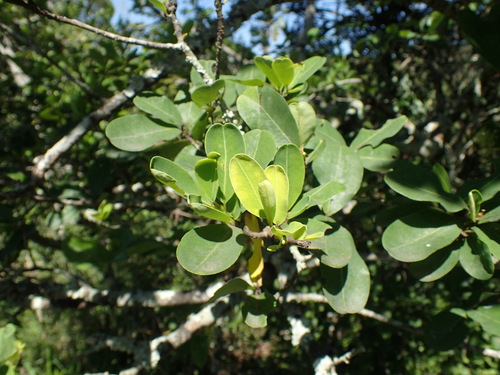
(c) Mahomed Desai, some rights reserved (CC BY)
What to Eat
Edible parts: Fruit, Leaves
The ripe fruit are eaten fresh and enjoyed. The leaves are cooked as a vegetable.
Where to Find It
A tropical plant. It grows in forests and on the edge of forests. In South Africa it grows from sea level up to 1700 m altitude.
Africa, Lesotho, South Africa, Southern Africa,
How to Identify
A shrub or medium sized tree. It can grow up to 13-18 m tall. It has many spreading branches. The bark is light grey and has cracks along it. The knobbly twigs are very flattened. The leaves are 4-7.5 cm long. They are oval with a rounded or notched tip. The upper surface is dark green and shiny and the lower surface light green. The midrib is raised under the leaf and about 10 pairs of hard to see veins loop around to the leaf edge. The leaves are on stalks 8 mm long. They have a pointed leafy structure (stipule) near the stalk which soon falls off. The flowers are cream and small. They are in the axils of leaves. The fruit is small and oval. It is about 1.3 cm long and bright red. The fruit are edible.
Medicinal Uses
The fruit and leaves have traditional uses in South African folk practice.
Other Information
The fruit are enjoyed.
Notes
There are about 250 Erythroxylum species.
References (6)
- Fox, F. W. & Young, M. E. N., 1982, Food from the Veld. Delta Books. p 188
- Palgrave, K.C., 1996, Trees of Southern Africa. Struik Publishers. p 336
- Palmer, E and Pitman, N., 1972, Trees of Southern Africa. Vol. 2. A.A. Balkema, Cape Town p 969
- Plowes, N. J. & Taylor, F. W., 1997, The Processing of Indigenous Fruits and other Wildfoods of Southern Africa. in Smartt, L. & Haq. (Eds) Domestication, Production and Utilization of New Crops. ICUC p 191
- Ruiters-Welcome, A. K., 2019, Food plants of southern Africa. Ph.D. thesis. Univ. of Johannesburg p 53
- Welcome, A. K. & Van Wyk, B.-E., 2019, An inventory and analysis of the food plants of southern Africa. South African Journal of Botany 122 (2019) 136–179