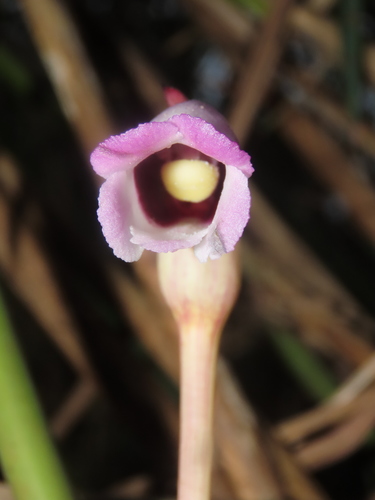
Escobedia grandiflora
(L.f.) Kuntze
Saffron of Andes

(c) Andrés Ramírez-Barrera, some rights reserved (CC BY), uploaded by Andrés Ramírez-Barrera

(c) Andrés Ramírez-Barrera, some rights reserved (CC BY), uploaded by Andrés Ramírez-Barrera

(c) Dick Culbert, some rights reserved (CC BY)
What to Eat
Edible parts: Roots - flavouring
American communities use the roots as a seasoning, to color food, and as medicine. This species is often confused with turmeric (Curcuma longa), which is an introduced species to the American continent to which it has adapted well. In the industry, it is used to color cheese, margarine, and butter. Popularly, it is used against jaundice, hepatitis, and liver diseases.
Where to Find It
A tropical plant. It grows in tropical places. It is recorded between 1,100-1,500 m above sea level in Costa Rica.
Andes, Bolivia, Brazil, Central America, Columbia, Costa Rica, Mexico, Panama, Peru, South America, Venezuela,
How to Identify
A herb. It grows erect and keeps growing from year to year. The stems are leafy and 60-150 cm long.
How to Grow
Plants can be grown from seed.
Other Uses
A yellow dye is obtained from the roots.
Wikipedia
Source ↗Escobedia grandiflora is a plant in the family Orobanchaceae.
Other Information
It is a cultivated plant. It is sold in local markets.
Notes
It is a cultivated food plant. Also put in the family Scrophulariaceae.
Names & Synonyms
Palillo, Raiz de color
References (6)
- Facciola, S., 1998, Cornucopia 2: a Source Book of Edible Plants. Kampong Publications, p 229 (As Escobedia scabrifolia)
- Hedrick, U.P., 1919, (Ed.), Sturtevant's edible plants of the world. p 294 (As Escobedia scabrifolia)
- Seidemann J., 2005, World Spice Plants. Economic Usage, Botany, Taxonomy. Springer. p 148 (As Escobedia scabrifolia)
- Syst. Veg. 159. 1798 (As Escobedia scabrifolia)
- Terra, G.J.A., 1973, Tropical Vegetables. Communication 54e Royal Tropical Institute, Amsterdam, p 46 (As Escobedia scabrifolia)
- World Checklist of Useful Plant Species 2020. Royal Botanic Gardens, Kew